
Barrio de las Letras self-guided walking tour · 1 hour · map
The Barrio de las Letras on foot: Cervantes, Lope de Vega and the first Don Quixote
The Barrio de las Letras, Madrid's literary quarter, is where Cervantes and Lope de Vega lived and died. This one-hour walk links what survives from their time and what remembers them: a church, a theatre, a club, a plaque, a house, a convent and a printing shop.
The quarter is named after the Golden Age writers who lived here in the 16th and 17th centuries, among them Cervantes, Lope de Vega, Quevedo and Góngora. Madrid's first playhouses opened here, and theatre companies were hired on today's Calle del León. Most buildings date from the late 19th and early 20th centuries. From the Golden Age, Lope's house, the Trinitarias convent and the church of San Sebastián remain, though the church was rebuilt after 1936. Since 2008 much of the quarter has been closed to through traffic.
A note on accuracy: some stops mark the site of what they remember, not the thing itself. Where a building is not the original, we say so, and every fact links to its source.
- Start
- Puerta del Sol, at Sol metro (L1, L2, L3) and Cercanías station
- Finish
- Calle de Atocha 87, 200 m from Antón Martín metro (L1)
- Distance
- 1.8 km, one way
- Time
- About an hour: 22 min walking and 7 stops, plus any visit to Lope de Vega's house
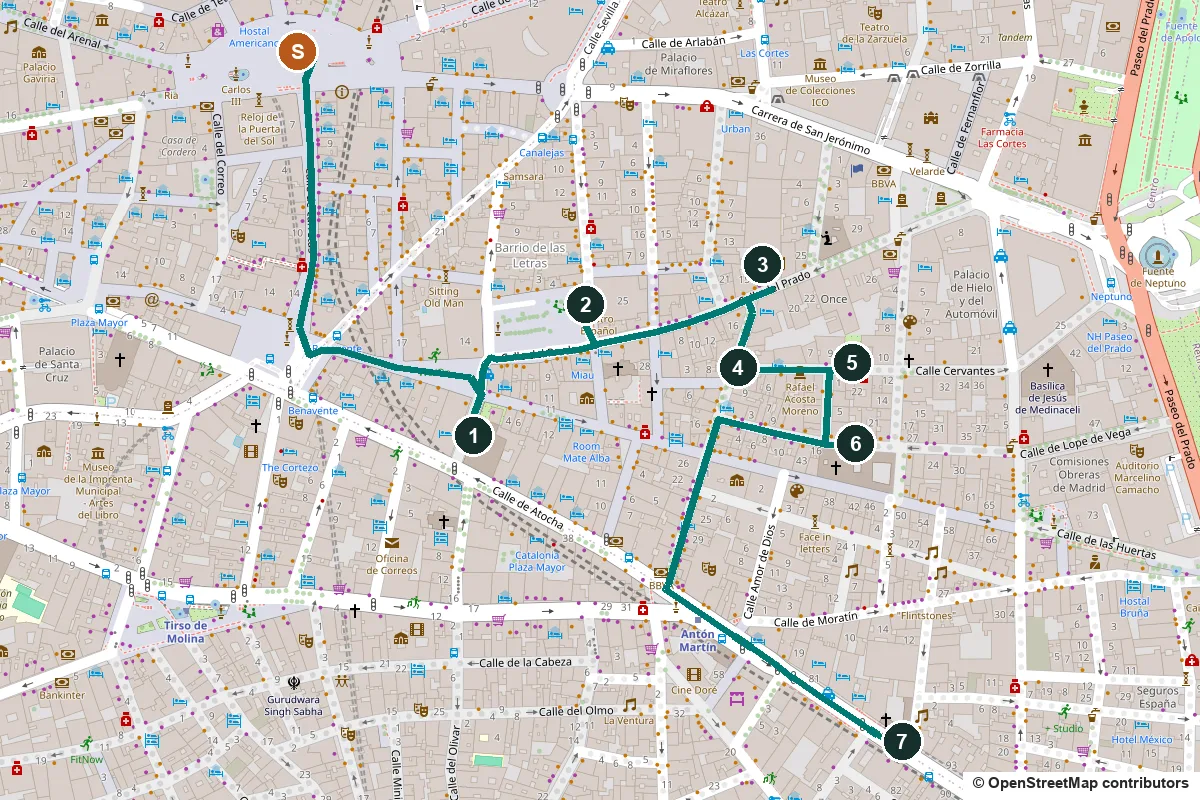
Terrain, water, opening days and a shorter version ↓
What to see: the stops
-
San Sebastián, the church where Lope de Vega was buried
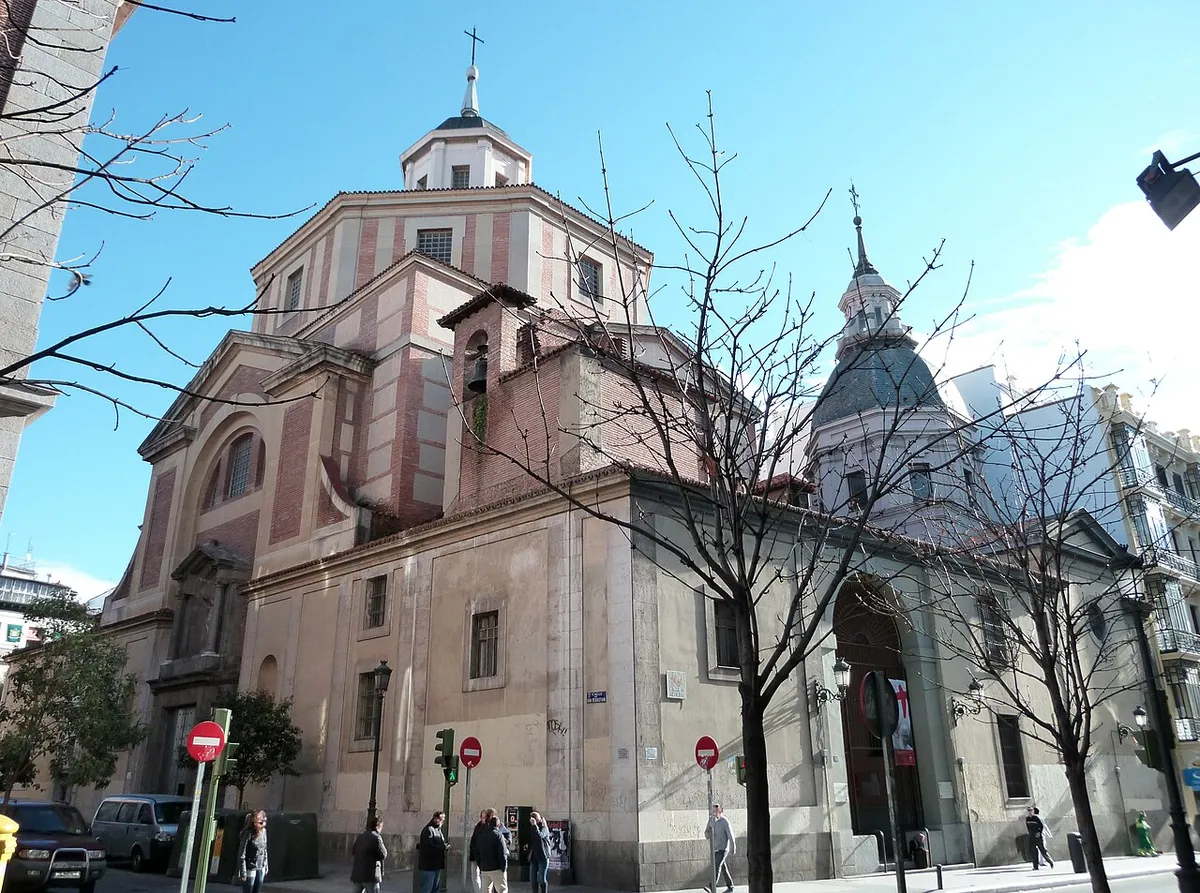
The church from Calle de Atocha. Photo: Luis García (Zaqarbal), CC BY-SA 3.0, via Wikimedia Commons (resized). From Puerta del Sol, walk down Calle de Carretas to Plaza de Jacinto Benavente, then through Plaza del Ángel into Calle de San Sebastián. The corner where this street meets Calle de las Huertas was the parish graveyard, later replaced by a flower shop. Lope de Vega was buried at San Sebastián in 1635, but no one now knows exactly where his remains lie. The master builder Antonio Sillero began the church in 1554. A bomb destroyed it in November 1936, and from 1943 Francisco Íñiguez Almech rebuilt it facing a new direction, keeping what had survived. It reopened in 1959. The door on this street keeps an older doorway, remodelled in 1829.
More history
Architects, actors and other trades paid for its chapels. Ventura Rodríguez remodelled the Chapel of the Architects in 1766–68, and he and Juan de Villanueva are buried there. Actors adopted the chapel of Our Lady of La Novena.
The graveyard has a darker story. After the actress María Ignacia Ibáñez was buried there, her lover, the writer José Cadalso, came back one night to dig up her body. Servants of his friend the Count of Aranda caught him and talked him out of it.
Sources: Ayuntamiento de Madrid; Wikipedia (es), Iglesia de San Sebastián; Wikipedia, St Sebastian's Church; Wikipedia, Lope de Vega.
-
Plaza de Santa Ana and the Teatro Español, a stage since 1583
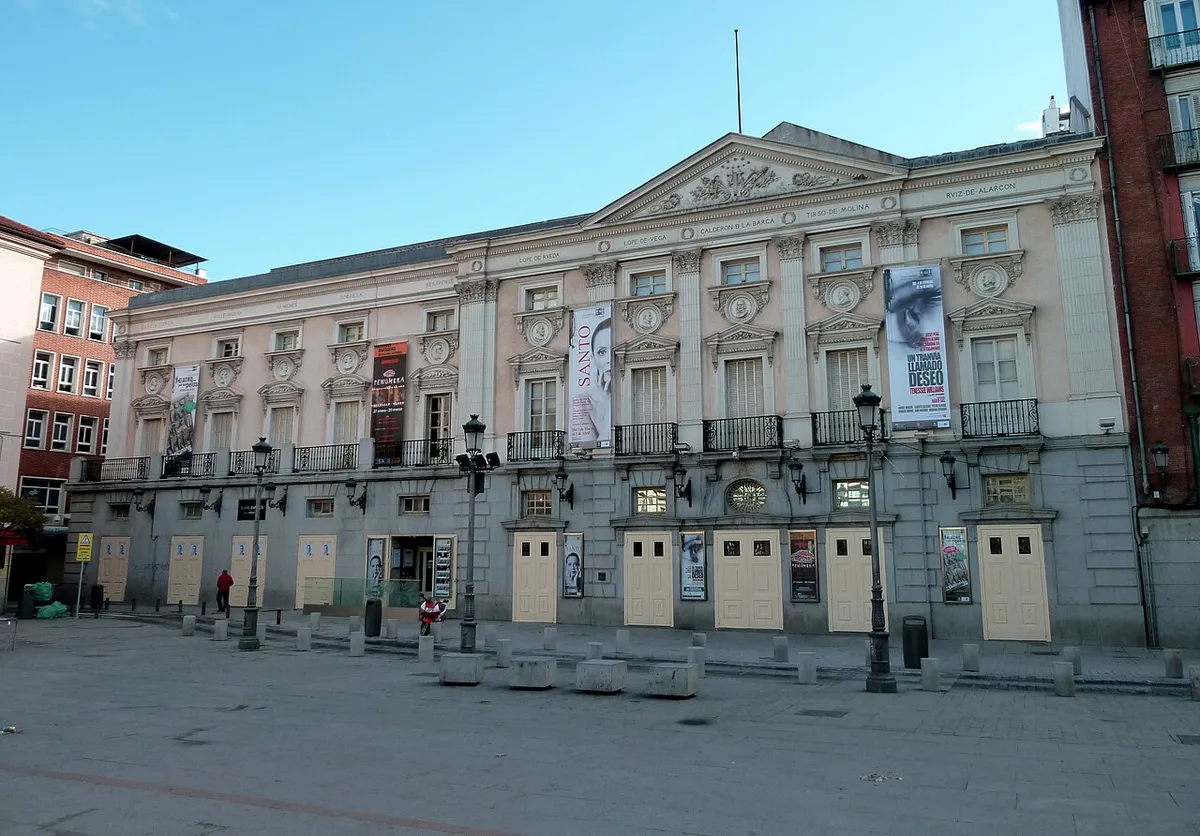
The Teatro Español from Plaza de Santa Ana. Photo: Luis García (Zaqarbal), CC BY-SA 3.0, via Wikimedia Commons (resized). Walk up Calle de San Sebastián to Plaza de Santa Ana and cross to the theatre on its east side. It stands where the Corral del Príncipe, one of Madrid's first playhouses, opened on 21 September 1583: an open-air yard with an awning that kept off the sun but not the rain. It was rebuilt as a roofed theatre from 1735 to 1745. After a fire in 1802, Juan de Villanueva designed a new building, and in 1849 it was renamed the Teatro Español. It burned again in 1975 and reopened in 1980. It belongs to the city council. The square goes back to 1810, when Joseph Bonaparte had a Carmelite convent, Santa Ana, pulled down. Its monuments honour the Golden Age playwright Calderón de la Barca and Federico García Lorca, whose Yerma premiered in this theatre in 1934.
More history
In the 18th century the theatre's fans, the chorizos, feuded with the polacos, who backed the rival Teatro de la Cruz. After closing as unsafe in 1887, it reopened in 1895, run by the actress María Guerrero, who premiered plays by Galdós, Benavente and Echegaray. On 28 March 1939, the day Franco's troops took Madrid, El alcalde de Zalamea was on stage.
Sources: Ayuntamiento de Madrid; Wikipedia (es), Teatro Español; Wikipedia (es), Teatro del Príncipe; Wikipedia, Teatro Español; Wikipedia, Plaza de Santa Ana. What's on: the Teatro Español's site.
-
Ateneo de Madrid, the writers' and politicians' club
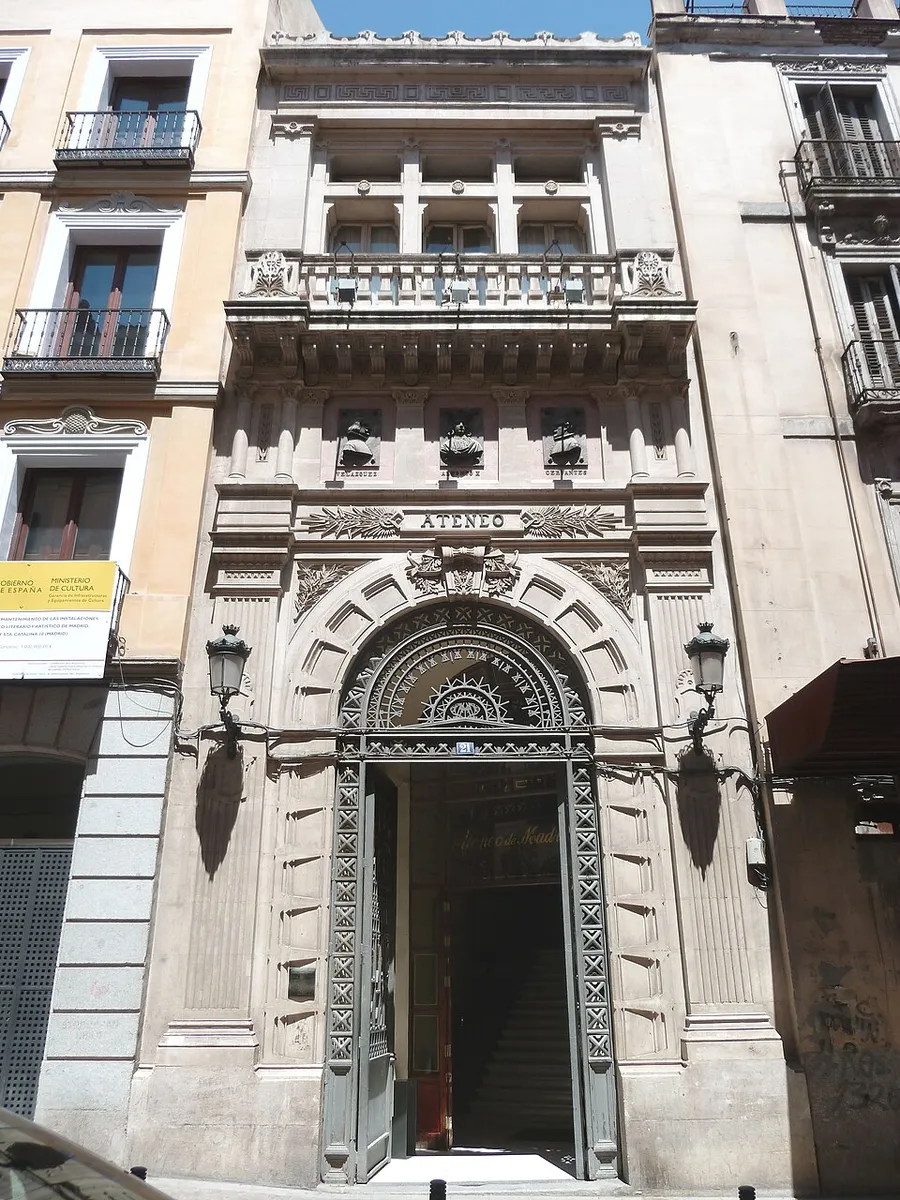
The front at Calle del Prado 21. Photo: Luis García (Zaqarbal), CC BY-SA 3.0, via Wikimedia Commons (resized). Walk east along Calle del Prado to number 21. The Ateneo, a private cultural society, was founded in 1835 and first opened in the old Abrantes house at Calle del Prado 28, a few doors further along. Its founders included the Duke of Rivas and the writer Ramón de Mesonero Romanos, whom you will meet again at the next stop. After several moves it came back to this street. Enrique Fort and Luis de Landecho designed this building from 1882, and Antonio Cánovas del Castillo opened it in 1884. The narrow stone front hides how far it runs back; Arturo Mélida decorated the interior. Its members have included six heads of government, and its presidents Miguel de Unamuno and Manuel Azaña.
More history
The novelist Emilia Pardo Bazán became its first woman member on 9 February 1905. Primo de Rivera's dictatorship suspended its activities. Through the Civil War it stayed open, and its library came through intact.
Sources: Ayuntamiento de Madrid; Wikipedia (es), Ateneo de Madrid; Wikipedia, Ateneo de Madrid. Events: the Ateneo's site.
-
The corner where Cervantes died
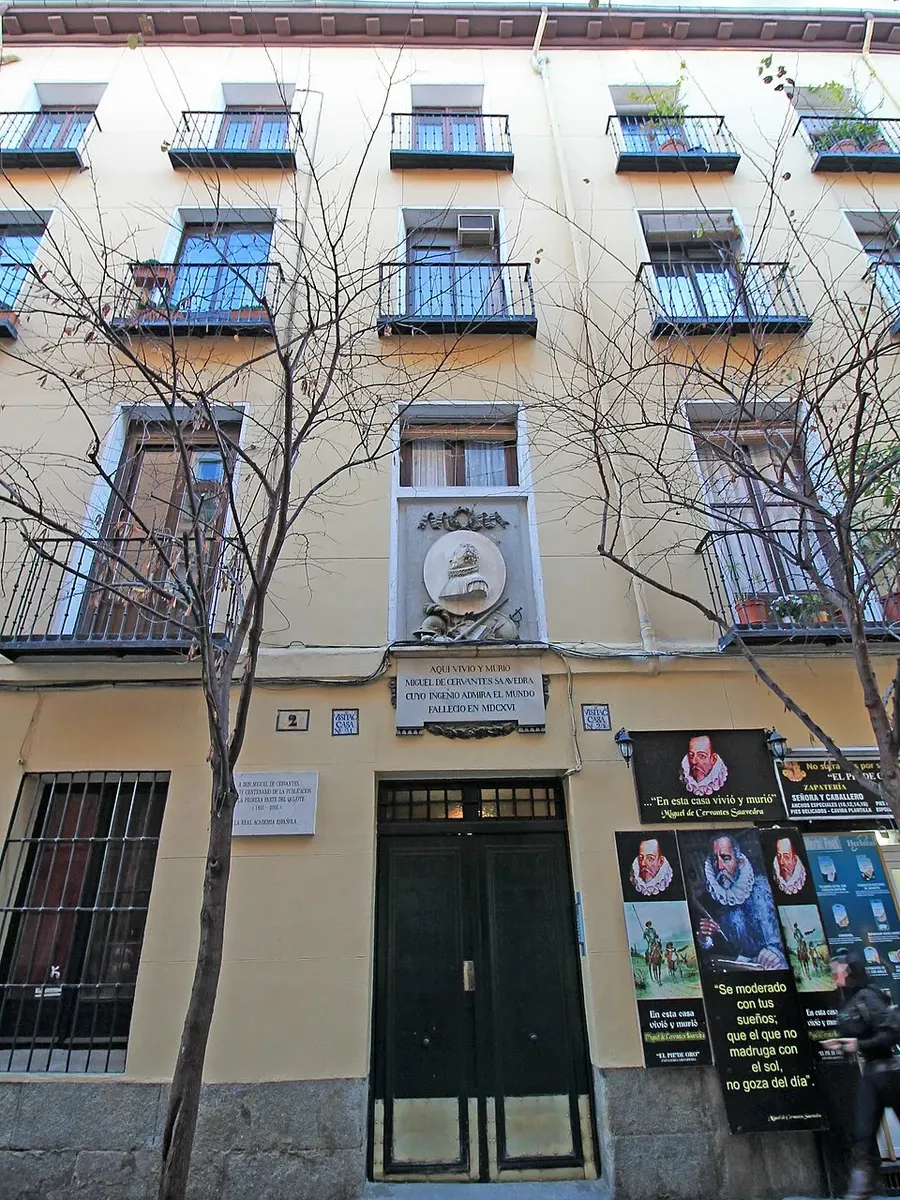
Calle de Cervantes 2, with the 1834 medallion over the door. Photo: Luis García (Zaqarbal), CC BY-SA 3.0 ES, via Wikimedia Commons (resized and cropped). Walk back a few steps and turn left down Calle del León to the corner of Calle de Cervantes. This street was once Calle del Mentidero, where companies and plays were hired for the playhouses. In a rented house on this corner, then the corner of Calle de Francos, Miguel de Cervantes died on 22 April 1616. He was buried the next day, which is why 23 April was long given as his death date. The building you see is not his house. In 1833 the owner began pulling down the ruined old house. Mesonero Romanos protested in print, and King Ferdinand VII offered to buy it, but the owner would not sell. On 13 June 1834 a marble medallion of Cervantes by Esteban de Ágreda was unveiled over the door of the new building. The plaque below it reads, in Spanish: "Here lived and died Miguel de Cervantes Saavedra, whose genius the world admires. He died in 1616." Soon afterwards Calle de Francos became Calle de Cervantes.
More history
Cervantes came back to Madrid in 1608, after six years in Valladolid, and moved several times around these streets, including Calle de las Huertas and an earlier house on Calle del León. Note the names: Calle de Cervantes holds Lope de Vega's house (the next stop), and Cervantes lies in a convent on Calle de Lope de Vega (the stop after).
Sources: Ayuntamiento de Madrid; Wikipedia (es), Casa de Cervantes; Wikipedia (es), Calle de Cervantes; Wikipedia (es), Barrio de las Letras; Wikipedia, Miguel de Cervantes.
-
Casa Museo de Lope de Vega, the playwright's own house
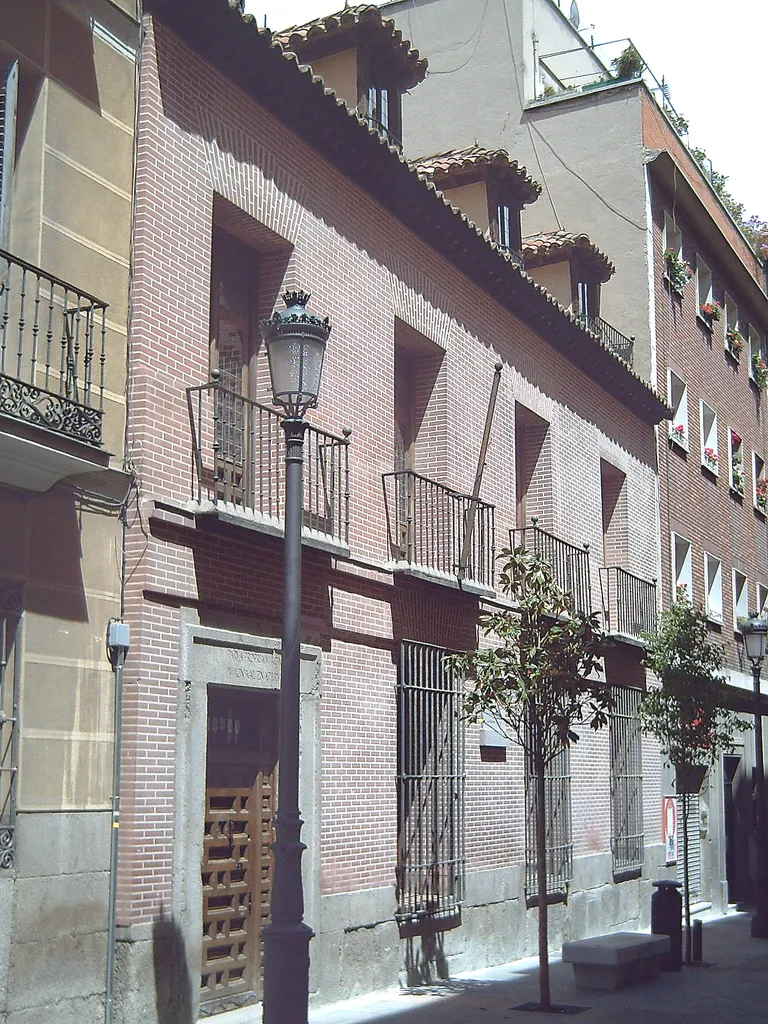
Calle de Cervantes 11. Photo: Luis García, CC BY-SA 2.0, via Wikimedia Commons. Walk down Calle de Cervantes to number 11. Lope de Vega, whom Cervantes called the "Phoenix of Wits", bought this house in 1610 and lived here until he died on 27 August 1635. It is a family house of the early 17th century: two floors, an attic, a garden at the back and a plain front with a stone base. It was later enlarged and split into rooms around a gallery, until Pedro Muguruza, working from a project by Emilio Moya, put back its original layout using Lope's own descriptions. The Real Academia Española bought it in 1930 and opened it as a museum in 1935, the year it was declared a national monument. The Comunidad de Madrid now runs it. Visits are free and guided, Tuesday to Sunday; book ahead if you can.
More history
Lope became a priest in 1614. Two years later he met Marta de Nevares, who stayed with him until her death in 1632. The Academy owns three of his manuscripts, on show in the house, and some of the furniture came from the Trinitarias convent, the next stop.
Sources: Ayuntamiento de Madrid; Wikipedia (es), Casa-Museo de Lope de Vega; Wikipedia, House-Museum of Lope de Vega; Wikipedia, Lope de Vega. Visiting: hours and booking on the Comunidad de Madrid's museum page.
-
The Trinitarias convent, where Cervantes is buried
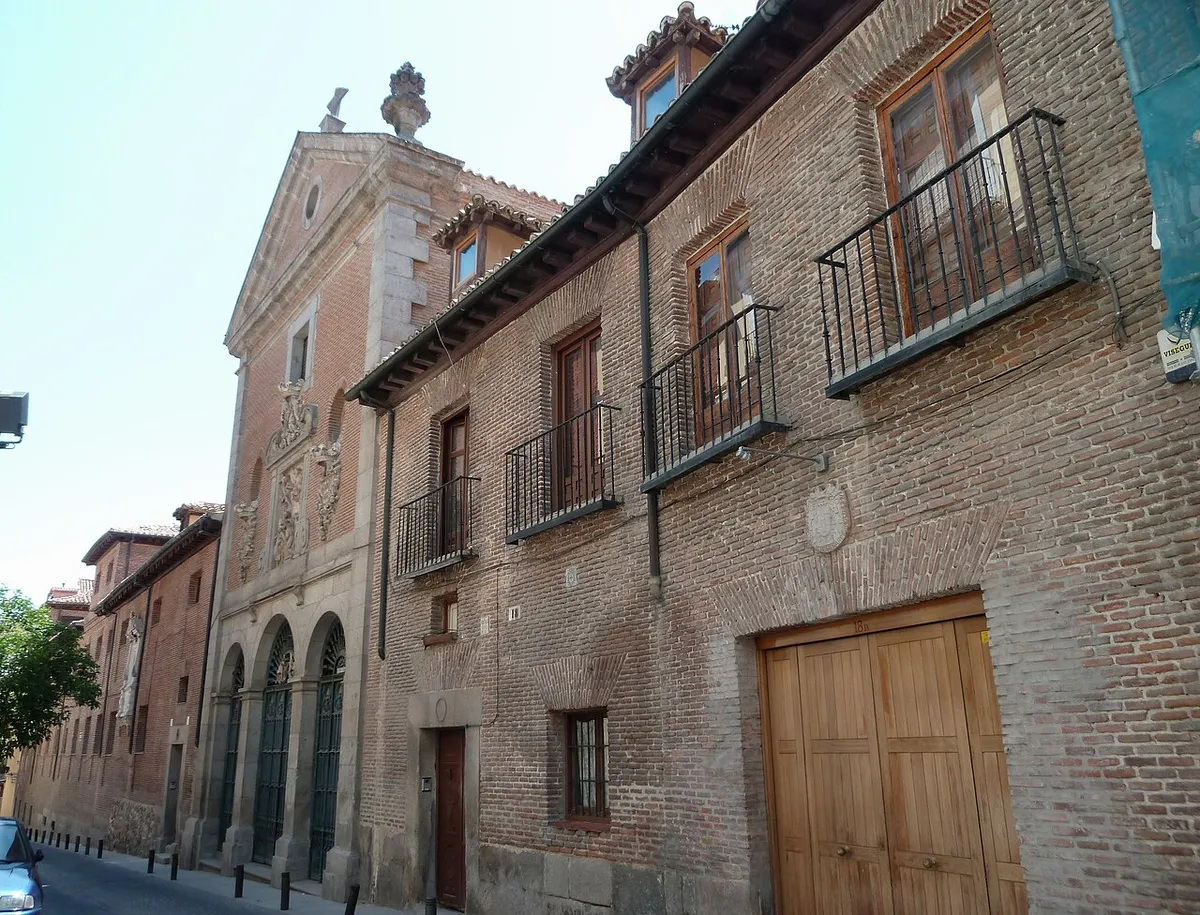
The convent's north front, on Calle de Lope de Vega. Photo: Luis García (Zaqarbal), CC BY-SA 3.0, via Wikimedia Commons (resized). Go back a few steps, turn left down Calle de Quevedo, then left onto Calle de Lope de Vega; the convent is on your right. This house of barefoot Trinitarian nuns was founded in 1612. Cervantes asked to be buried here, because Trinitarian friars had ransomed him from captivity in Algiers in 1580. He was laid in its first, modest church in 1616. When the convent was rebuilt from 1673, that church was pulled down and his remains were lost. The present church, designed by Marcos López, was finished at the end of the 17th century. In 2015 a forensic team identified bone fragments in the crypt as those of Cervantes, his wife and others, and in June 2015 they were reburied in a new monument in the church. Lope's daughter Marcela took her vows here in 1621. The day after Lope died, his funeral procession passed the convent so that she could say goodbye from a window.
More history
In 1868 the convent was nearly demolished. Mesonero Romanos raised the alarm again, and the Royal Academy, led by the Marquis of Molíns, saved it. To warn off speculators, they put plaques and reliefs by the sculptor Ponzano on the front.
Sources: Ayuntamiento de Madrid; Wikipedia (es), Convento de las Trinitarias Descalzas; Wikipedia, Convent of the Barefoot Trinitarians; Wikipedia, Miguel de Cervantes.
-
Calle de Atocha 87, where Don Quixote was first printed
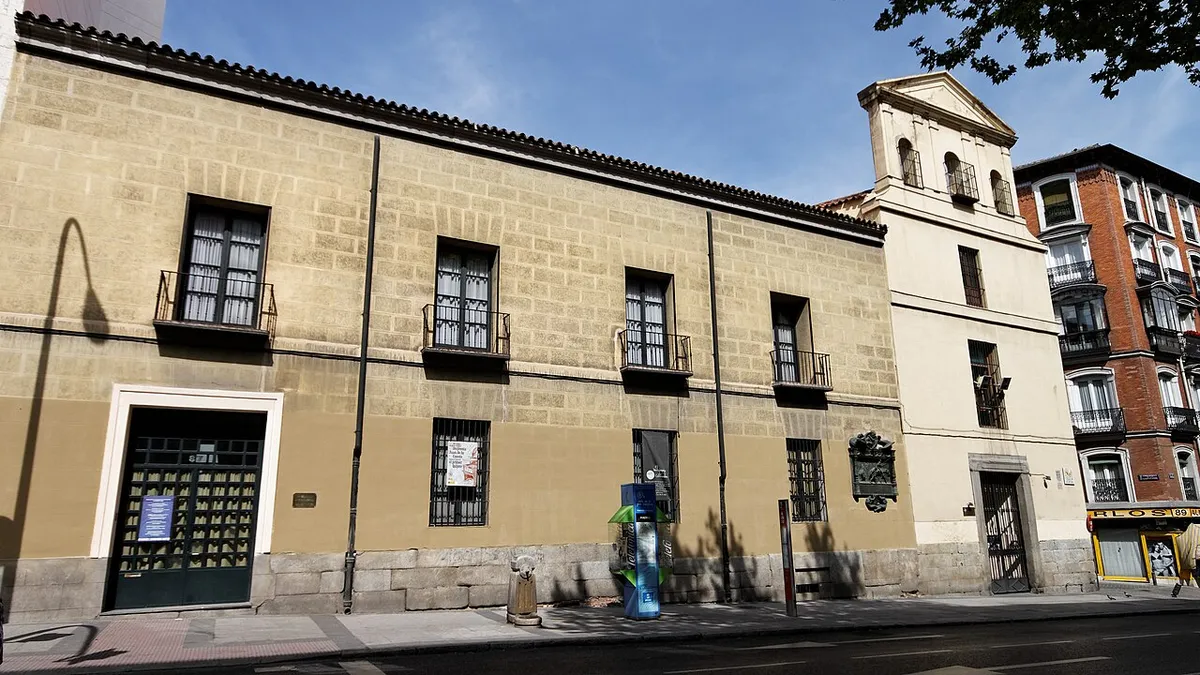
Calle de Atocha 87, home of the Sociedad Cervantina. Photo: Barcex, CC BY-SA 3.0, via Wikimedia Commons (resized). Walk west along Calle de Lope de Vega and turn left down Calle del León. On the corner of Calle de las Huertas, the brick block on your left is the Real Academia de la Historia, designed by Juan de Villanueva in 1788 as the prayer-book office of the monks of El Escorial; look for St Lawrence's gridiron on the front. Calle de las Huertas has lines by Moratín and Quevedo set in gold letters in its paving. At Calle de Atocha, turn left to number 87. Here stood the printing shop that Pedro Madrigal opened in 1586 and that Juan de la Cuesta later ran for Madrigal's widow. At the end of 1604 the bookseller Francisco de Robles ordered the first edition of Don Quixote. It was printed here and came out in early 1605, on rather poor paper from a mill owned by the monks of El Paular, in large, worn type. In 1609 the press moved to nearby Calle de San Eugenio, so Part Two, in 1615, was printed there. The plaque, by Lorenzo Coullaut Valera, was unveiled on 9 May 1905 for the 300th anniversary.
More history
Juan de la Cuesta also printed Cervantes' Novelas ejemplares (1613) and Persiles y Sigismunda, published in 1617 after his death. The building, a national monument since 1981, belongs to the Sociedad Cervantina de Madrid, founded in 1953.
Sources: Ayuntamiento de Madrid; Wikipedia (es), Juan de la Cuesta; Wikipedia, Juan de la Cuesta. On the way: Ayuntamiento de Madrid; Wikipedia (es), Real Academia de la Historia; Wikipedia (es), Calle de las Huertas.
_01.jpg)
_01.jpg)
_01.jpg)
_01.jpg)
_01.jpg)
_01.jpg)

Practical details
- Terrain
- Gentle: Open-Meteo puts every stop between about 661 and 669 m above sea level. Narrow streets, many closed to through traffic.
- Step-free
- OpenStreetMap maps no steps on the route. It marks Sol station as wheelchair accessible, but not Antón Martín (steps at every entrance, no lifts). Lope de Vega's house says its upper floors are hard or impossible to reach with reduced mobility.
- Water
- OpenStreetMap lists drinking fountains on Calle de Atocha by stop 7 and on Calle del Prado, about 120 m past the Ateneo.
- Toilets
- OpenStreetMap shows no public toilets on the route. Plan on a café.
- Sit and eat
- Plaza de Santa Ana (stop 2) is ringed by cafés and tapas bars with terraces, and Calle de las Huertas is lined with bars. Both get busy at night.
- When to go
- Lope de Vega's house opens Tuesday to Sunday, 10:00 to 18:00. It is closed on Mondays, 1 and 6 January, 1 and 15 May, and 24, 25 and 31 December.
- Shorter walk
- Finish at stop 6, the Trinitarias: 1.2 km, about 45 minutes. Antón Martín metro is about 380 m away.
- Getting back
- Antón Martín metro (L1) is about 200 m back up Calle de Atocha. Step-free Sol is about 1.2 km, 15 minutes on foot.
Walking distances and times from the Valhalla pedestrian router on OpenStreetMap data. Elevations from Open-Meteo. Stations, fountains and toilets from OpenStreetMap; museum hours from the Comunidad de Madrid. Checked 23 September 2026.
Questions people ask
How long does the Barrio de las Letras walking tour take, and is there a map?
About an hour: 1.8 km, 22 minutes of walking and seven stops, from Puerta del Sol to Calle de Atocha 87, 200 m from Antón Martín metro. The map is on this page, and you can print it or save it as a PDF.
What is there to see in the Barrio de las Letras?
Lope de Vega's house, now a free museum; the Trinitarias convent, where Cervantes is buried; the corner where he died; the Teatro Español on Plaza de Santa Ana, on the site of a 1583 playhouse; the Ateneo; the church of San Sebastián, where Lope was buried; and the spot on Calle de Atocha where the first Don Quixote was printed.
Did Cervantes live in the Barrio de las Letras?
Yes. After he came back to Madrid in 1608 he lived at several addresses in the quarter. He died on 22 April 1616 in a rented house on the corner of Calle del León and Calle de Francos, now Calle de Cervantes. That house was pulled down in 1833; the building on the corner today carries a medallion and plaque from 1834.
Where is Cervantes buried?
In the church of the Trinitarias Descalzas convent, on Calle de Lope de Vega. His remains were lost when the convent was rebuilt from 1673. In 2015 a forensic team identified bone fragments in the crypt as those of Cervantes, his wife and others, and in June 2015 they were reburied in the church.
Why is it called the Barrio de las Letras?
Letras means letters, as in literature, so the name translates as the Literary Quarter. It is named after the 16th- and 17th-century writers who lived here, among them Cervantes, Lope de Vega, Quevedo and Góngora. It has also been called the barrio de las Musas.
Walk it with Strolio
Open Strolio at Puerta del Sol and ask for an hour through the Barrio de las Letras. Strolio builds walks in any city with mapped streets, so its route may pick different stops from this page. Stories play as you reach each place, and you can ask about anything else you pass, by voice or with a photo. You can also start from your hotel and choose your own time and interests.
Also on Strolio: Barcelona
- The Gothic Quarter and El Born: about 90 minutes, from Roman columns to the cathedral and El Call.
- El Born, from the 1714 graveyard to the Ciutadella: about 75 minutes.
- Gràcia's village squares: about an hour.
Sources
- Ayuntamiento de Madrid, Patrimonio cultural y paisaje urbano: the heritage page for each building or plaque, linked under each stop. We used their facts and wrote our own text.
- Wikipedia (Spanish): Barrio de las Letras, Iglesia de San Sebastián, Teatro Español, Teatro del Príncipe, Ateneo de Madrid, Casa de Cervantes, Calle de Cervantes, Casa-Museo de Lope de Vega, Convento de las Trinitarias Descalzas, Juan de la Cuesta, Real Academia de la Historia, Calle de las Huertas
- Wikipedia (English): St Sebastian's Church, Teatro Español, Plaza de Santa Ana, Ateneo de Madrid, Miguel de Cervantes, Lope de Vega, House-Museum of Lope de Vega, Convent of the Barefoot Trinitarians, Juan de la Cuesta
- Opening times and visits: Comunidad de Madrid, Casa Museo Lope de Vega, Teatro Español, Ateneo de Madrid
- Map data and places: © OpenStreetMap contributors, ODbL; walking route from the Valhalla router run by FOSSGIS
- Elevations: Open-Meteo
- Photos: Wikimedia Commons contributors Luis García (Zaqarbal) and Barcex, credited under each photo