
Gràcia self-guided walking tour · 1 hour · map
A one-hour walk through Gràcia's squares
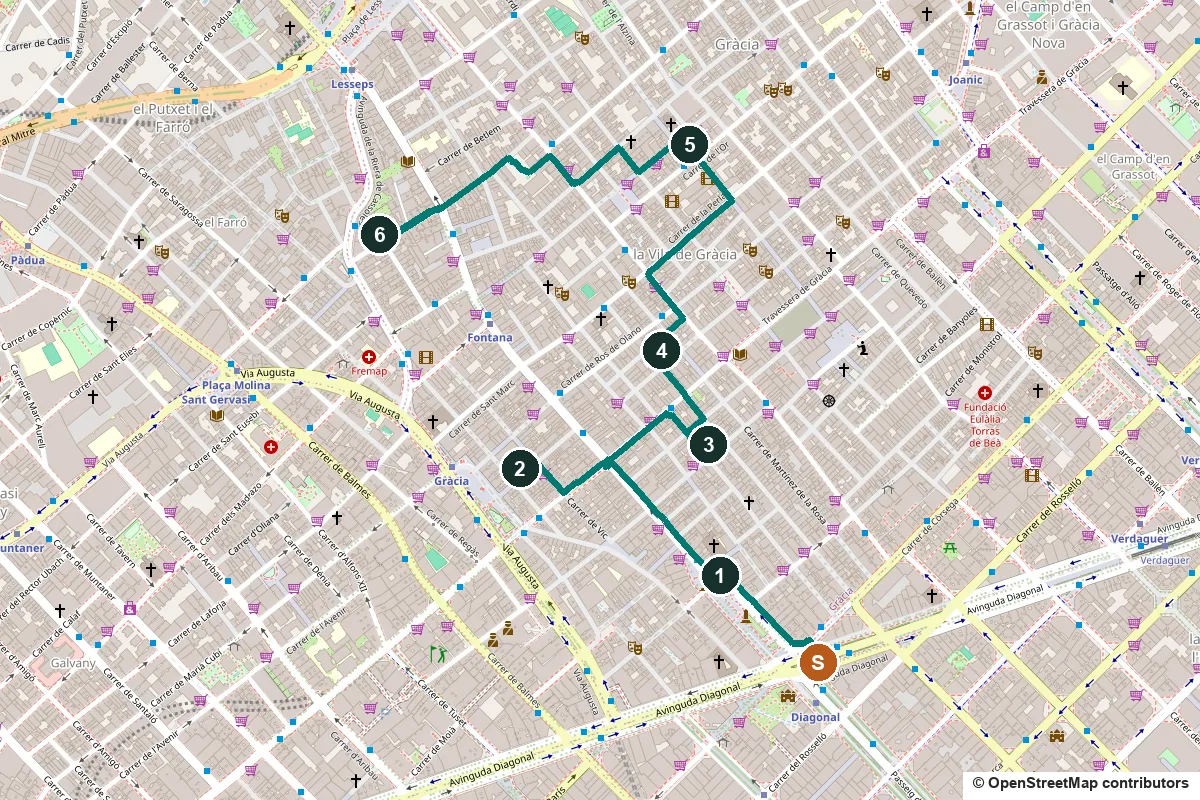
Gràcia ran its own affairs from 1850 until it joined Barcelona in 1897. This walk links its squares, from the top of Passeig de Gràcia to Casa Vicens, Gaudí's first important work.
The squares were laid out one by one in the 1800s: Plaça de la Vila in 1836, Plaça del Sol from 1840, Plaça de la Virreina in 1878. The old heart of the town was Plaça del Rei, today's Plaça de la Llibertat, and Gràcia could only grow east, because to the west it bordered Sant Gervasi de Cassoles. When Gràcia became a town of its own, it put its town hall on Plaça de la Vila, then at the eastern edge. That square still holds a day of castells, human towers, each August during the Festa Major de Gràcia.
- Start
- Diagonal metro (L3, L5), at the top of Passeig de Gràcia
- Finish
- Casa Vicens, Carrer de les Carolines, near Fontana metro (L3)
- Distance
- 2.7 km, one way
- Time
- About an hour: 35 min walking and 6 stops
Terrain, water, toilets and cafés ↓
The stops
-
Casa Fuster, at the top of Passeig de Gràcia
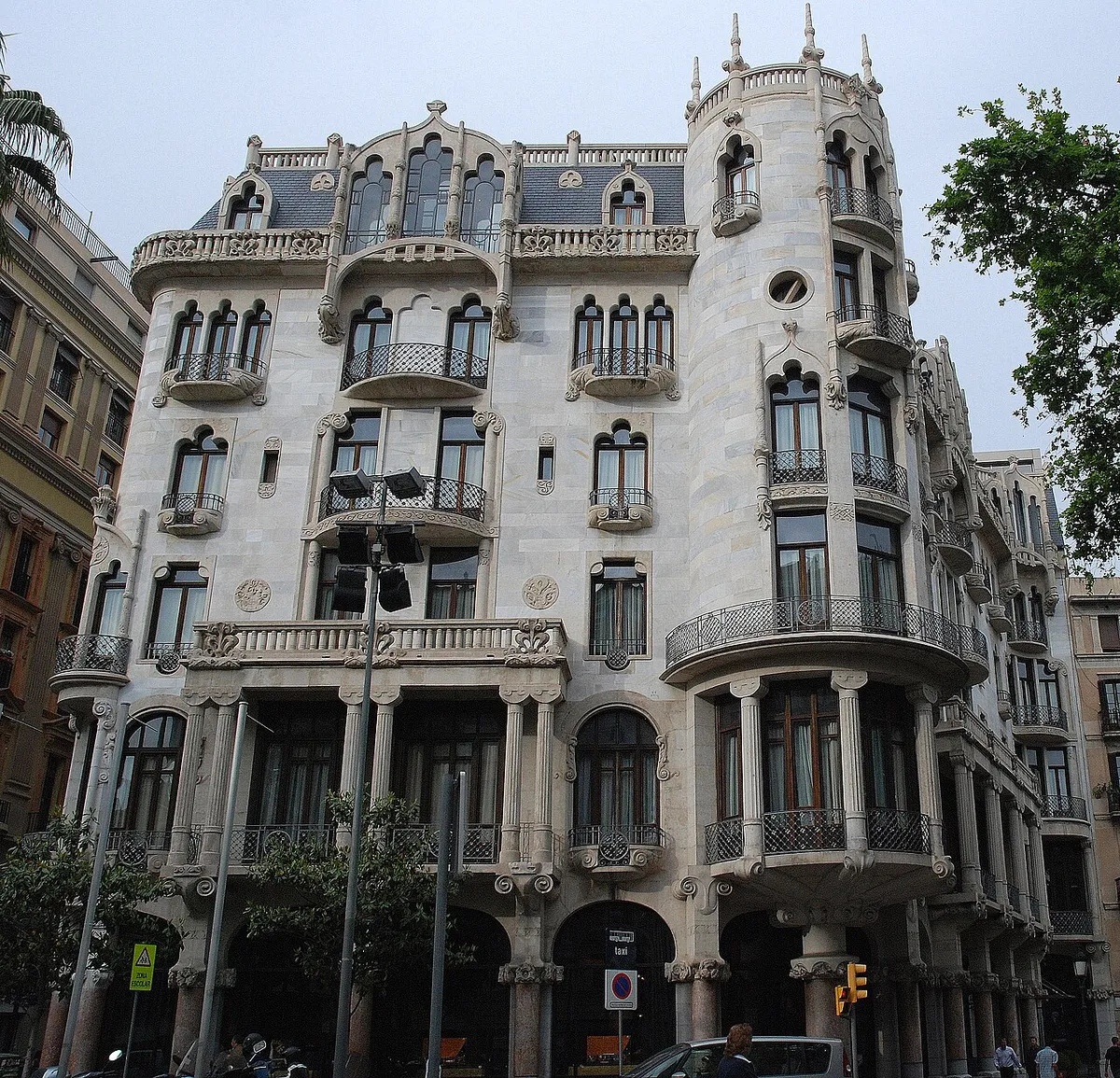
The rounded corner and the red marble columns. Photo: Paul Hermans, CC BY-SA 3.0, via Wikimedia Commons (resized). Lluís Domènech i Montaner designed this Modernista house at the top of Passeig de Gràcia, and it went up between 1908 and 1911. Look at the rounded corner that rises the full height of the building, and at the ground-floor columns of red marble against the white façade. A power company bought it in 1962 to knock it down; public protest saved it, and since 2004 it has been a five-star hotel.
More history
The story starts with chocolate. Pere Juncosa i Font sold the property to Consol Fabra i Puig after closing his chocolate factory, and in 1905 she asked Domènech i Montaner to design a new home. The Fuster i Fabra family lived on the main floor; the hotel restaurant there today, Galaxó, is named after the hill in Mallorca where Marià Fuster had a house.
Jaume Ymbern i Fort bought the building in 1922, and for many years it was a block of flats. The Espriu brothers were among the tenants, and the basement was a dance hall, El Danubio Azul. In 1962 the power company Empresa Nacional Hidroelèctrica de la Ribagorçana bought it, planning to pull it down for a new head office. Public opposition and anonymous newspaper articles saved it. Hoteles Center bought it in 2000 and opened the hotel in 2004, although Gràcia's neighbourhood groups had asked for a cultural centre.
Source: Viquipèdia, Casa Fuster.
-
Mercat de la Llibertat, the market on the old main square
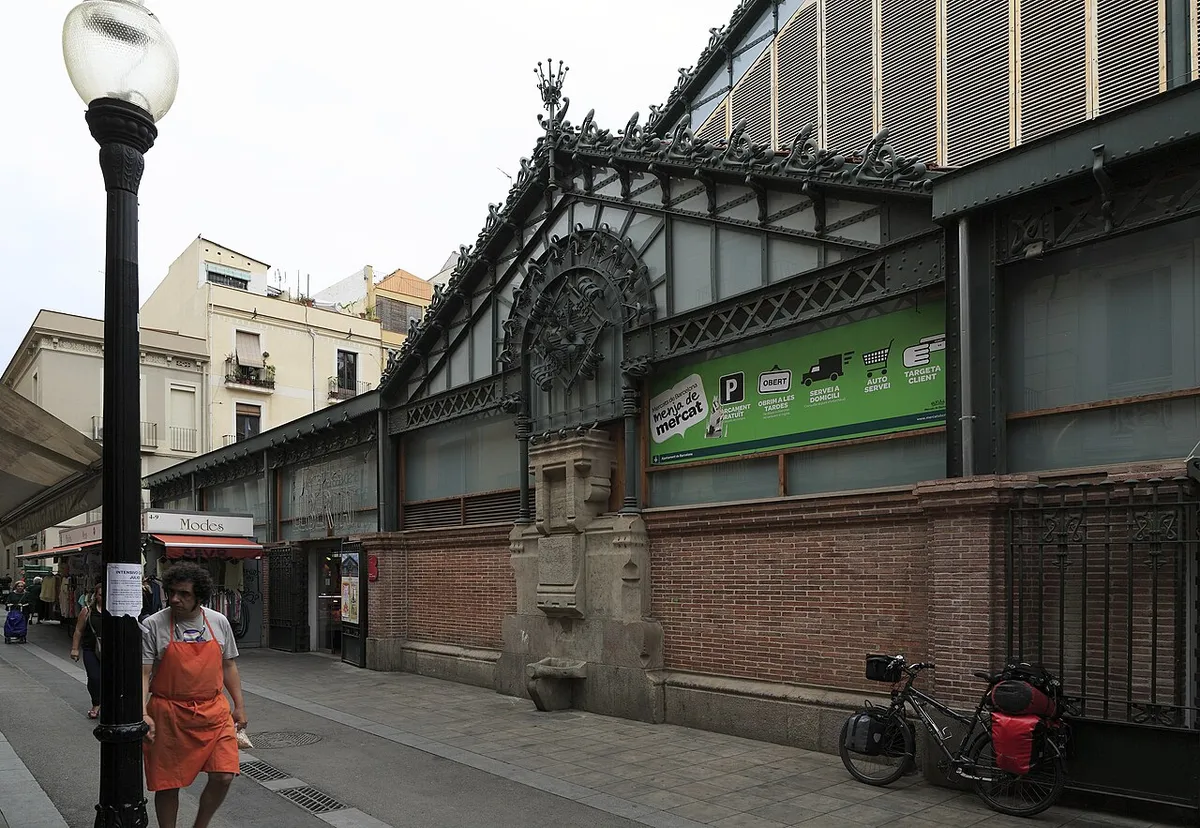
One of the market's gable ends. Photo: Falk2, CC BY-SA 4.0, via Wikimedia Commons (resized). This iron-framed market hall opened in 1893 on Plaça de la Llibertat, which, as Plaça del Rei, was once the heart of the town. Look at the two end walls: each rises to a triangular gable, and in the middle of the curling stone and wrought-iron work is Gràcia's coat of arms with its three lilies. It is still a working food market.
More history
The land belonged to Marc d'Olives (1782–1855), a landowner from Menorca. His will asked for buildings around a square, laid out so that goods and people could pass through and several streets could meet. Work began in 1888. The market is believed to be by Francesc Berenguer i Mestres, who had no architect's title and usually built to plans signed by someone else; the curling lines on the gables are typical of him.
The metal structure is like that of the Born and Sant Antoni markets; the Modernista touch is in the decoration. In 2009 the architect Josep Llobet renovated the whole building: a supermarket moved in, the market began opening every afternoon, and the usable space doubled to 4,400 m². In 2012 the World Union of Wholesale Markets gave it its annual award.
Sources: Viquipèdia, Mercat de la Llibertat; Viquipèdia, Plaça de la Vila de Gràcia.
-
Plaça de la Vila, the town hall and the bell tower
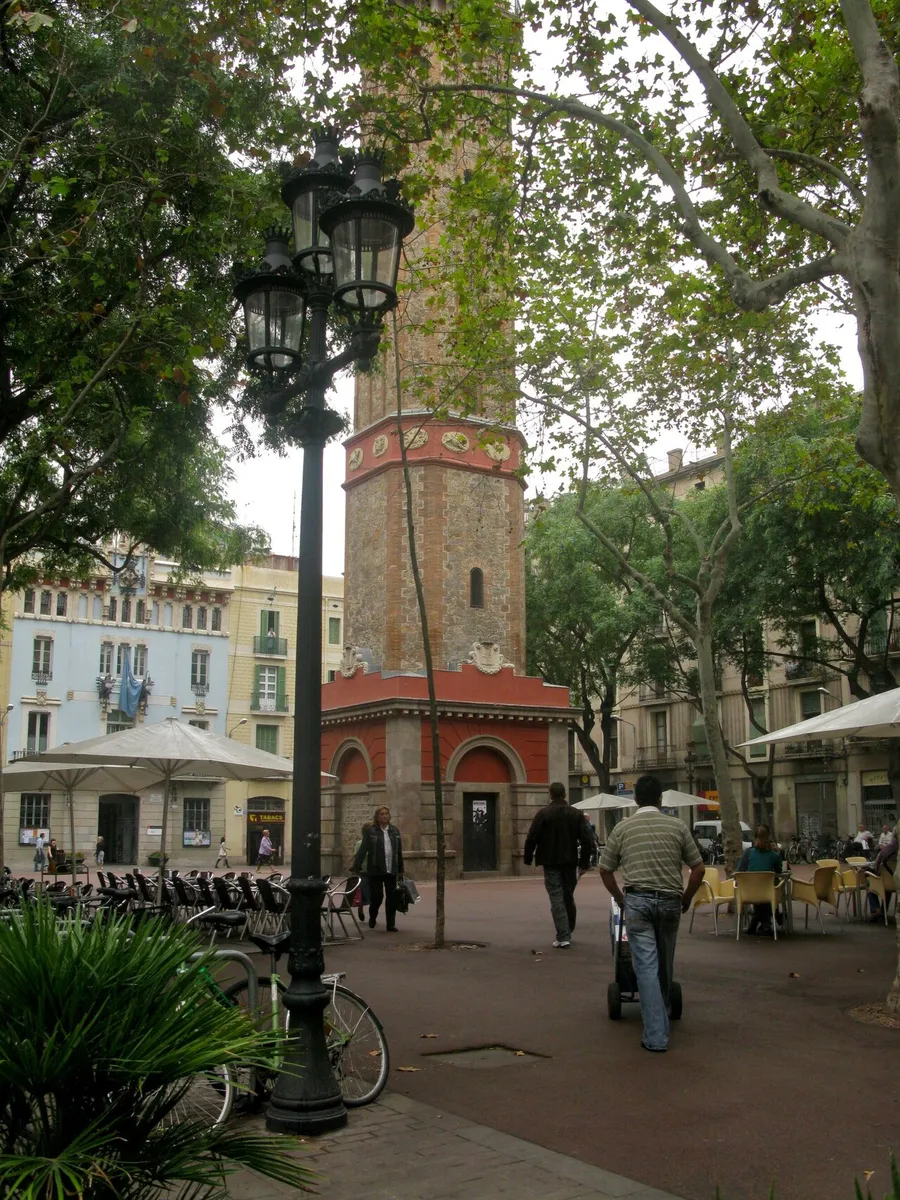
The bell tower in 2008. Photo: Alain Rouiller, CC BY-SA 2.0, via Wikimedia Commons (resized). When Gràcia became a town of its own in 1850, it put its town hall on this square, and it opened around 1853. The bell tower in the middle went up in 1864, designed by Antoni Rovira i Trias, and at the time it was twice as tall as any other building in the town. Look for the four-faced clock, the double fountain at its foot, and the bell at the top, known as la Marieta.
More history
The land belonged to the Dominican order, and in 1808 their prior asked to lay out streets on it. The Peninsular War stopped the plan: the Napoleonic authorities ordered every building below the Travessera pulled down. State seizures of the land blocked it twice more, and the square was only laid out in 1836. From at least 1850 people called it Plaça de l'Orient, East Square, because it sat at the eastern edge of the town.
From 4 to 9 April 1870 the square was at the centre of the Quintes revolt against a large military call-up. The rebels, mostly women, stormed the town hall, threw the conscription papers off the balcony and burned them in the square while the bell rang the alarm. The bell became a symbol of the revolt and a target for the army's artillery. As punishment it was silenced for years, and the square was to stay unpaved so that cavalry could move in easily. The damaged tower was only repaired in 1882, when the clock faces were also lit.
The district building's façade is by Francesc Berenguer i Mestres, with Gràcia's coat of arms in wrought iron and two lanterns above the main balcony. The square holds castells days in August and November, and it has its own small festival giant, Pepitu Campanar, modelled on the bell tower.
-
Plaça del Sol, a sundial, a liberty tree and a stage
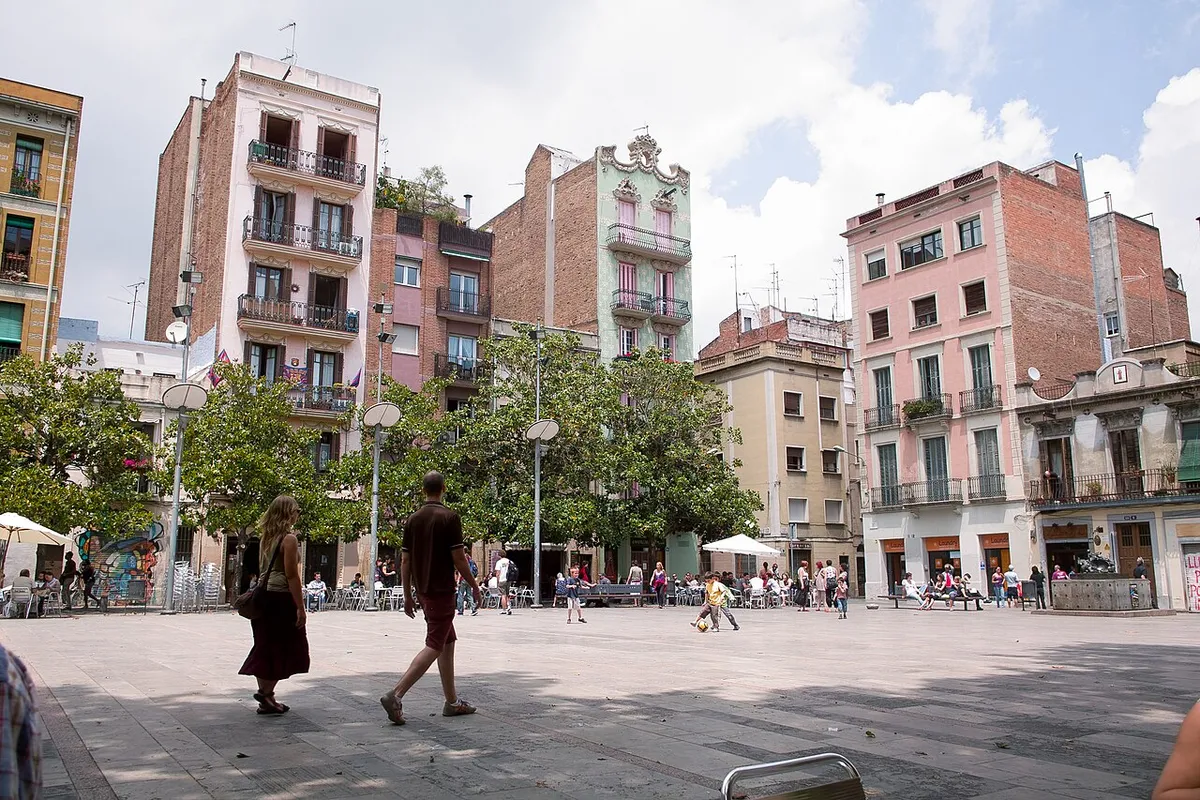
Photo: thierrytutin, CC BY 2.0, via Wikimedia Commons (resized). Laid out from 1840, this square has kept its original name. For much of the 20th century it was one of Gràcia's stages: a festival marquee stood in the middle from at least 1907 to 1982, and Joan Manuel Serrat, La Trinca and Los Mustang all played under it. On the north-east side is a bronze sundial from 1987, a hollow half-sphere ringed by the signs of the zodiac; it was removed for a while in 2019 during work on the lift of the car park below.
More history
The first record of this land is from 1781. In 1840 Joaquim Mas i Mateu, son of a baker, began laying out the square on a spot then called Llepaolles, and the plots were built on quickly. The streets around it had sky names too, such as Carrer de la Lluna (Moon) and Carrer de l'Estrella (Star); Carrer del Planeta is the one left. When Gràcia joined Barcelona in 1897, part of Carrer de Santa Madrona was renamed Maspons.
In 1869 the local revolutionary committee planted a cedar in the middle as a liberty tree, a symbol of that year's new Spanish Constitution. During the Quintes revolt of 1870 it was where Francesc Derch, leader of the Voluntaris de la Llibertat, tried to calm the rebels. From 1872 until the Civil War a street market set up here on Sunday mornings, possibly the origin of the square's nickname, Plaça dels Encants.
During the Civil War the city built an air-raid shelter under the square, with a main hall of about 750 m²; the Franco authorities later closed it. In 1975 police stopped a concert by Raimon in front of thousands of people and charged through the surrounding streets, and many people were arrested.
Source: Viquipèdia, Plaça del Sol.
-
Plaça de la Virreina, the church square
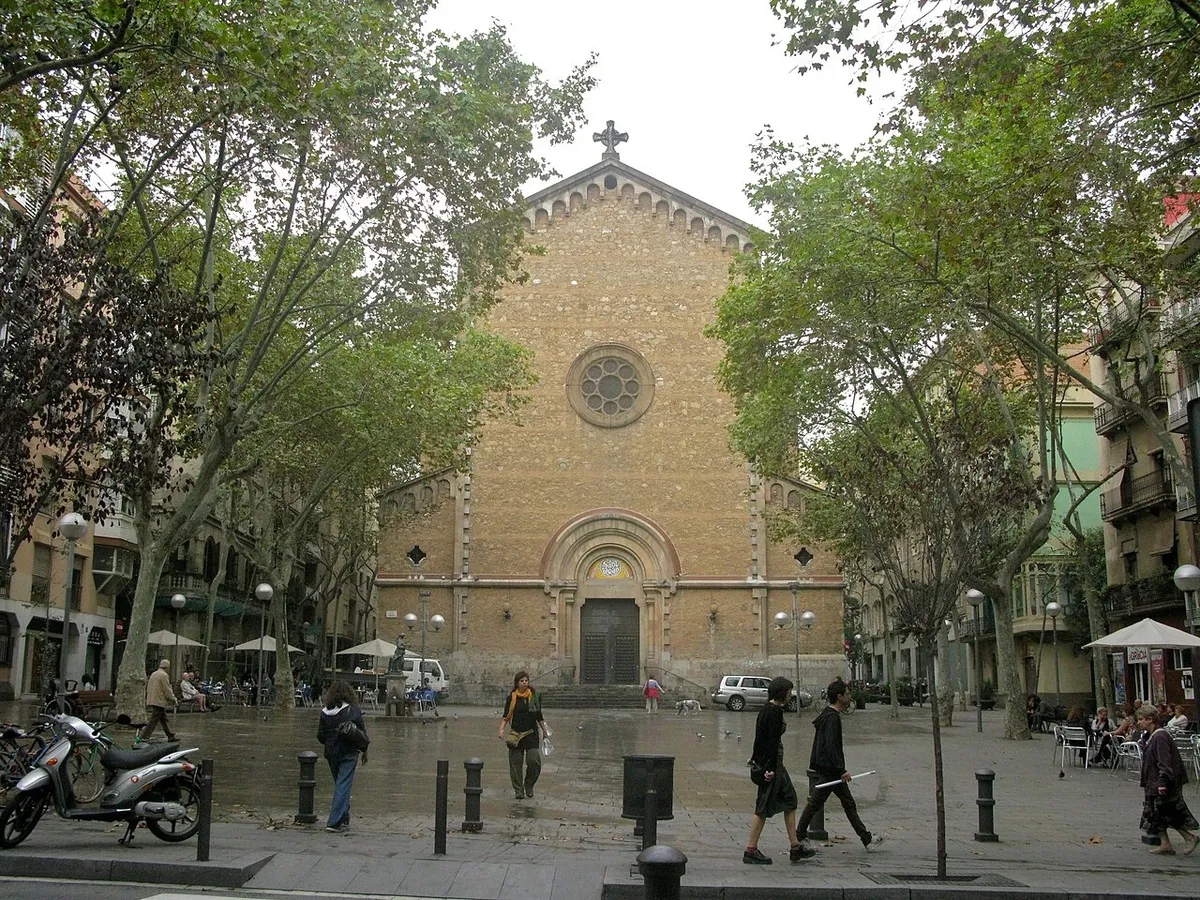
The church of Sant Joan. Photo: Alain Rouiller, CC BY-SA 2.0, via Wikimedia Commons (resized). This square was laid out in 1878 to a design by the architect Josep Artigas i Ramoneda, and the church of Sant Joan was begun at the same time and finished in 1884. In the middle is the Font de Rut, a fountain topped by a bronze of the biblical Ruth holding a sheaf of wheat, which is why people also call it l'Espigoladora, the gleaner. The stone benches under the plane trees make this a good place to sit.
More history
The square is named after La Virreina, a palace that no longer exists: the summer home of the viceroy Manuel d'Amat i de Junyent. People also call it Plaça de Sant Joan, after the 19th-century church. The fountain, by the sculptor Josep Maria Camps i Arnau, was unveiled on 11 September 1949, the date that would become Catalonia's national day. Its stone base has a spout and a basin on each side.
From the 1920s the Orfeó Gracienc organised sardana dancing here. In its early years the square held no Festa Major events, out of respect for the church; the neighbours began taking part in the Festa Major in 1947. During the Civil War local people sheltered from Italian air raids in a shelter at one side of the square. Its condition today is unknown.
Source: Viquipèdia, Plaça de la Virreina.
-
Casa Vicens, Gaudí's first important work
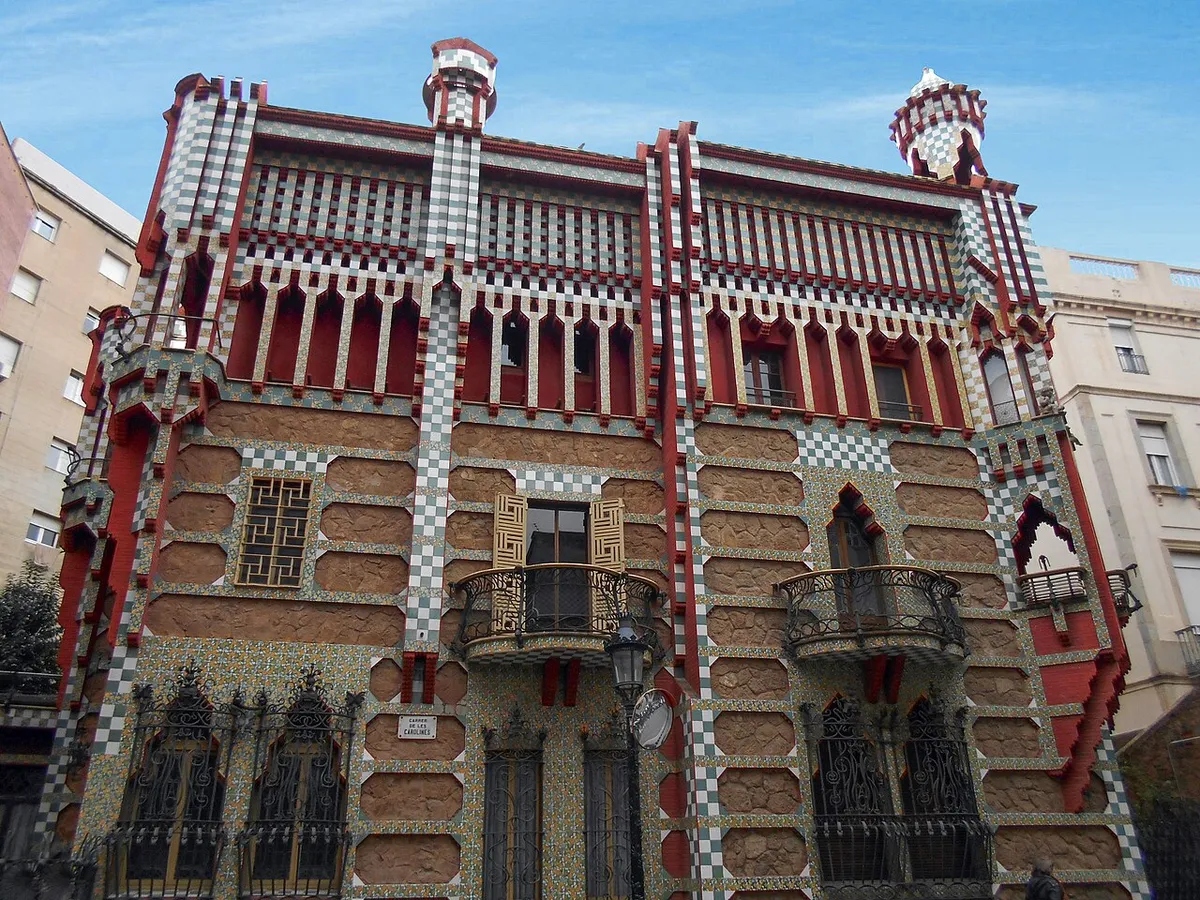
Casa Vicens from Carrer de les Carolines. Photo: Canaan, CC BY-SA 4.0, via Wikimedia Commons (resized). In 1878 the stockbroker Manuel Vicens i Montaner asked Antoni Gaudí for a family summer house in the town of Gràcia; built between 1883 and 1885, it was Gaudí's first important work. Look at the walls of rough stone banded with tiles of yellow flowers from the area, and at the iron railing of fan-palm leaves: Gaudí based the entrance gate on a palm tree growing on the plot. It is now a UNESCO World Heritage Site and a house museum; check tickets and opening hours on the official Casa Vicens site.
More history
Gaudí finished the design of the house and garden in 1880, and the plans were signed on 15 January 1883. He designed all the furniture too, down to the sliding doors and the cast-brass cupboard locks. A corner fireplace of wood and metal, with the initials M.V. for Manuel Vicens, is still in the house.
In 1899 the house was sold to a doctor, Antoni Jover. In 1925 the owners planned to enlarge it into a main home, and the architect Joan Baptista Serra added a new bay and the right-hand half of the façade in Gaudí's style; in 1927 the city gave it its prize for the best building. In 1946 part of the garden was sold for housing and its cascade was demolished. Apartment blocks now stand on the old gardens.
The house became a Cultural Asset of National Interest in 1993 and a UNESCO World Heritage Site in 2005. The Andorran bank MoraBanc bought it in 2014. The architects Elies Torres and José Antonio Martínez Lapeña, with David García of Daw Office, restored it between 2015 and 2017 and brought back the water jet from Gaudí's original design. It opened as a house museum on 16 November 2017.
Source: Viquipèdia, Casa Vicens.


.jpg)
.jpg)
.jpg)

Practical details
- Terrain
- Gently uphill. You start at about 52 m above sea level at Diagonal and finish at about 83 m at Casa Vicens, a climb of about 30 m over 2.7 km.
- Step-free
- Plaça del Sol's central space has steps or ramps on every side except Carrer del Planeta. OpenStreetMap marks Casa Vicens and Fontana station as wheelchair accessible.
- Water
- OpenStreetMap lists free city drinking fountains in Plaça del Sol, in Plaça de la Virreina and next to the Mercat de la Llibertat.
- Toilets
- OpenStreetMap lists a free public toilet on Travessera de Gràcia, which you cross between stops 3 and 4 (limited wheelchair access).
- Sit and eat
- Benches under the plane trees in Plaça de la Virreina. OpenStreetMap lists Café Vienés in Casa Fuster at the start and chromatic café next to Casa Vicens, which also has a café in its garden.
- When to go
- The Festa Major de Gràcia is in August, with castells in Plaça de la Vila: expect crowds and check this year's dates.
- Getting back
- Fontana metro (L3) is about 300 m from Casa Vicens, 4 minutes on foot. Lesseps (L3) is about 400 m away.
Walking distance and times from the OSRM foot router on OpenStreetMap data. Elevations from Open-Meteo. Metro, fountains, toilets and cafés from OpenStreetMap. Checked 22 September 2026.
Gràcia walking tour: questions
How long does the Gràcia walking tour take?
About an hour. The route is 2.7 km one way, about 35 minutes of walking plus six stops, from Diagonal metro to Casa Vicens. Fontana metro (L3) is about 300 m from the finish.
Is there a map of the walking route through Gràcia?
Yes. The map above shows the route from Diagonal metro and the six numbered stops in walking order. Use the “Print this walk” button to print it or save it as a PDF.
What is there to do in Gràcia, Barcelona?
Walk its squares: Plaça de la Vila with its 1864 bell tower, Plaça del Sol and Plaça de la Virreina. Stop at the Mercat de la Llibertat, a market hall opened in 1893, and visit Casa Vicens, Gaudí's first important work, now a house museum.
Is Gràcia worth visiting?
Yes, if you like places with a history of their own. Gràcia was a separate town from 1850 until it joined Barcelona in 1897, and this walk links the squares it grew around. It also has a UNESCO World Heritage Site, Casa Vicens.
When is the Festa Major de Gràcia?
In August. Plaça de la Vila holds a day of castells, human towers, as part of it, and Plaça del Sol has long been one of its places for dances and concerts. Check this year's dates before you go.
Walk it with Strolio
Open Strolio at Diagonal metro and ask for an hour through old Gràcia. Stories play as you reach each place, and you can ask about anything else you pass, by voice or with a photo. This is one example: you can also start from your own street and choose your own time and interests.
More walks in Barcelona
- Gaudí and Modernisme on foot: Casa Vicens was Gaudí's first important work, and this walk takes you to more of his buildings. Casa Fuster's architect, Domènech i Montaner, is part of the same Modernista story.
- The Gothic Quarter and El Born: the medieval old town, on foot.
- El Born, from the 1714 graveyard to the Ciutadella: merchant palaces, a market and Domènech i Montaner's Palau de la Música.
- Montjuïc, from the fountain to the Olympic ring: a longer walk up the hill.
- Hometown walks: shorter walks through Barcelona's neighbourhoods, from Horta to Poblenou.
Sources
- Viquipèdia: Casa Fuster, Mercat de la Llibertat, Plaça de la Vila de Gràcia, Plaça del Sol, Plaça de la Virreina, Casa Vicens
- Casa Vicens: official site (tickets and opening hours)
- Map data and places: © OpenStreetMap contributors, ODbL
- Elevations: Open-Meteo
- Photos: Wikimedia Commons contributors Paul Hermans, Falk2, Alain Rouiller, thierrytutin and Canaan, credited under each photo