
Montjuïc self-guided walking tour · 2–2½ hours · map
Up Montjuïc, from the 1929 exhibition to the 1992 Olympics
Barcelona held two world events on this hill. The 1929 International Exhibition left a fountain, a palace, a pavilion and a whole model village. The 1992 Olympics held their ceremonies in its remodelled stadium and added an arena and a tower. This walk climbs through both, from Plaça d'Espanya to the botanical garden.
The first half is 1929: the fountain, the German pavilion, the Poble Espanyol and the Palau Nacional were all built for the exhibition. The second half is the Olympic ring of 1992.
- Start
- Plaça d'Espanya (Espanya metro)
- Finish
- Jardí Botànic de Barcelona, off Passeig Olímpic
- Distance
- 4.7 km, one way
- Time
- About 2–2½ hours: an hour of walking, most of it uphill, and 8 stops
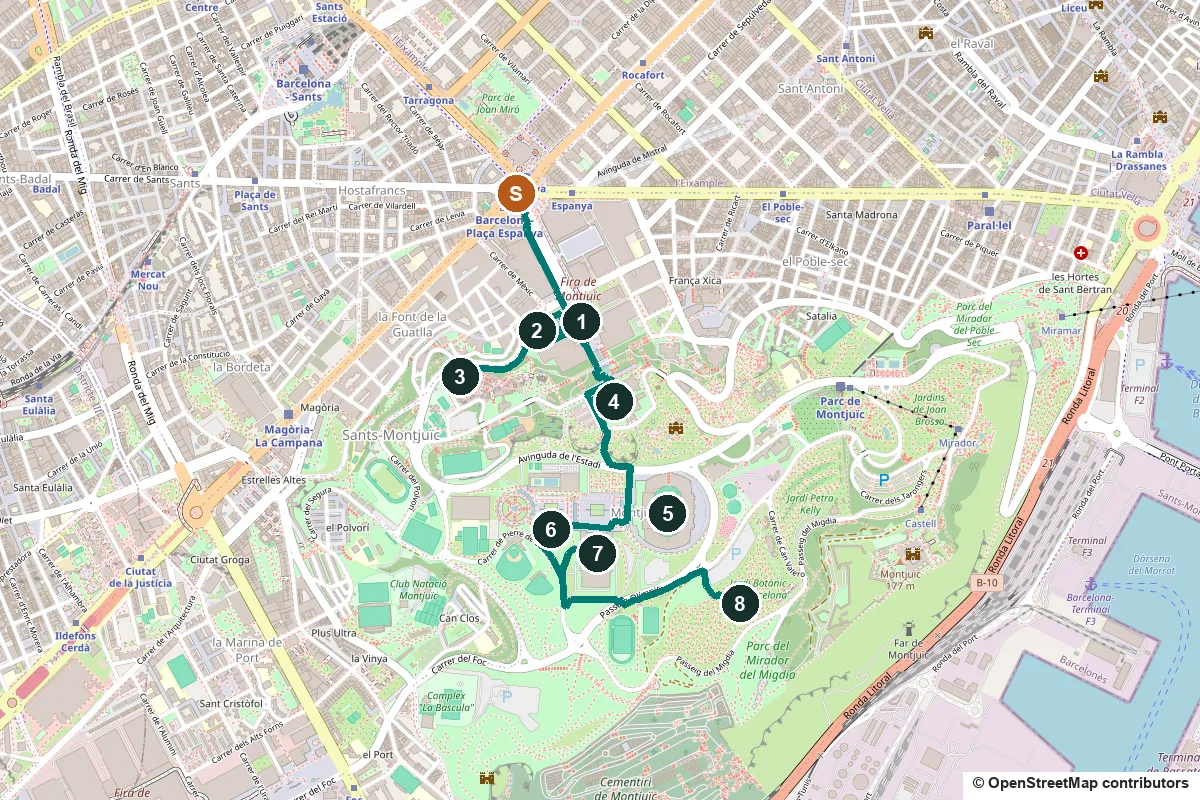
Escalators, water, toilets and the way back down ↓
The stops
-
Font Màgica and Les Quatre Columnes, a fountain where the columns stood
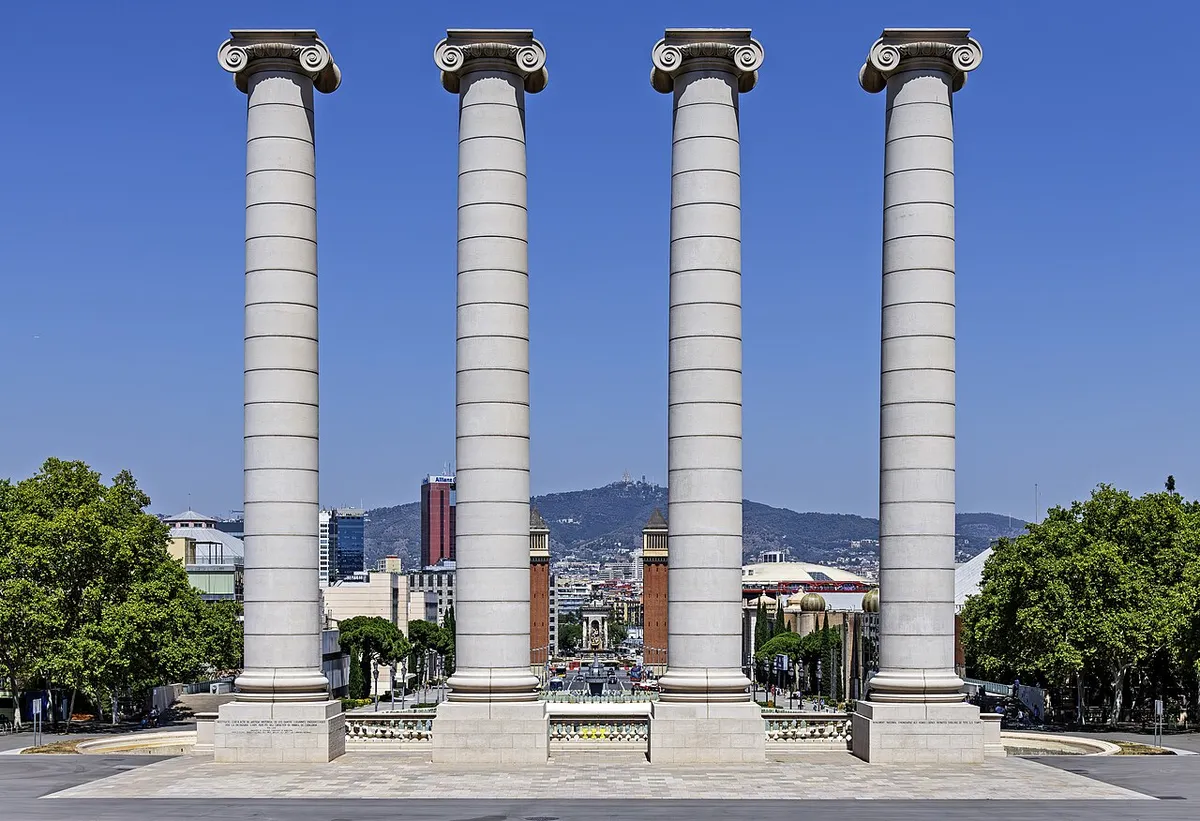
Les Quatre Columnes, looking down to Plaça d'Espanya. Photo: Didier Descouens, CC BY-SA 4.0, via Wikimedia Commons (resized). Walk up Avinguda de la Reina Maria Cristina to the fountain and look up at the four columns. Josep Puig i Cadafalch raised the first ones in 1919, one for each bar of the Catalan flag. They were pulled down in 1928, under Primo de Rivera's dictatorship, and the engineer Carles Buïgas built the Font Màgica on their site for the 1929 exhibition. Today's columns were rebuilt in 2010, a little higher up.
More history
Building the fountain took less than a year and more than 3,000 workers. It is three concentric pools on stepped levels, and its water is lit through 120 skylights. Music was added in the 1980s.
The original columns were 20 metres tall, of rendered brick made to look like stone, and were meant as a symbol of Catalanism. They came down shortly before a visit to the city by Primo de Rivera. The city approved rebuilding them in 1994, but no one could agree where. The new ones, rings of artificial stone, were inaugurated on 27 February 2011.
Sources: Viquipèdia, Font Màgica de Montjuïc; Viquipèdia, Les Quatre Columnes.
-
Pavelló Mies van der Rohe, Germany's pavilion of 1929
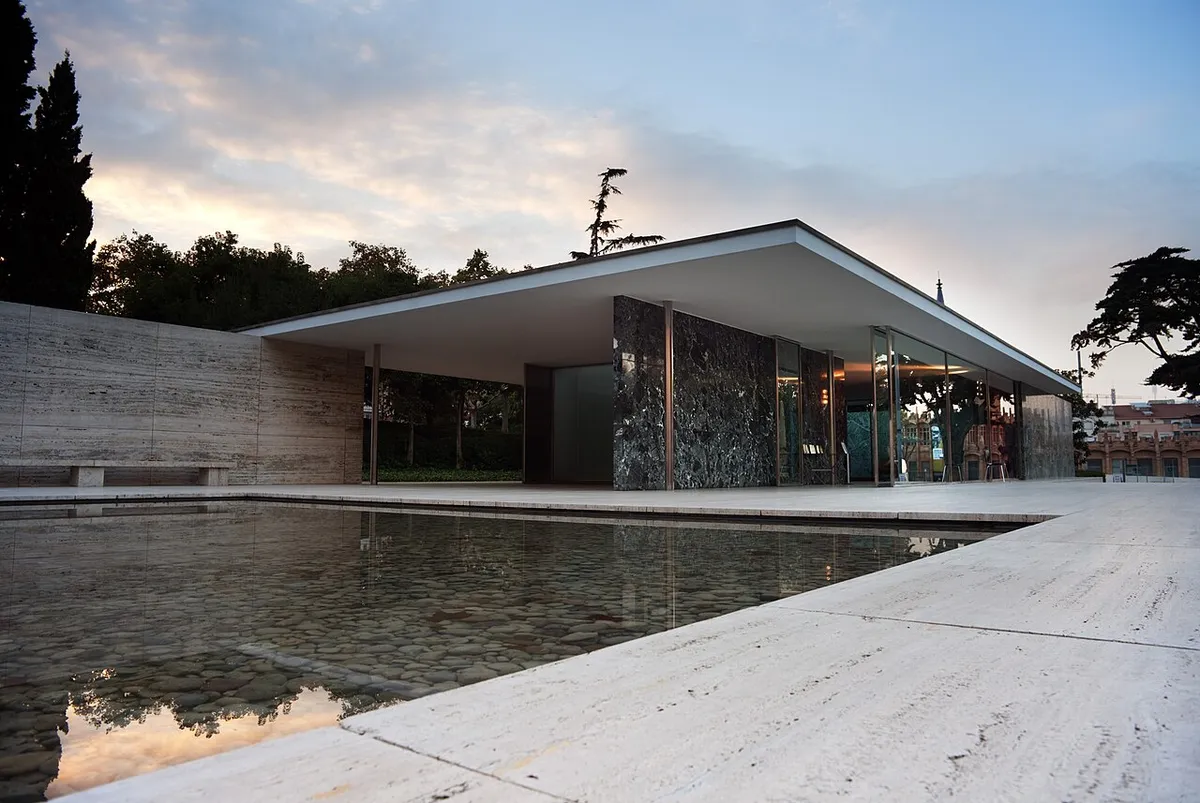
Photo: Ashley Pomeroy, CC BY 3.0, via Wikimedia Commons (resized). Look for the flat roof resting on thin, cross-shaped chrome columns, and the bronze figure in the small pool. The Weimar Republic commissioned this pavilion from Ludwig Mies van der Rohe and Lilly Reich in 1928, for the 1929 exhibition, and it was taken down in 1930. What you see was rebuilt on the same spot between 1983 and 1986, using the original materials and methods wherever possible.
More history
It was supposed to present a new Germany: democratic, culturally progressive, prosperous and pacifist. It was to show only the structure, furniture designed for it, including Mies's own Barcelona chair, and one sculpture: Georg Kolbe's Morgen (Dawn), now a bronze copy in the small pool. The materials include Roman travertine, green marble from the Alps and Greece, and golden onyx from the Atlas.
Just north, the red-brick building is Puig i Cadafalch's Casaramona textile factory of 1909, now CaixaForum. Its new entrance is by Arata Isozaki, the architect of the Palau Sant Jordi at stop 7.
Sources: Viquipèdia, Pavelló Mies van der Rohe; Fundació "la Caixa", CaixaForum opening (25/02/2002).
-
Poble Espanyol, a village built to last six months
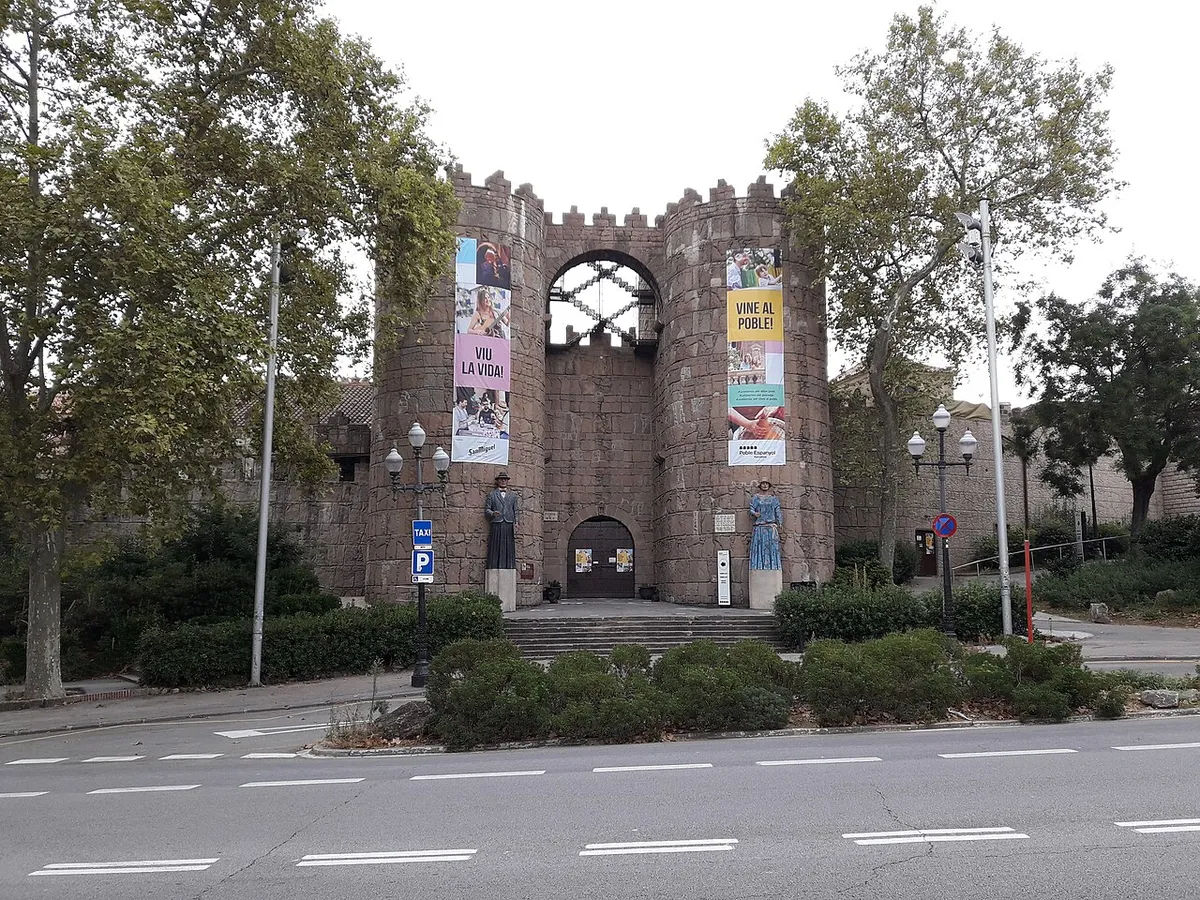
The Porta d'Àvila, the way in. Photo: Pere prlpz, CC BY-SA 3.0, via Wikimedia Commons (resized). Walk up Avinguda de Francesc Ferrer i Guàrdia to the Porta d'Àvila, a gate between two towers and the only way in through the walls. Behind them are 117 full-size buildings, a whole village made for the 1929 exhibition. It was meant to last six months, but its success with visitors made people think about keeping it, and it is still open. Going in needs a ticket; this walk looks from the gate.
More history
The idea came from Puig i Cadafalch. The architects Francesc Folguera and Ramon Reventós designed it with the art critic Miquel Utrillo and the painter Xavier Nogués; the four of them visited 1,600 towns and villages. The buildings come from fifteen of today's autonomous communities, but none from the Canary Islands: the budget did not stretch to a visit. The village was first to be called Iberona; the Primo de Rivera dictatorship renamed it Pueblo Español.
-
Palau Nacional, the exhibition's main building
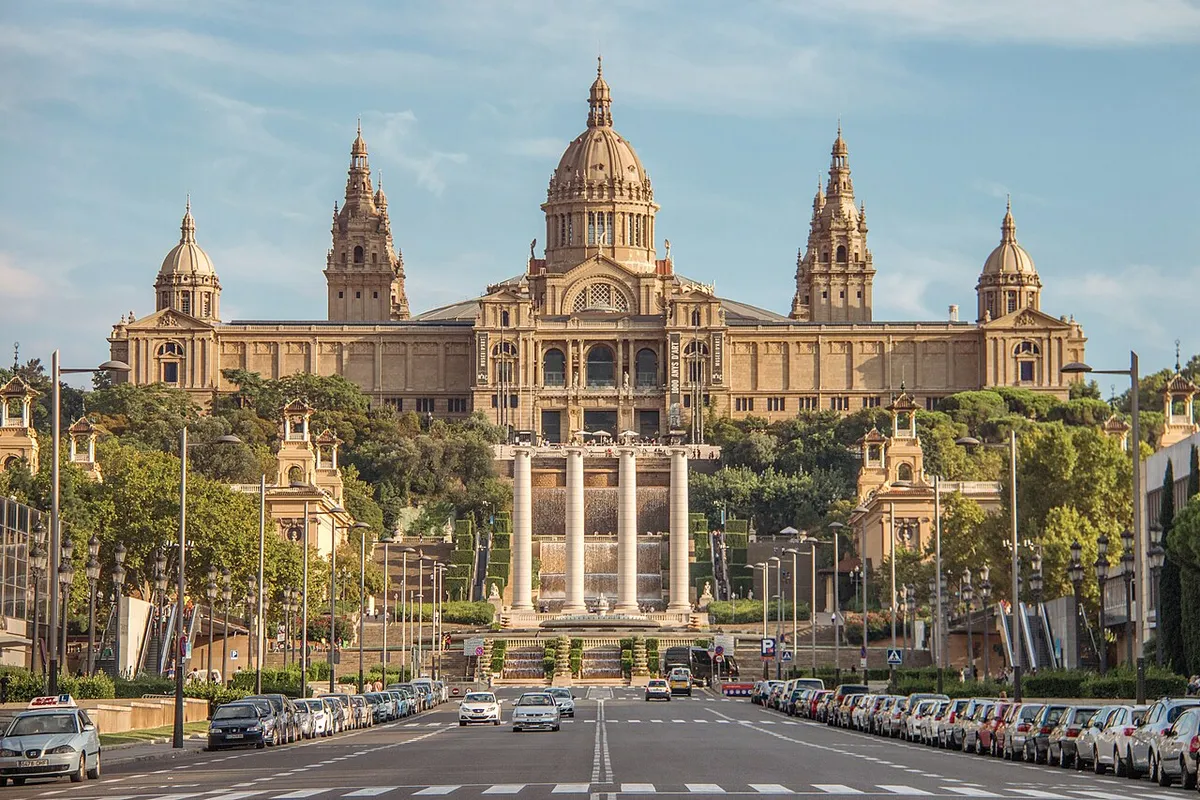
The Palau Nacional above the cascades and the rebuilt columns. Photo: Juanedc, CC BY 2.0, via Wikimedia Commons (resized). Walk back down the avenue and climb the stairs beside the cascades; escalators run alongside. At the top is the Palau Nacional, built between 1926 and 1929 as the exhibition's main building. Look at the big central dome and the towers at the four corners of its Great Hall. The cascades and fountains on the stairs are also by Carles Buïgas. Since 1934 the building has housed the Museu Nacional d'Art de Catalunya (MNAC).
More history
The design was by Eugenio Cendoya and Enric Catà, supervised by Pere Domènech i Roura, the exhibition's director of construction. King Alfonso XIII and Queen Victoria Eugenia led the exhibition's opening ceremony in the Great Hall. The first searchlights behind the building came on in 1929; in the Civil War they were used to spot enemy planes coming to bomb the city.
The museum in its current form dates from 1990; for the 1992 Olympics it could only show a preview. It is known for its Romanesque art, including wall paintings lifted from churches with a technique called strappo.
Sources: Viquipèdia, Palau Nacional (Barcelona); Wikipedia (es), Museo Nacional de Arte de Cataluña.
-
Estadi Olímpic Lluís Companys, the 1929 stadium of the 1992 Games
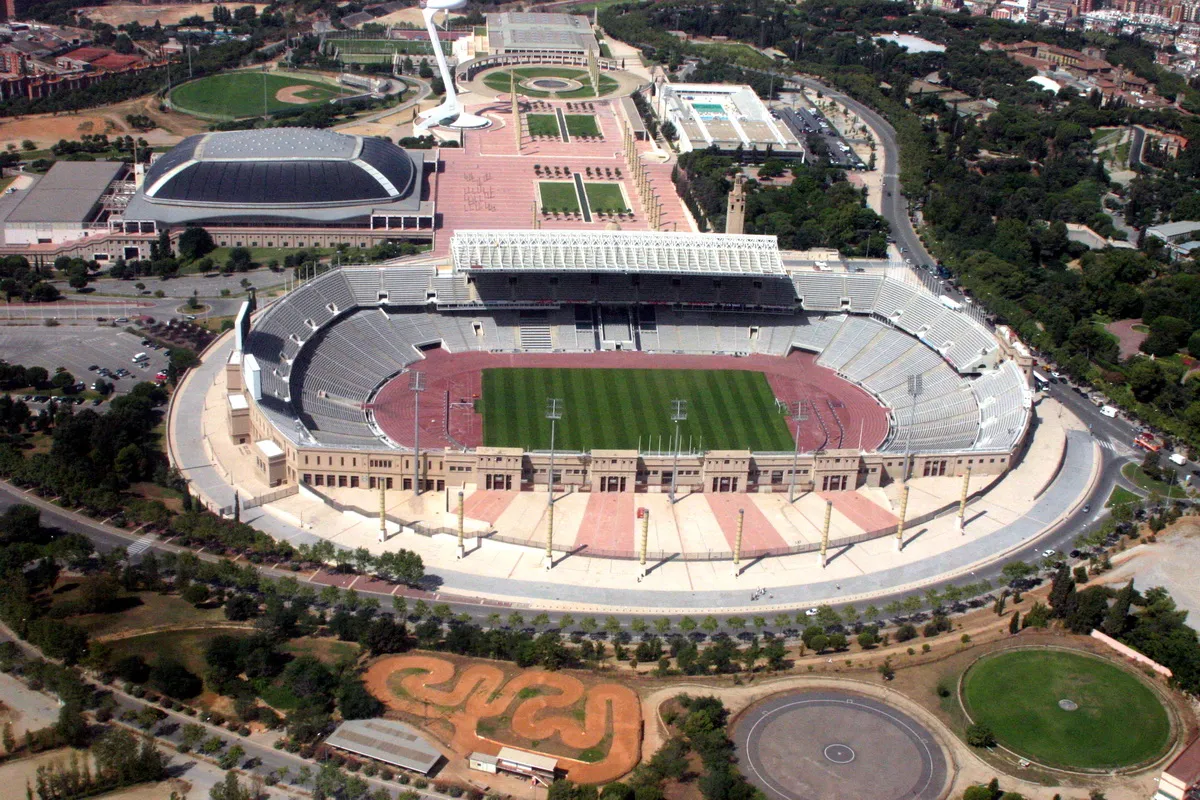
The stadium from the air, with the Palau Sant Jordi and the Calatrava tower behind. Photo: Amadalvarez, CC BY 3.0, via Wikimedia Commons. Behind the Palau, more escalators help you up towards Avinguda de l'Estadi. The stadium opened on 20 May 1929 and was remodelled between 1985 and 1989: the track was lowered 11 metres and new stands went up for about 56,000 people. In 1992 it hosted the Olympic opening and closing ceremonies. Look for the marathon gate, with a group of sculptures by Vicenç Navarro on its pediment.
More history
It was commissioned from Pere Domènech i Roura, who also supervised the Palau Nacional. It was due to host the Popular Olympiad of 1936, and later held the 1955 Mediterranean Games, but in the 1960s it was underused. The architects Correa, Milà, Margarit and Buixadé, with the Italian Gregotti, led the remodelling, and it reopened on 8 September 1989 for the Athletics World Cup. It has carried the name of Lluís Companys since 2001.
-
Torre de Comunicacions, the leaning Olympic tower
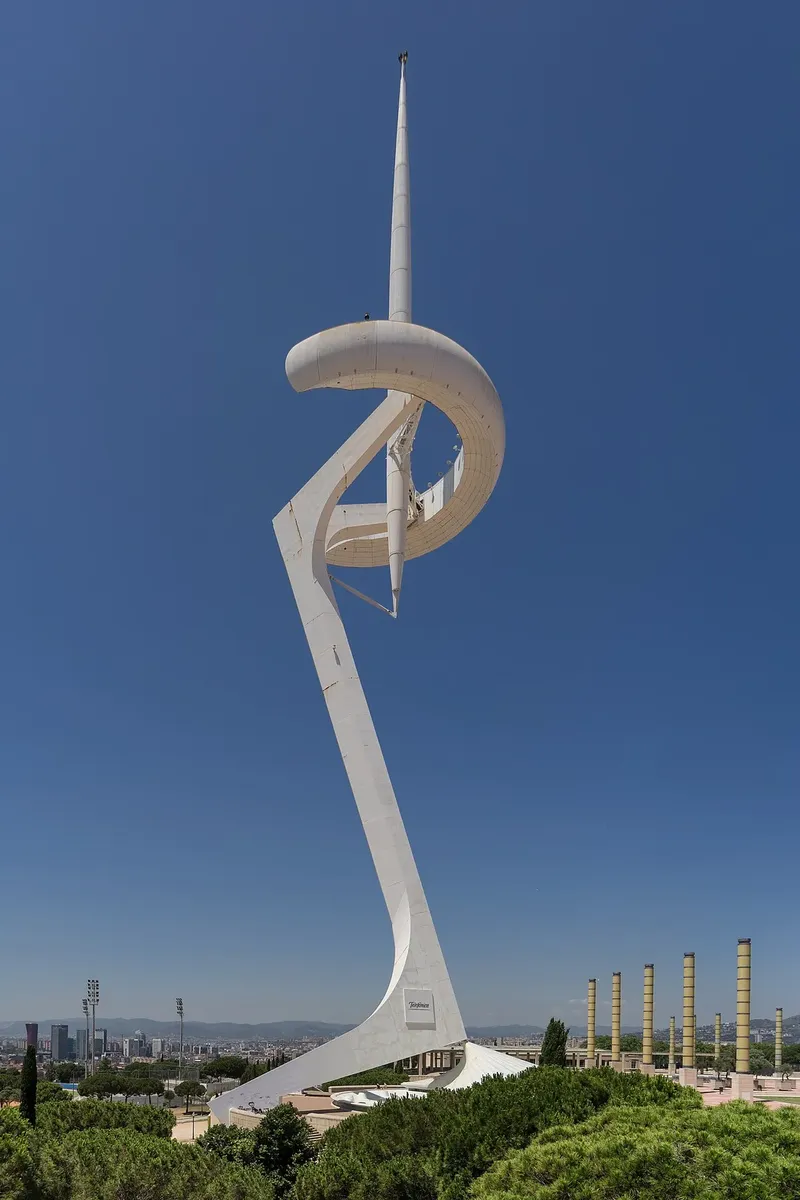
Photo: Thomas Ledl, CC BY-SA 4.0, via Wikimedia Commons (resized). Santiago Calatrava's steel tower rises 136 metres over the Olympic ring. Telefónica had it built between 1989 and 1992 for the Olympics, and people call it the Torre Calatrava. Its outline recalls an athlete bending down to collect a medal. Look at the base, covered in trencadís, a mosaic of broken tiles.
More history
The tower does not rest on a vertical trunk. The shadow of its central needle falls across Plaça d'Europa, so it works as a sundial. Higher up, a circular platform carries the dishes that transmit data. It has also been called the Torre Telefónica.
-
Palau Sant Jordi, the Olympic arena
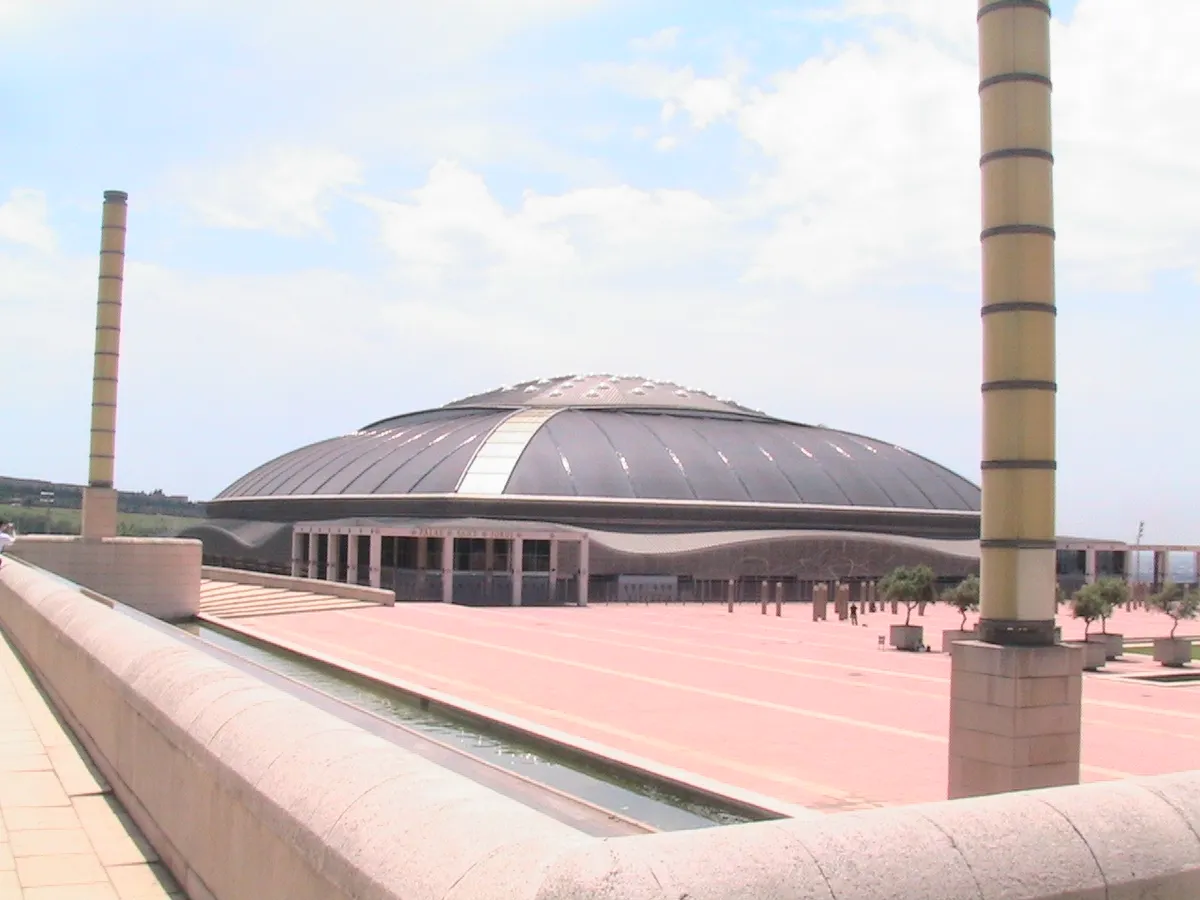
Photo: Hosiawak, CC BY 2.0, via Wikimedia Commons (resized). Arata Isozaki's arena was the main indoor hall of the 1992 Olympics. It held the artistic gymnastics and the handball and volleyball finals. It opened on 21 September 1990, and its first concert was Depeche Mode, on 5 November that year. Look at the dome: it was built with a method called Pantadome.
More history
It was first meant to go on the Montjuïc rubbish dump, but another site was chosen, and the first design, a wavy sheet-metal roof, was changed. The idea was that after the Games it would host big cultural and sporting events. Inside, 62 columns above the seating carry the dome. It holds 16,670 people for sport and up to 18,000 for concerts.
Source: Viquipèdia, Palau Sant Jordi.
-
Jardí Botànic, a garden on an old dump
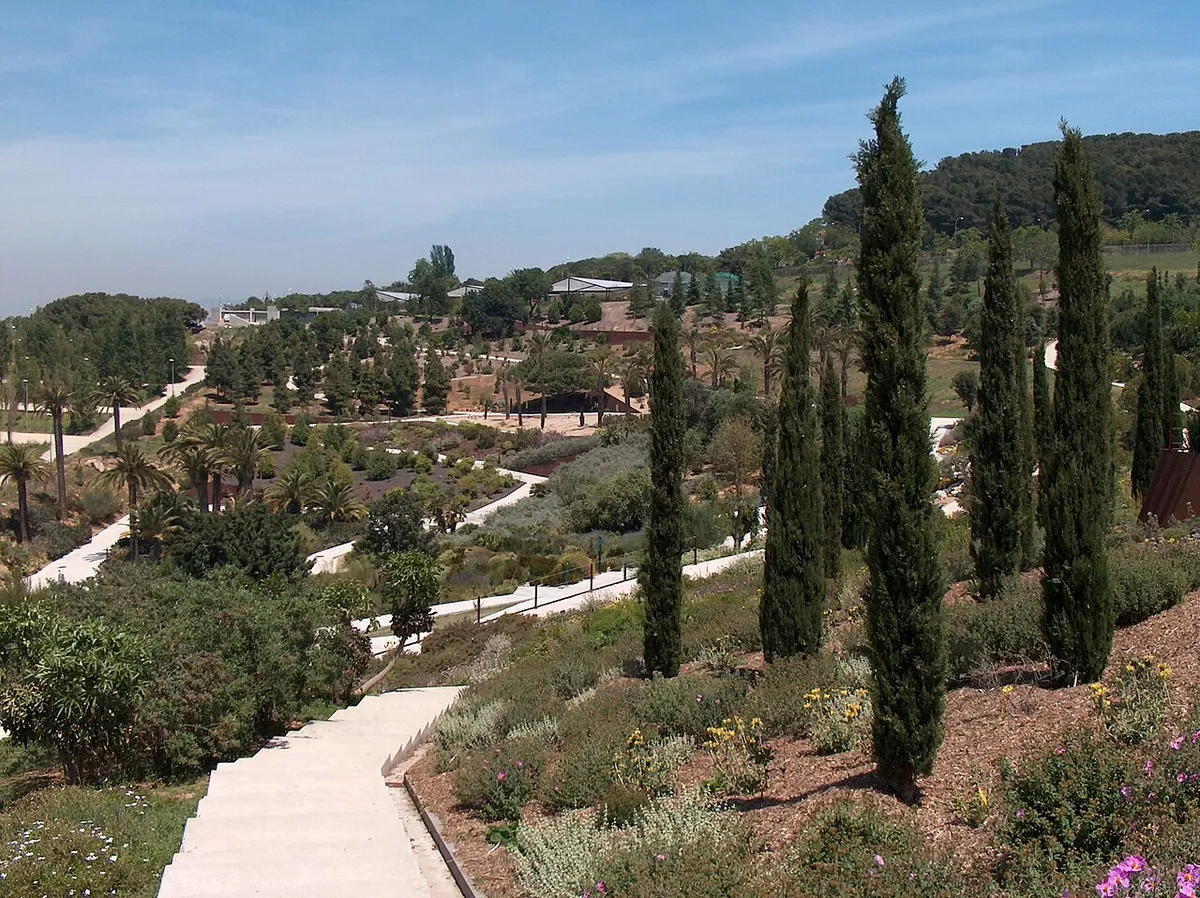
The garden in 2005. Photo: Valérie et Agnès, CC BY-SA 3.0, via Wikimedia Commons (resized). Follow Passeig Olímpic east to the Jardí Botànic de Barcelona. It opened on 18 April 1999, on land that had been a rubble dump in Montjuïc park. Its 14 hectares hold plants from the Mediterranean regions of the world, with paths leading from one area to the next.
More history
The Botanical Institute of Barcelona is older than the garden: it was founded in 1934, and in 2003 it moved into a modern building at the top of the garden. It is run jointly by the CSIC and the city council and studies Mediterranean plants. The city council also designed the garden. Among its plants is a Wollemia.
_Quatre_Columnes_(Four_Columns)_by_Josep_Puig_i_Cadafalch.jpg)


Practical details
- Terrain
- Uphill most of the way. You start at about 29 m above sea level at Plaça d'Espanya, reach about 103 m at the stadium and finish at about 109 m at the Botànic. The steepest part is the stairs from the fountain up to the Palau Nacional.
- Escalators and lifts
- OpenStreetMap maps outdoor escalators, up and down, beside the stairs from the fountain to the Palau Nacional and behind the Palau, plus two lifts at the Palau. Bus 150 from Plaça d'Espanya skips the climb.
- Water
- OpenStreetMap lists free city drinking fountains on Avinguda de la Reina Maria Cristina near the start, by the Font Màgica, and near the Calatrava tower.
- Toilets
- OpenStreetMap lists free public toilets near the pavilion, below the stadium and at the Botànic entrance, the first and last wheelchair accessible.
- Sit and eat
- OpenStreetMap lists Bar Plaça Carles Buïgas by the fountain, Les Cascades café on the climb, and La Terrassa del MNAC by the Palau Nacional.
- Tickets
- Free from outside. The pavilion, Poble Espanyol, MNAC and Botànic charge for entry: check their sites.
- When to go
- The stairs and the Olympic ring are open, so on hot days go early or late. For Font Màgica show times, check the city's page.
- Getting back
- Bus 13 from the Estadi Olímpic stop, 400 m back along Passeig Olímpic, runs down to the Mercat de Sant Antoni. The funicular from Parc de Montjuïc (1.1 km) goes down to Paral·lel metro. Or walk down to Plaça d'Espanya, 1.9 km.
Walking distances and times from the OSRM foot router on OpenStreetMap data; the router ignores the climb, so we added time for it. Elevations from Open-Meteo. Escalators, lifts, buses, the funicular, fountains, toilets and cafés from OpenStreetMap. Checked 22 September 2026.
Montjuïc walking route: questions
How long is the Montjuïc walking route?
4.7 km one way, from Plaça d'Espanya to the Jardí Botànic: about an hour of walking, most of it uphill. With eight stops, allow 2 to 2½ hours.
How long does it take to walk up Montjuïc?
From Plaça d'Espanya it is about 1.4 km to the Olympic stadium, a climb of roughly 75 m. We would allow 25 to 30 minutes at an easy pace without stops; escalators help on the stairs up to the Palau Nacional.
Should I walk up or down Montjuïc?
Walk up, as this route does: the climb comes early and there are escalators on the steepest part. To come down, walk back to Plaça d'Espanya (about 1.9 km), take bus 13 from the Estadi Olímpic stop, or take the funicular from Parc de Montjuïc to Paral·lel.
Is there a Montjuïc walking tour map?
Yes. The map above shows the route from Plaça d'Espanya and the eight numbered stops in walking order. Use the “Print this walk” button to print it or save it as a PDF.
Is Montjuïc worth it?
Yes, if you want to see two world events in one walk: the fountain, palace, pavilion and village built for the 1929 International Exhibition, then the stadium, arena and tower of the 1992 Olympics. You can see all of them from outside for free.
Walk it with Strolio
Open Strolio at Plaça d'Espanya and ask for a two-hour walk up Montjuïc. Stories play as you reach each place, and you can ask about anything else you pass, by voice or with a photo. This is one example: you can also start from your own street and choose your own time and interests.
More walks in Barcelona
- Gaudí and Modernisme on foot: Puig i Cadafalch, who designed the Four Columns and the Casaramona factory, also remodelled Casa Amatller on that walk.
- The Gothic Quarter and El Born: the medieval old town, where Santa Maria del Mar was built with stone from Montjuïc.
- El Born, from the 1714 graveyard to the Ciutadella: a 75-minute walk through La Ribera to the park of the 1888 Exhibition.
- Gràcia's village squares: a one-hour walk through the town that joined Barcelona in 1897.
- Hometown walks: shorter walks through Barcelona's neighbourhoods, from Horta to Poblenou.
Sources
- Viquipèdia: Font Màgica de Montjuïc, Les Quatre Columnes, Pavelló Mies van der Rohe, Poble Espanyol de Barcelona, Palau Nacional (Barcelona), Estadi Olímpic Lluís Companys, Torre de Comunicacions de Montjuïc, Palau Sant Jordi
- Wikipedia (es): Museo Nacional de Arte de Cataluña, Jardín botánico de Barcelona
- Fundació "la Caixa": Barcelona recupera una de les obres mestres del modernisme industrial (25/02/2002)
- Official sites (tickets and opening hours): Fundació Mies van der Rohe, Poble Espanyol, MNAC, Estadi Olímpic, Jardí Botànic, Magic Fountain (Barcelona City Council)
- Map data, escalators, transport and places: © OpenStreetMap contributors, ODbL
- Elevations: Open-Meteo
- Photos: Wikimedia Commons contributors Didier Descouens, Ashley Pomeroy, Pere prlpz, Juanedc, Amadalvarez, Thomas Ledl, Hosiawak and Valérie et Agnès, credited under each photo