
Literary Dublin self-guided walking tour · 1 hour 40 minutes · map
Literary Dublin on foot: Joyce, Yeats, Beckett and the writers' city
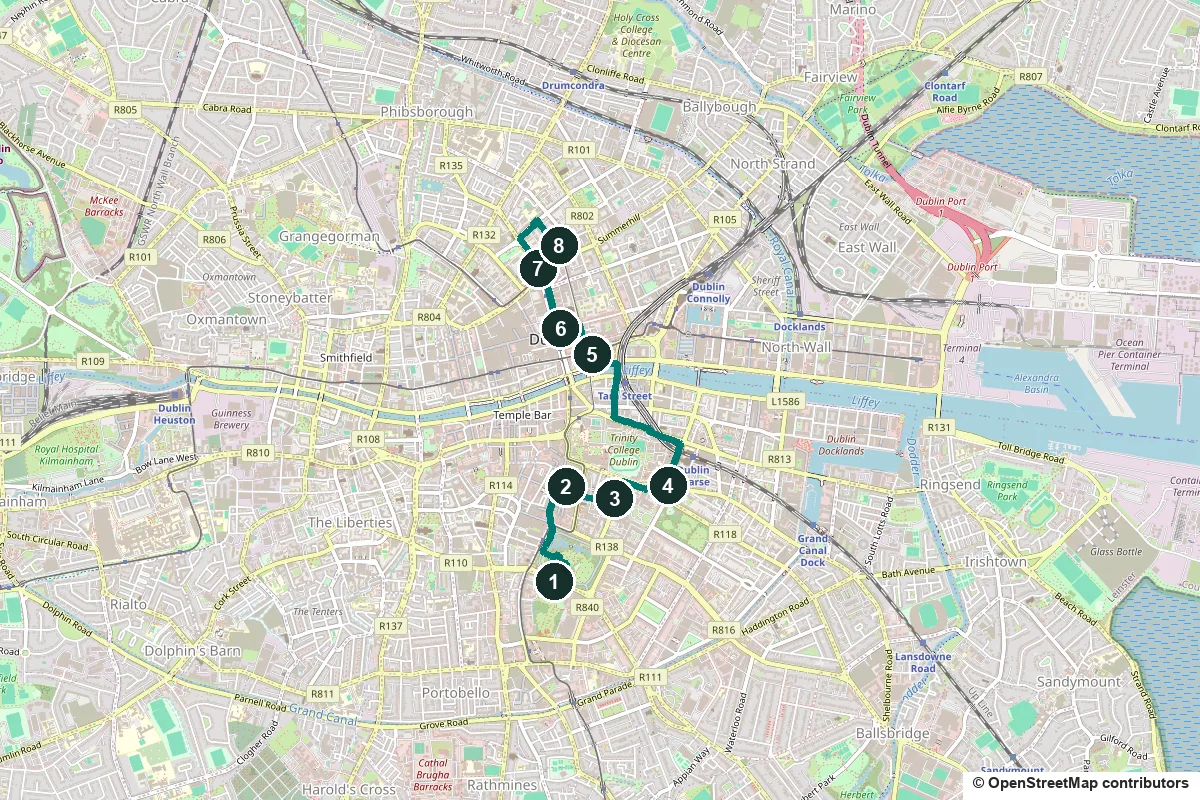
This walk links the places where Dublin's writers studied, drank, read and staged their plays, from a literature museum on St Stephen's Green, across the Liffey, to a Georgian house given over to James Joyce. Three of the stops are settings in Ulysses.
In 2010 Dublin became the fourth UNESCO City of Literature in the world. The city claims four Nobel Prize-winning writers: W. B. Yeats, George Bernard Shaw, Samuel Beckett and Seamus Heaney. But the writer you meet most on these streets is James Joyce. Ulysses follows three Dubliners, among them Leopold Bloom and Stephen Dedalus, through a single day, 16 June 1904, and fans still retrace their steps every 16 June. On this route you pass Bloom's chemist, his lunchtime pub and the library where Stephen argues about Shakespeare. You also see the theatre Yeats co-founded, the stage that put on all of Beckett's stage plays in one festival, and Joyce's old school.
A note on accuracy: some of these places are scenes in a novel, not in history, and one literary museum on the route has closed for good. Where that is the case, we say so, and every fact links to its source. Trinity College, Merrion Square's Oscar Wilde statue and Temple Bar are on our Dublin historic centre walk, so they are not repeated here.
- Start
- Museum of Literature Ireland (MoLI), 86 St Stephen's Green South, about 2 minutes from the St Stephen's Green Luas stop
- Finish
- James Joyce Centre, 35 North Great George's Street
- Distance
- 4.2 km, one way
- Time
- About 1 hour 40 minutes: 56 min walking and 8 stops, plus any museum visits
Terrain, water, opening days and a shorter version ↓
What to see: the stops
-
MoLI at Newman House, and Joyce and Yeats in the Green
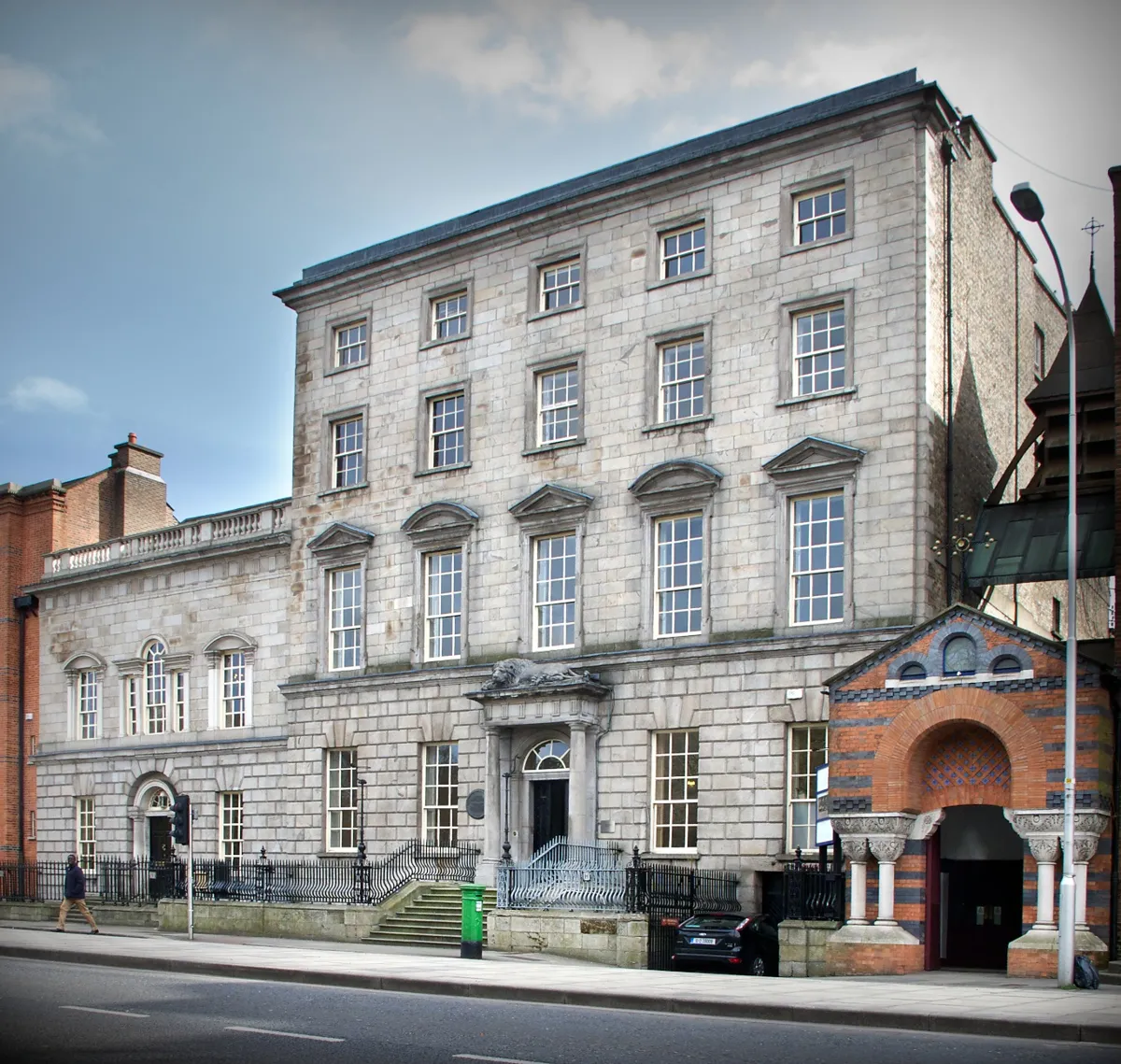
Newman House, home of MoLI. Photo: Michael Foley, CC BY 2.0, via Wikimedia Commons (resized). Start outside numbers 85 and 86 on the south side of St Stephen's Green. Number 85, built in 1738 to Richard Castle's design, was the first stone-fronted house on the Green; number 86 followed around 1765. In 1854 they became home to the Catholic University of Ireland, with John Henry Newman as rector; it was the forerunner of University College Dublin. A plaque records that the poet Gerard Manley Hopkins taught Greek here and that Joyce was a student. Since September 2019 the houses have held the Museum of Literature Ireland, run by UCD and the National Library. Its name, MoLI, is a nod to Molly Bloom. Its best-known treasure is Joyce's "Copy No. 1" of Ulysses. Tickets start at €16.50. Then cross into the park: just inside, Marjorie FitzGibbon's bronze bust of Joyce faces his old college. It is dated 1982, and its plinth quotes him: "Crossing Stephen's, that is, my green". Walk north to the Yeats memorial, Henry Moore's bronze Knife Edge, set up in 1967 among stepped stone terraces.
More history
With plasterwork by the Swiss Lafranchini brothers, number 85 has some of the finest 18th-century interiors in Ireland. Number 86 was built for Richard Chapel Whaley, whom the heritage record calls a notorious rake and gambler. Joyce's copy of Ulysses is inscribed to his patron, Harriet Weaver. The Yeats memorial is the only abstract figure among the Green's many monuments, and it stands where glasshouses once were.
Sources: NIAH, Newman House 85; NIAH, Newman House 86; NIAH, James Joyce memorial; NIAH, W. B. Yeats memorial; Wikipedia, Museum of Literature Ireland. Visiting: tickets and hours on MoLI's site.
-
Davy Byrne's, where Leopold Bloom had lunch
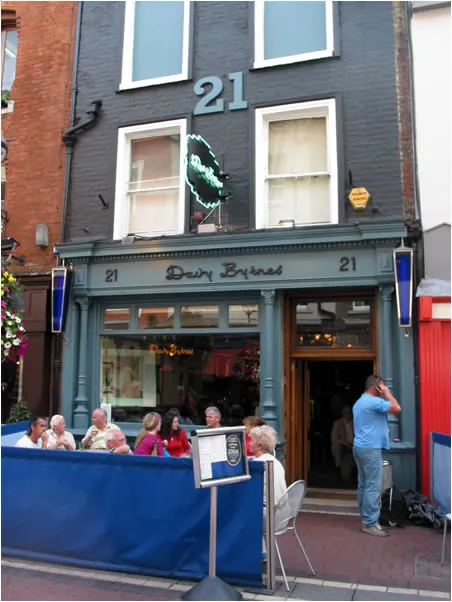
Davy Byrne's, 21 Duke Street. Photo: DanMS, CC BY-SA 3.0, via Wikimedia Commons. Keep north through the park and leave by the gate at the Grafton Street corner. Walk up Grafton Street and turn right into Duke Street; Davy Byrne's is number 21. Davy Byrne, from County Wicklow, bought the pub in 1889 and ran it until 1939. In chapter 8 of Ulysses, "Lestrygonians", Joyce calls it a "moral pub". Bloom stops in just before 2 pm and eats a gorgonzola cheese sandwich with mustard and a glass of burgundy. Readers have copied his order ever since, above all on Bloomsday, 16 June. Joyce also sends the clerk Farrington here in "Counterparts", a story in Dubliners. Later regulars included Flann O'Brien, Patrick Kavanagh and Brendan Behan. Across the street, the Bailey is where the 1954 Bloomsday pilgrimage broke down in drink and arguments halfway round the route.
More history
Michael Collins and Arthur Griffith held meetings upstairs. The pub was refitted in 1941, and the Doran family owned it for three generations from 1942. Inside are murals by Cecil Salkeld, Brendan Behan's father-in-law.
Sources: Wikipedia, Davy Byrne's pub; Davy Byrne's, history; Wikipedia, Ulysses; Wikipedia, Bloomsday; Wikipedia, Duke Street.
-
The National Library of Ireland, Ulysses chapter 9
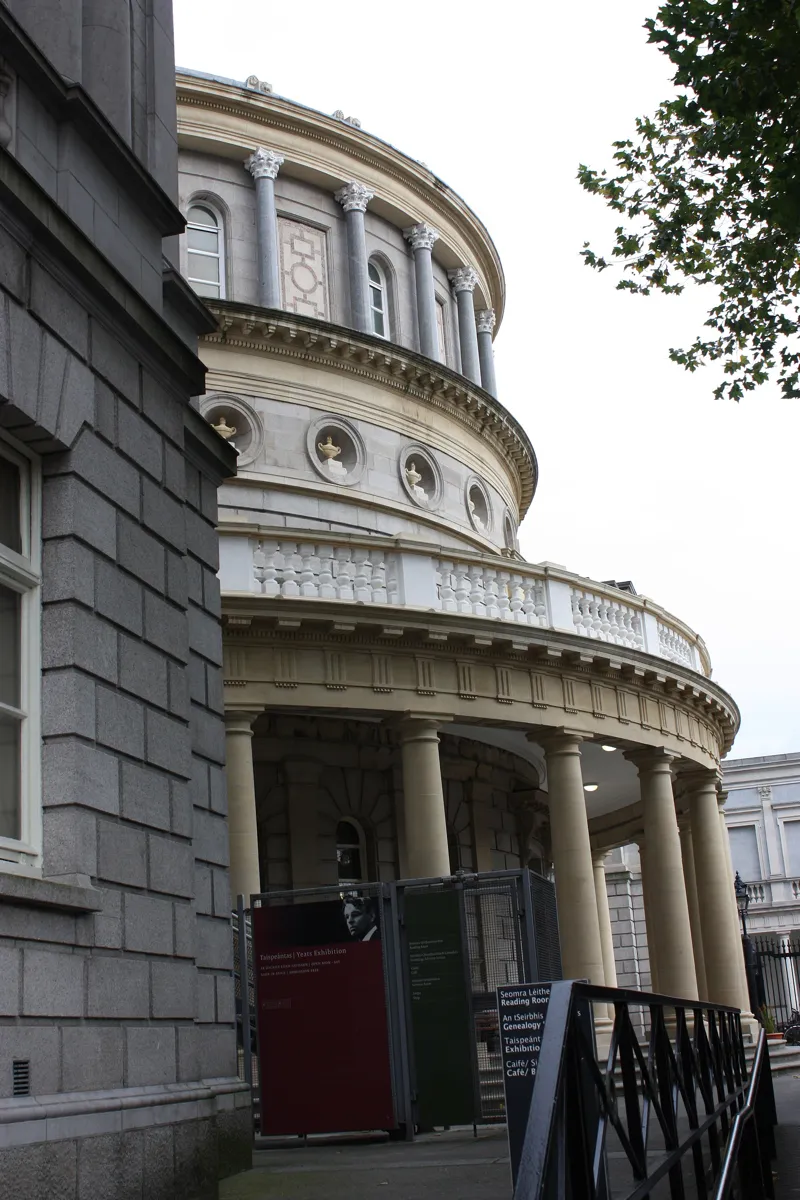
The library's rotunda entrance on Kildare Street. Photo: Ardfern, CC BY-SA 3.0, via Wikimedia Commons (resized). You are now on Bloom's own route: after lunch he heads for the National Museum, the library's twin on Kildare Street. Carry on along Duke Street, turn right on Dawson Street and almost at once left into Molesworth Street, then turn left at Kildare Street; the library is on your right, beside the gates of Leinster House. Thomas Newenham Deane and his son Thomas Manly Deane designed it, and it opened here in 1890. Chapter 9 of Ulysses, "Scylla and Charybdis", takes place inside: Stephen sets out his theory of Shakespeare and Hamlet to a group of scholars, and Bloom comes in to look up an old advertisement. The library's free exhibition Yeats: The Life and Works of William Butler Yeats shows manuscripts of "The Lake Isle of Innisfree" and "Easter, 1916" and his Nobel medal. The reading room is for card-holding readers, but a planned redevelopment will turn its balcony into a public viewing gallery.
More history
The library and its twin, the National Museum, which faces it across the front of Leinster House, went up in 1890 in Leinster granite with Donegal sandstone above. On the library, the sandstone crumbled in Dublin's polluted air and was replaced with Ardbraccan limestone in 1969.
Sources: NIAH, National Library of Ireland; NLI, A brief architectural tour; Wikipedia, National Library of Ireland; Wikipedia, Ulysses; NLI, Yeats exhibition; NLI, Reimagining the National Library. Visiting: NLI opening hours.
-
Sweny's Pharmacy, and Beckett on Clare Street
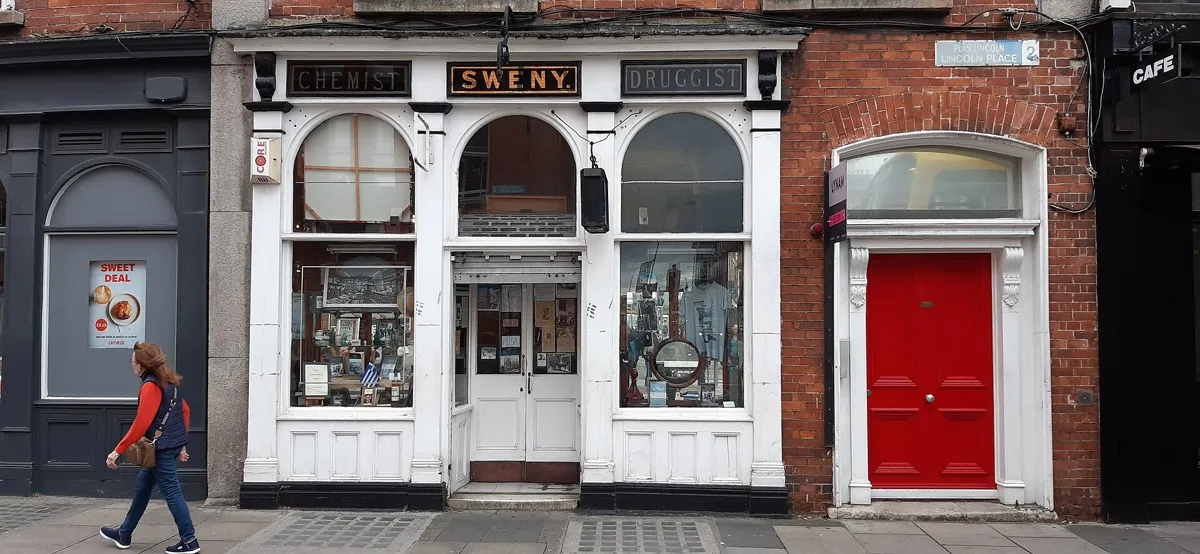
Sweny's on Lincoln Place. Photo: Ridiculopathy, CC0, via Wikimedia Commons. Walk north up Kildare Street and turn right into Leinster Street South. Where Clare Street carries straight on, Samuel Beckett lived on the top floor of number 6, a few doors along, above his father's firm, and wrote More Pricks Than Kicks. Bear left into Lincoln Place; Sweny's is number 1, facing Westland Row. The Sweny family lived and kept a chemist's shop here from the mid-19th century. In chapter 5 of Ulysses, "Lotus Eaters", Bloom buys a bar of lemon soap here while he waits for a prescription. In the 1990s a Dublin Tourism brochure noted that the shop was still fitted out as it was in 1904. It no longer sells medicine: it is now a bookshop and Joyce centre with group readings of his books, and you can still buy the lemon soap.
More history
In 1862 Mark Sweny, a doctor, worked from the house. Lincoln Place then had Turkish baths and an eye hospital, and the chemist would have supplied the people who used them. The heritage record praises the gold lettering, the red brick and the granite corners.
Sources: NIAH, Sweny; Wikipedia, Sweny's Pharmacy; Wikipedia, Ulysses; Wikipedia, Clare Street. Readings: Sweny's site.
-
The Abbey Theatre, founded by Yeats and Lady Gregory
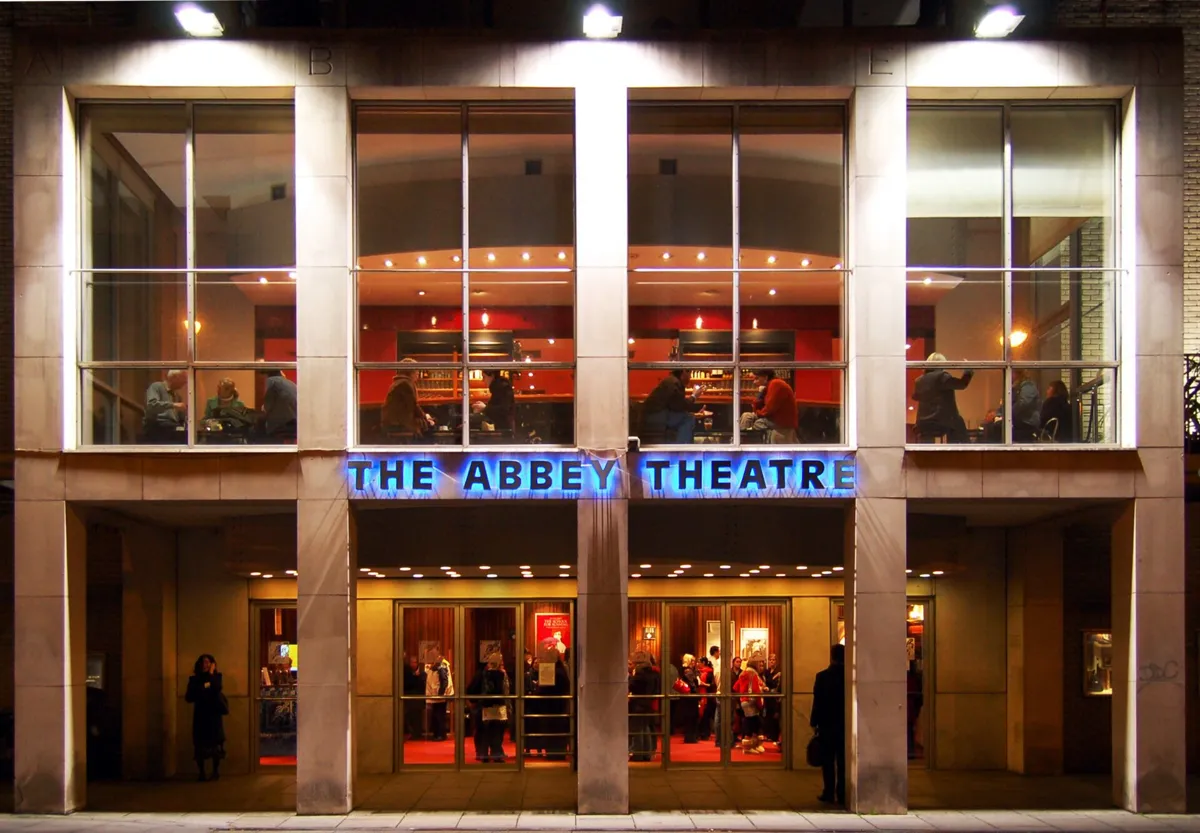
The Abbey on Lower Abbey Street. Photo: Flickr user bjaglin, CC BY 2.0, via Wikimedia Commons (resized). Walk up Westland Row past Pearse station; in chapter 5 Bloom collects a secret love letter at the post office on this street. Turn left along Pearse Street, right up Tara Street and cross the Liffey by Butt Bridge; Joyce set chapter 16 in a cabman's shelter near this bridge. On the far side, turn left along Eden Quay, right up Marlborough Street and right into Lower Abbey Street. Yeats and Lady Gregory founded the Abbey as Ireland's national theatre. With money from Annie Horniman, the old Mechanics' Institute here and a building on Marlborough Street were converted, and it opened on 27 December 1904 with new plays by Yeats and Gregory. In 1907 J. M. Synge's The Playboy of the Western World started riots in the audience. In 1926 the crowd rioted at Seán O'Casey's The Plough and the Stars, and Yeats told them from the stage: "You have disgraced yourselves again." The building you see is not the original. Fire damaged the old theatre in 1951, and this one, by Michael Scott & Associates, opened on 18 July 1966.
More history
The first theatre's main entrance was through a building that had been the city morgue, which shocked some theatregoers. From 1925 the Abbey received a yearly grant from the Irish Free State, making it the first state-subsidised theatre in the English-speaking world.
Sources: Abbey Theatre, history; Wikipedia, Abbey Theatre; Wikipedia, Ulysses.
-
The James Joyce statue on North Earl Street
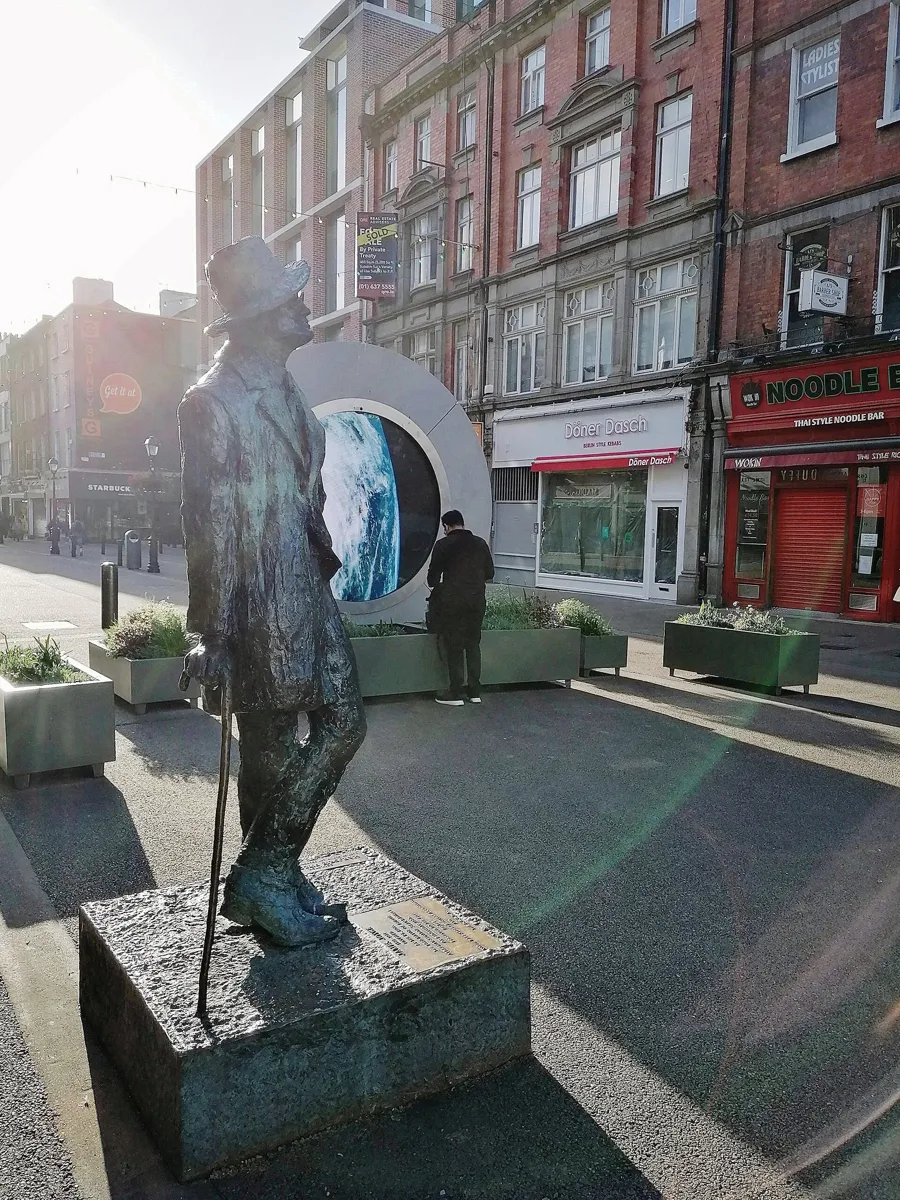
Joyce on North Earl Street. Photo: Karlunun, CC0, via Wikimedia Commons. Go back to Marlborough Street, walk north and turn left into North Earl Street. Near its O'Connell Street end stands Joyce in bronze, hat on, leaning on his cane. Marjorie FitzGibbon, who also made the bust you saw in St Stephen's Green, sculpted it. The Dublin City Centre Business Association commissioned it, and it was unveiled on 16 June 1990, Bloomsday. Dubliners nicknamed it "the prick with the stick". The street was pedestrianised in 1980. It was badly damaged in the 1916 Rising, and much of it was rebuilt from 1917.
More history
FitzGibbon, born in Reno, Nevada, was an actress before she took up sculpture in the late 1960s, encouraged by her friend Micheál MacLiammóir, a founder of the Gate Theatre, two stops on. She made many heads of Irish literary figures.
Sources: Wikipedia, North Earl Street; Wikipedia, Marjorie FitzGibbon.
-
The Gate Theatre and Parnell Square
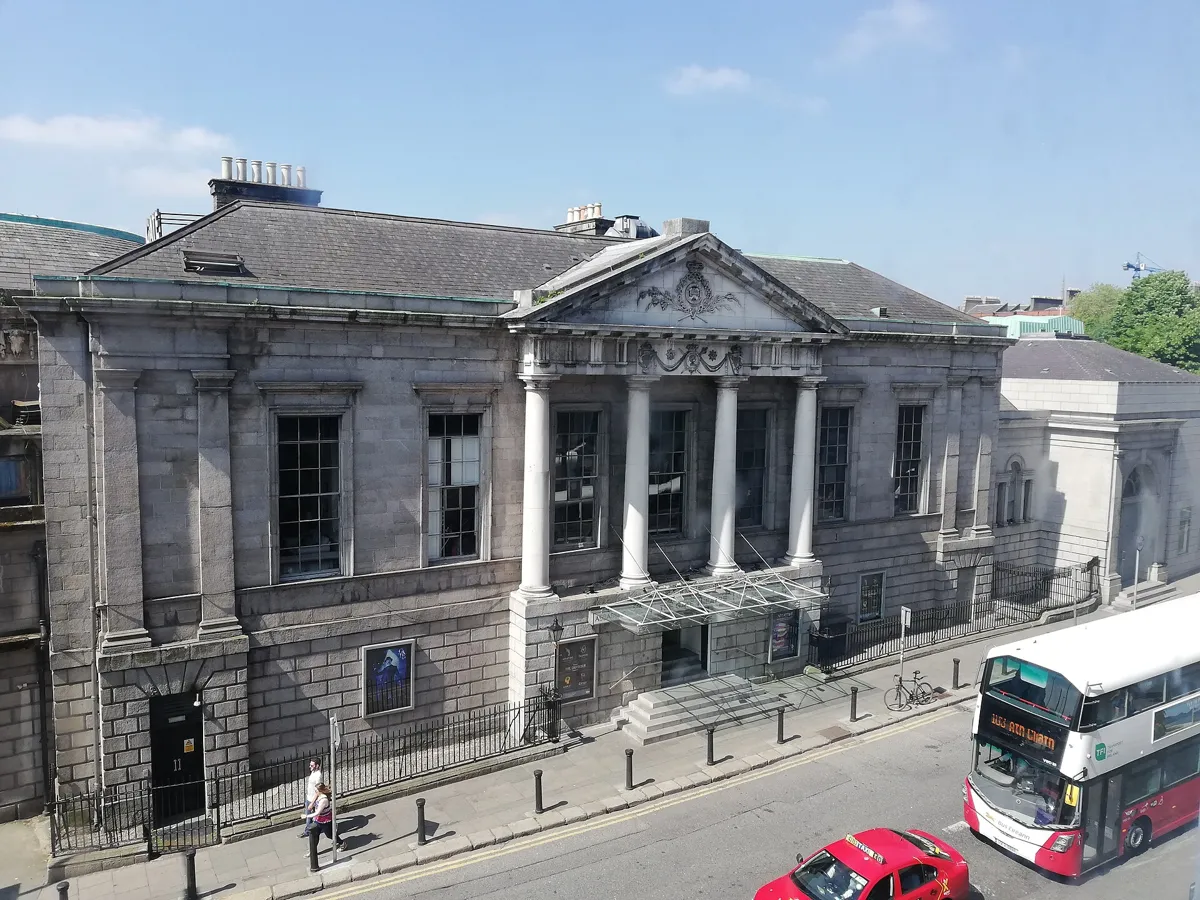
The Gate on Cavendish Row. Photo: Danny Wilson, CC BY-SA 4.0, via Wikimedia Commons (resized). Walk on to O'Connell Street, turn right and follow it north to the top, where it becomes Cavendish Row; the Gate is on your left. Hilton Edwards and Micheál MacLiammóir founded the company in 1928, bringing European and American plays to Dublin, and staged Wilde's Salomé in their first season. After two seasons in the Abbey's Peacock Theatre, they moved into this building, the Upper Concert Hall of the Rotunda's 18th-century annex, built in 1784–86 as part of the New Assembly Rooms. Orson Welles and Michael Gambon started their acting careers at the Gate. This is the Beckett stop: in 1991 the Gate staged all nineteen of Samuel Beckett's stage plays over three weeks, a festival later repeated in London and New York.
More history
At the top of the square, number 18 Parnell Square North was the Dublin Writers Museum, opened in November 1991 in two 18th-century buildings, partly decorated by the stuccodore Michael Stapleton. It showed Beckett's telephone, Joyce's typewriter and a first edition of Dracula. It closed for the pandemic in March 2020 and never reopened; in 2022 Fáilte Ireland, the tourism board, decided to close it for good.
Sources: Gate Theatre, about; Wikipedia, Gate Theatre; Wikipedia, Dublin Writers Museum.
-
Belvedere College and the James Joyce Centre
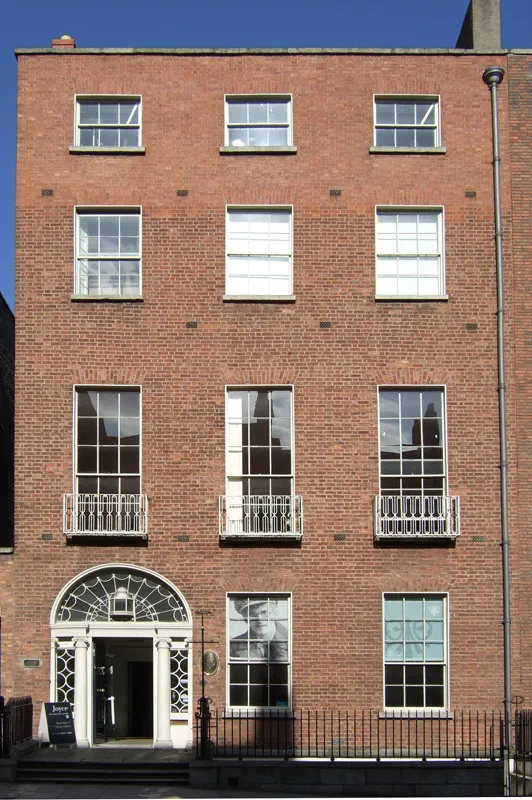
The James Joyce Centre, 35 North Great George's Street. Photo: Pointillist, public domain, via Wikimedia Commons. Continue up Cavendish Row and Parnell Square East, and turn right into Great Denmark Street. On your left is Belvedere College, the Jesuit school Joyce attended without fees from 1893; it is a setting in A Portrait of the Artist as a Young Man. Belvedere House closes the top of North Great George's Street, so turn right and walk down its slope of red-brick Georgian houses to number 35. It was built in 1784 as the town house of the Earl of Kenmare. At the end of the 19th century a dancing master named Maginn ran an academy here as "Mr Denis J Maginni, Professor of Dancing &c", and Joyce put him in Ulysses. By 1982 the council had pulled down twelve houses on the street, including the one next door. Campaigners led by Senator David Norris saved this one, and the James Joyce Centre opened here in June 1996. In the courtyard is the real front door of 7 Eccles Street, the Blooms' address; the house was demolished in 1982. Adult admission is €7, and the centre opens Tuesday to Saturday.
More history
The keys were handed over on 16 June 1982, Bloomsday in Joyce's centenary year. The courtyard murals of the eighteen episodes of Ulysses are by Paul Joyce, the writer's great-grandnephew. In 1967 John Ryan, one of the organisers of the 1954 Bloomsday pilgrimage, had fitted the Eccles Street door in his pub, the Bailey on Duke Street. Since 1994 the centre has run the Bloomsday Festival for the city.
Sources: James Joyce Centre, about; James Joyce Centre, visit; Wikipedia, James Joyce Centre; Wikipedia, Belvedere College; Wikipedia, James Joyce; Wikipedia, North Great George's Street; Wikipedia, Bloomsday. Visiting: tickets and tours.


Practical details
- Terrain
- Nearly flat: Open-Meteo puts every stop between about 10 and 20 m above sea level. The main slope is North Great George's Street, which you walk down at the end.
- Step-free
- The Yeats memorial sits in a sunken garden of stone terraces; OpenStreetMap maps flights of 10 and 15 steps there, so view it from the edge if you need to. Newman House's front doors are up granite steps, though MoLI's conversion added a lift; check access with MoLI and the James Joyce Centre before you go. The Gate has a wheelchair lift at the back. OpenStreetMap marks the St Stephen's Green and Parnell Luas stops as wheelchair accessible.
- Water
- OpenStreetMap maps no outdoor drinking fountains on the route. Bring water.
- Toilets
- OpenStreetMap shows public toilets in St Stephen's Green near the Grafton Street gate, but the park's own website does not list them or their hours. Otherwise, plan on a café or museum.
- Sit and eat
- MoLI's Commons Café is in Newman House's old student dining halls, and its Readers Garden can also be reached from the Iveagh Gardens. Davy Byrne's serves pub food.
- When to go
- Tuesday to Saturday, when everything is open. MoLI opens daily, 10:00 to 17:00 (last entry 16:00), except 17 March, 24–26 December and 1 January. The James Joyce Centre opens Tuesday to Saturday, 10:30 to 16:30. The library's Yeats exhibition opens daily, but industrial action closed the Kildare Street buildings on 3 October 2026 and more closures may come at short notice: check before you go. On 16 June, Bloomsday, the Joyce stops are at their busiest.
- Shorter walk
- Finish at stop 4, Sweny's: 1.6 km, about 40 minutes. Pearse station is on Westland Row, the street Sweny's faces.
- Getting back
- The Parnell Luas stop is about 130 m from the James Joyce Centre, and O'Connell Upper about 300 m.
Walking distances and times from the OSRM foot router on OpenStreetMap data. Elevations from Open-Meteo. Stations, fountains and toilets from OpenStreetMap; opening times and prices from MoLI, the National Library and the James Joyce Centre. Checked 4 October 2026.
Questions people ask
How long does a self-guided literary walking tour of Dublin take?
This one takes about 1 hour 40 minutes: 4.2 km, 56 minutes of walking and eight stops, from the Museum of Literature Ireland on St Stephen's Green to the James Joyce Centre on North Great George's Street. Add time for any museum. The map is on this page, and you can print it or save it as a PDF.
Where are the Ulysses locations in Dublin?
Many are in the city centre. On this walk you pass Sweny's Pharmacy on Lincoln Place and the Westland Row post office (episode 5), Davy Byrne's pub on Duke Street (episode 8), the National Library on Kildare Street (episode 9) and Butt Bridge, near which Joyce set the cabman's shelter of episode 16. The front door of 7 Eccles Street, Leopold and Molly Bloom's address, is kept at the James Joyce Centre.
What is Bloomsday?
Bloomsday is 16 June, the day on which Ulysses is set, in 1904. It is named after the novel's hero, Leopold Bloom. On the 50th anniversary, in 1954, a group of writers set out on a day-long pilgrimage along the book's route. Since 1994 the James Joyce Centre has run a Bloomsday Festival in the week of 16 June, with readings, performances and people in Edwardian dress; Davy Byrne's serves Bloom's gorgonzola sandwich and glass of burgundy.
Is Dublin a UNESCO City of Literature?
Yes. Dublin became the fourth UNESCO City of Literature in the world in 2010. Dublin City Libraries runs the programme for Dublin City Council. The city counts four Nobel Prize-winning writers: W. B. Yeats, George Bernard Shaw, Samuel Beckett and Seamus Heaney.
Where is the James Joyce statue in Dublin?
On North Earl Street, a pedestrian street that runs off O'Connell Street beside the Spire. The bronze, by Marjorie FitzGibbon, was unveiled on 16 June 1990. The same sculptor made the 1982 bust of Joyce in St Stephen's Green, which faces Newman House, where he studied.
Walk it with Strolio
Open Strolio on St Stephen's Green and ask for a literary walk through Dublin. Strolio builds walks in any city with mapped streets, so its route may pick different stops from this page. Stories play as you reach each place, and you can ask about anything else you pass, by voice or with a photo. You can also start from your hotel and choose your own time and interests.
More walks in Dublin
- Georgian and medieval: ~90 min, 8 stops. Oscar Wilde's square, the Book of Kells, the old Parliament, Temple Bar and both medieval cathedrals.
- O'Connell Street and the 1916 Rising: ~1 h, 8 stops. The GPO, Moore Street and the 1916 Rising, from O'Connell Bridge to the Famine memorial.
- The Liberties to Kilmainham: ~90 min, 7 stops. Marsh's Library to the Guinness Storehouse and Kilmainham Gaol, through the old Liberties.
- All Dublin walks, with maps side by side.
- Walks in other cities.
Sources
- National Inventory of Architectural Heritage (Buildings of Ireland): the records for Newman House, the Joyce and Yeats memorials in St Stephen's Green, the National Library and Sweny's, linked under each stop. We used their facts and wrote our own text.
- Official sites: Museum of Literature Ireland, National Library of Ireland, Abbey Theatre, Gate Theatre, James Joyce Centre, Davy Byrne's, Sweny's Pharmacy, Dublin UNESCO City of Literature
- Wikipedia: Museum of Literature Ireland, Davy Byrne's pub, Duke Street, Ulysses, Bloomsday, National Library of Ireland, Sweny's Pharmacy, Clare Street, Abbey Theatre, North Earl Street, Marjorie FitzGibbon, Gate Theatre, Dublin Writers Museum, Belvedere College, James Joyce, James Joyce Centre, North Great George's Street
- Map data and places: © OpenStreetMap contributors, ODbL; walking route from the OSRM foot router run by FOSSGIS
- Elevations: Open-Meteo
- Photos: Wikimedia Commons contributors Michael Foley, DanMS, Ardfern, Ridiculopathy, bjaglin, Karlunun, Danny Wilson and Pointillist, credited under each photo