
Liberties self-guided walking tour · 90 minutes · map
The Liberties to Kilmainham on foot: Marsh's Library, the Guinness Storehouse and Kilmainham Gaol
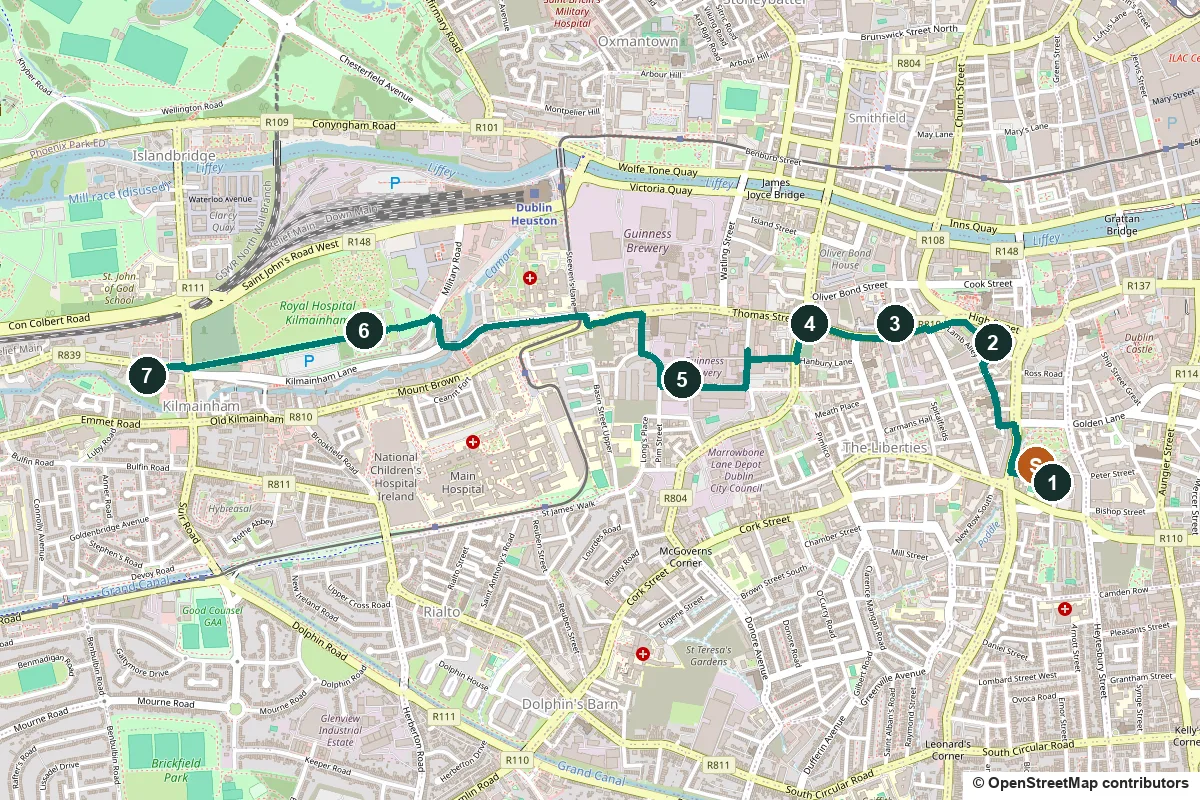
This walk starts at St Patrick's Cathedral and heads west through the Liberties, along Thomas Street to the Guinness brewery, and on to Kilmainham. On the way: Ireland's first public library, an old guildhall, two churches, the brewery, a 17th-century soldiers' hospital and the gaol where the leaders of the 1916 Rising were shot.
The Liberties take their name from medieval manors that were joined to the city but kept their own courts and rights. The two biggest were the Archbishop's Liberty of St Sepulchre, around St Patrick's, and the Liberty of Thomas Court and Donore, which belonged to the Abbey of St Thomas and later to the Earls of Meath. Their privileges ended in 1840. The area became known for weaving, brewing, distilling and markets, and later for poverty and tenements. Thomas Street, the spine of this walk, is named after that abbey.
A note on accuracy: some stops are rebuilt churches or the site of something older, and the Storehouse is a visitor centre, not the working brewery. Where a building is not the original, we say so, and every fact links to its source.
- Start
- St Patrick's Cathedral, St Patrick's Close
- Finish
- Kilmainham Gaol, Inchicore Road
- Distance
- 3.8 km, one way
- Time
- About 90 minutes: 51 min walking and 7 stops, plus any visits inside (allow about 90 minutes each for the Storehouse and the Gaol)
Terrain, water, opening days and a shorter version ↓
What to see: the stops
-
Marsh's Library, Ireland's first public library
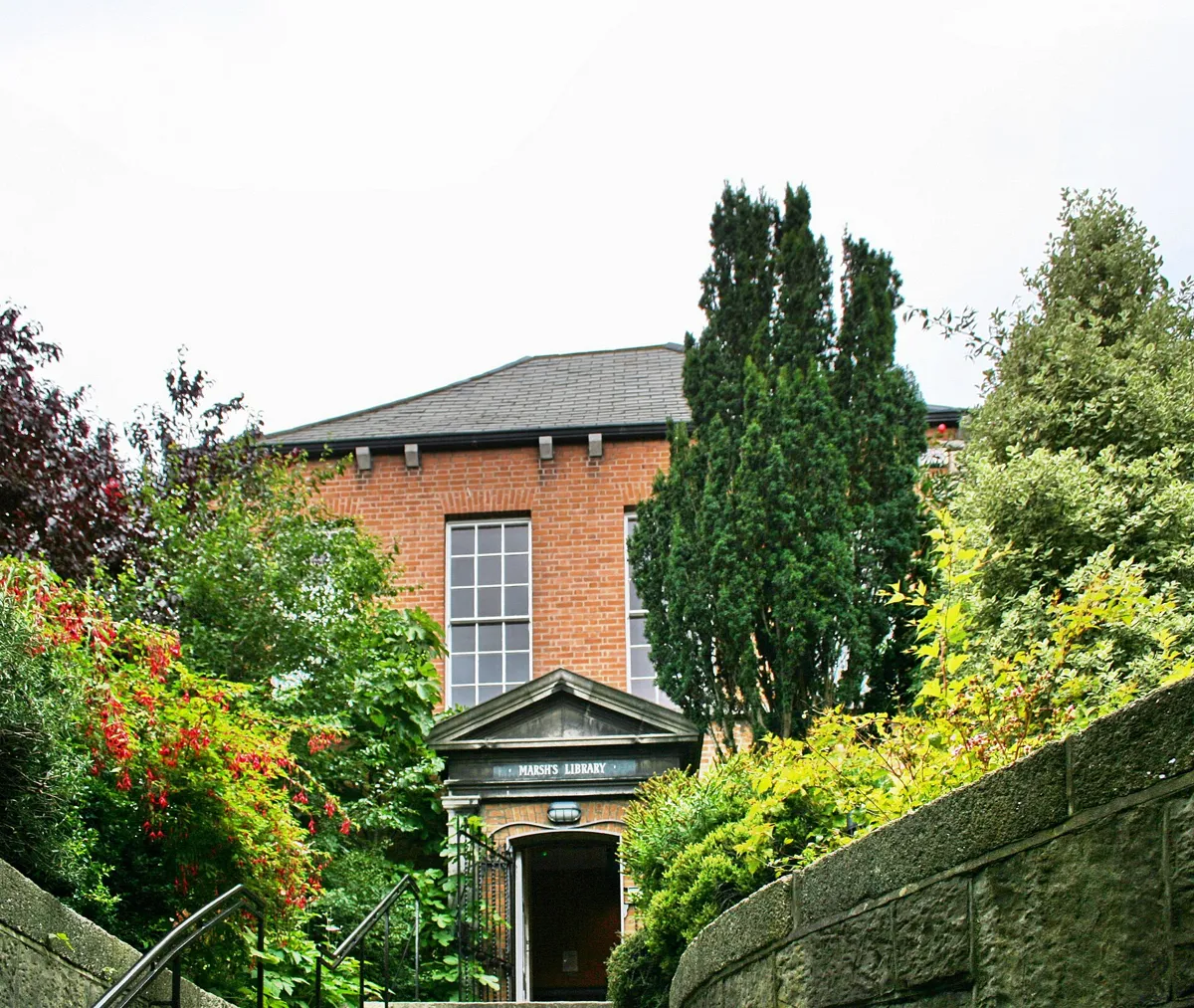
The library from the steps of its garden. Photo: Sitomon, CC BY-SA 2.0, via Wikimedia Commons (resized). Start at St Patrick's Cathedral, the last stop of our historic centre walk, and walk about 70 m along St Patrick's Close to the library gate. Narcissus Marsh, Archbishop of Dublin, built it in the garden of his palace beside the cathedral. Sir William Robinson, the Surveyor General, designed it, and the apartment promised to the first librarian was ready in December 1703. In 1707 an Act of the Irish Parliament set it up as a public library "forever". The library calls itself the first public library in Ireland: earlier libraries belonged to the university or to churches, while this one was for anyone who could read. The books still stand on their original oak shelves. At the end of the second gallery are three wired alcoves, the "cages", where readers were locked in after more than 1,000 books had gone missing by the mid-1760s. Jonathan Swift, then dean of St Patrick's, was one of the first governors. Bram Stoker read here in 1866, and James Joyce in 1902.
More history
The first librarian, Élie Bouhéreau, was a Huguenot refugee from La Rochelle. He had to put his own books in the library as a condition of the job. On Sunday 30 April 1916, at the end of the Easter Rising, a British machine gun in the Iveagh Buildings on Bull Alley fired on the library. It broke windows and damaged books, most of them Bouhéreau's.
Sources: Marsh's Library, history; Wikipedia, Marsh's Library. Visiting: the library's visit page.
-
Tailors' Hall, where the Back Lane Parliament met
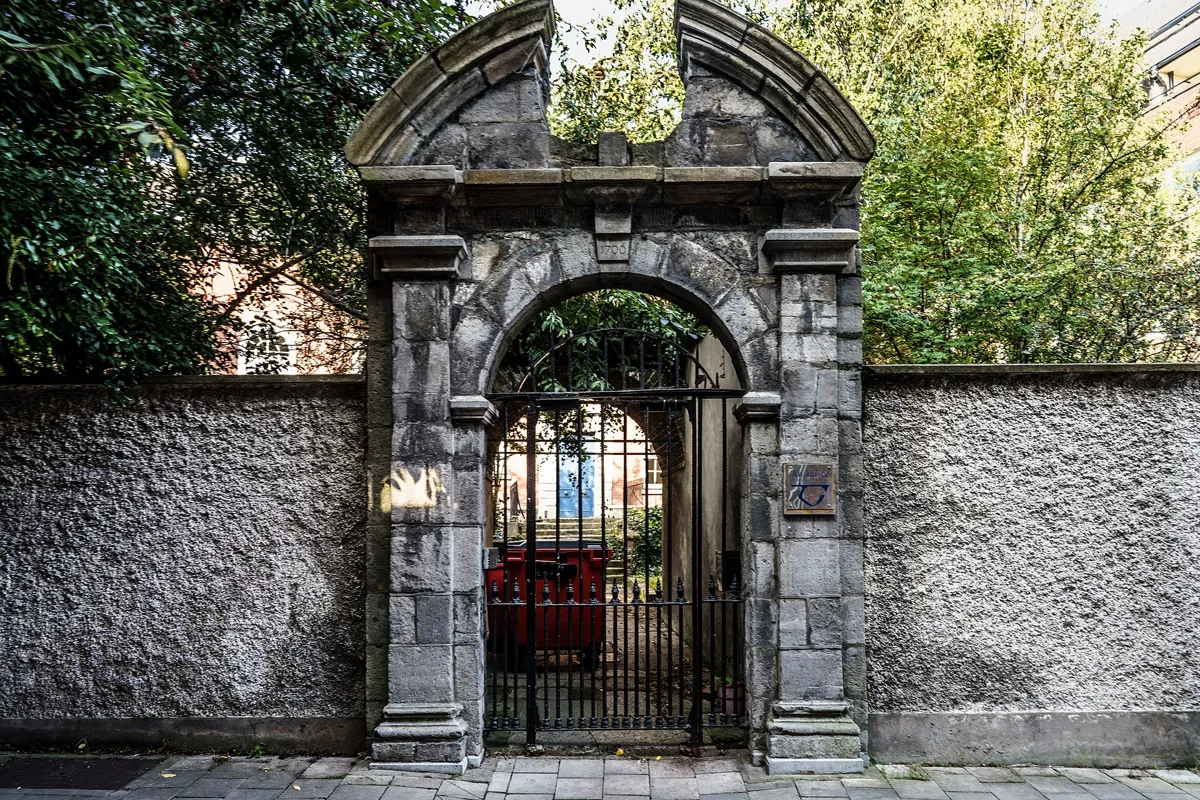
The gateway to Tailors' Hall on Back Lane. Photo: William Murphy, CC BY-SA 2.0, via Wikimedia Commons (resized). Follow St Patrick's Close out to Patrick Street and head north. Turn west along Hanover Lane, then north up John Dillon Street to Back Lane. The hall stands behind the stone gateway. The Tailors' Guild began it in 1703 on a site once used by a Jesuit chapel and college, and finished it in 1707. It is the oldest surviving guildhall in Dublin. In December 1792 the Catholic Convention met here, a gathering of delegates elected across Ireland that became known as the Back Lane Parliament. The Catholic Committee that organised it had Theobald Wolfe Tone as its assistant secretary. The delegates took a petition straight to King George III, and in 1793 a Catholic Relief Act lifted most of the remaining Penal Laws: Catholics could now vote on the same limited terms as Protestants, join the guilds and serve as army officers. By the mid-20th century the hall was derelict. The Irish Georgian Society began a campaign to save it in 1966, and it reopened on 17 April 1971. Since 1984 it has been the headquarters of An Taisce, Ireland's National Trust.
More history
The United Irishmen also met here. In 1798 the British Army took over the hall to house troops sent to put down that year's rebellion. A Christian mission to the Liberties used the building until 1949, when Dublin Corporation declared it unsafe.
Sources: Wikipedia, Tailors' Hall; Wikipedia, Catholic Committee.
-
John's Lane Church, the tallest steeple in Dublin
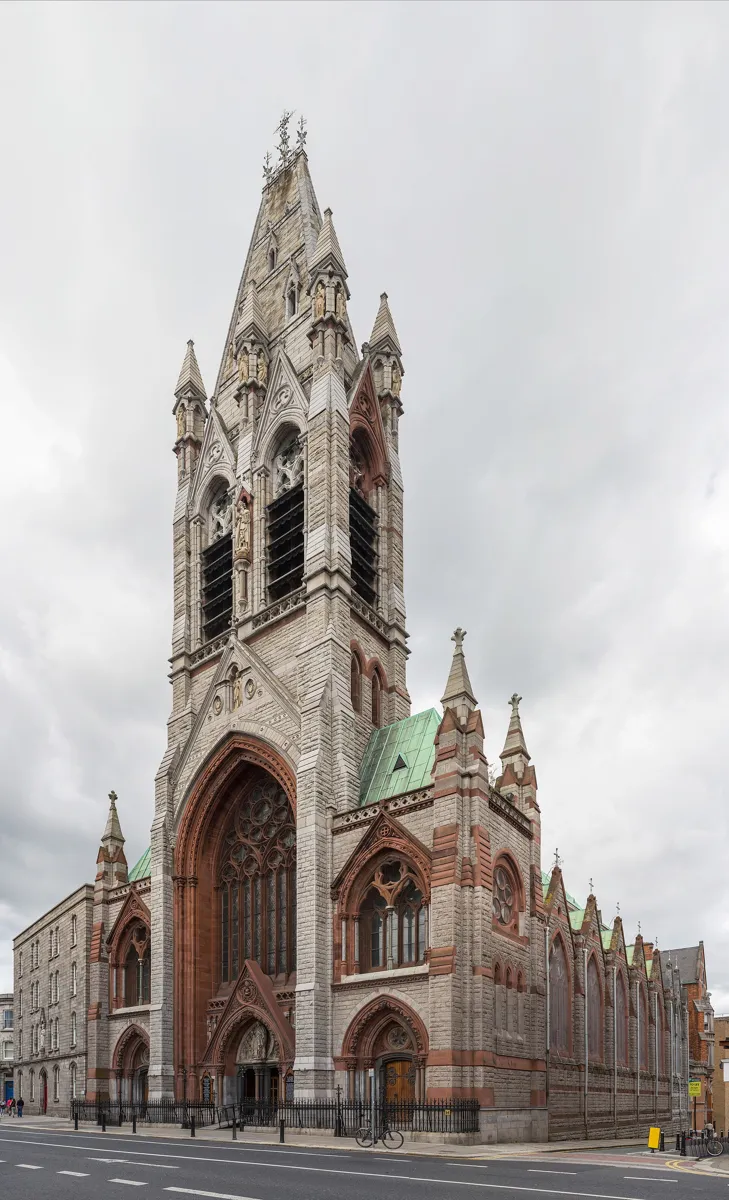
The church from Thomas Street. Photo: Diliff, CC BY-SA 3.0, via Wikimedia Commons (resized). Carry on west along Back Lane, follow the short path out to Francis Street and turn west onto Thomas Street. The church of St Augustine and St John is on your left. Around 1180 a Norman pilgrim, Aelred the Palmer, founded the Hospital of St John here, just outside the city's Newgate. In 1316, as Edward Bruce's army approached, Dubliners set fire to Thomas Street, and the flames burned the hospital church to the ground. The present church is by Edward Welby Pugin and George Ashlin. Building began at Easter 1862; it opened in 1874, but the outside was not finished until 1895 and the inside until 1911. Many of the workmen, including the foreman, were Fenians, so people called it "the Fenian Church". Its steeple, over 200 feet (61 m) high, is the tallest in the city. The twelve statues in the niches of the tower are by James Pearse, father of Patrick Pearse, whom you will meet again at Kilmainham.
More history
John Murphy of Dublin cast eight bells in 1872, first rung on St Patrick's Day 1873; two more were added in 1898. Inside, there are windows by the Harry Clarke studio and Michael Healy.
Sources: Wikipedia, John's Lane Church.
-
St Catherine's Church, where Robert Emmet was executed
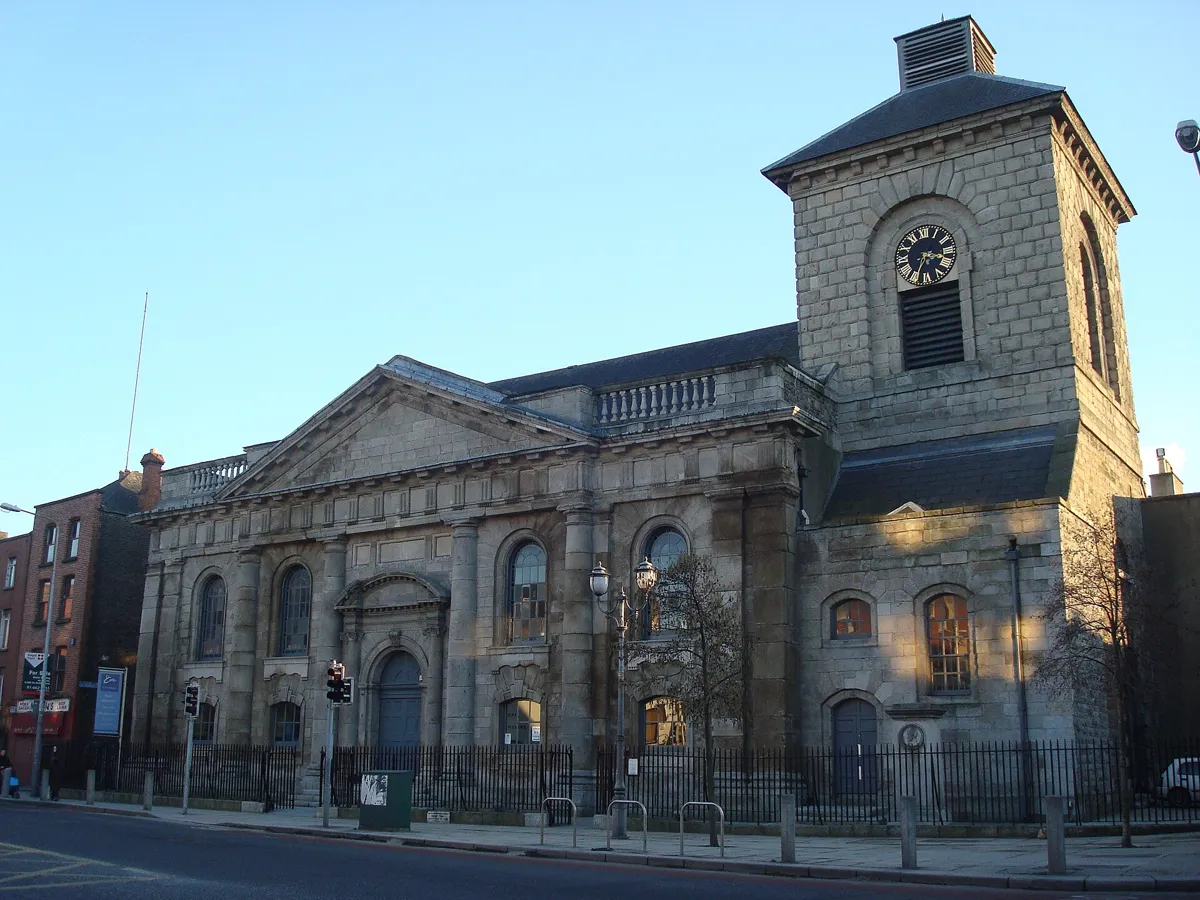
St Catherine's on Thomas Street. Photo: DubhEire, CC0, via Wikimedia Commons (resized). Keep west along Thomas Street for about 300 m; St Catherine's is on your left. A church was first built here in 1185, on the great road that led west out of Dublin. It began as a chapel of the Abbey of St Thomas the Martyr, founded in 1177 and dedicated to Thomas Becket, which gave the street its name. The church you see was built in 1760–69 to designs by John Smyth, for £7,000. The historian Maurice Craig called its granite front, with four Doric half-columns under a pediment, "the finest façade of any church in Dublin". A spire was planned but never built, for lack of money. In July 1803 Robert Emmet led a failed rising from an arms depot on this street. On 20 September 1803 he was hanged on Thomas Street in front of this church, then beheaded; a plaque remembers him. The church closed in 1966 as its congregation dwindled and was restored and reconsecrated in 1998.
More history
Emmet's speech from the dock ends with the famous line about his epitaph, which should not be written "till other times and other men" could do him justice. His body went first to Newgate Prison and then back to Kilmainham Gaol, with orders to bury it in Bully's Acre, the Royal Hospital's graveyard (stop 6), if no one claimed it. Family tradition says it was moved in 1804 to a family vault at St Peter's Church on Aungier Street, since demolished.
Sources: Wikipedia, St Catherine's Church; Wikipedia, Thomas Street; Wikipedia, Robert Emmet.
-
The Guinness Storehouse and the 9,000-year lease
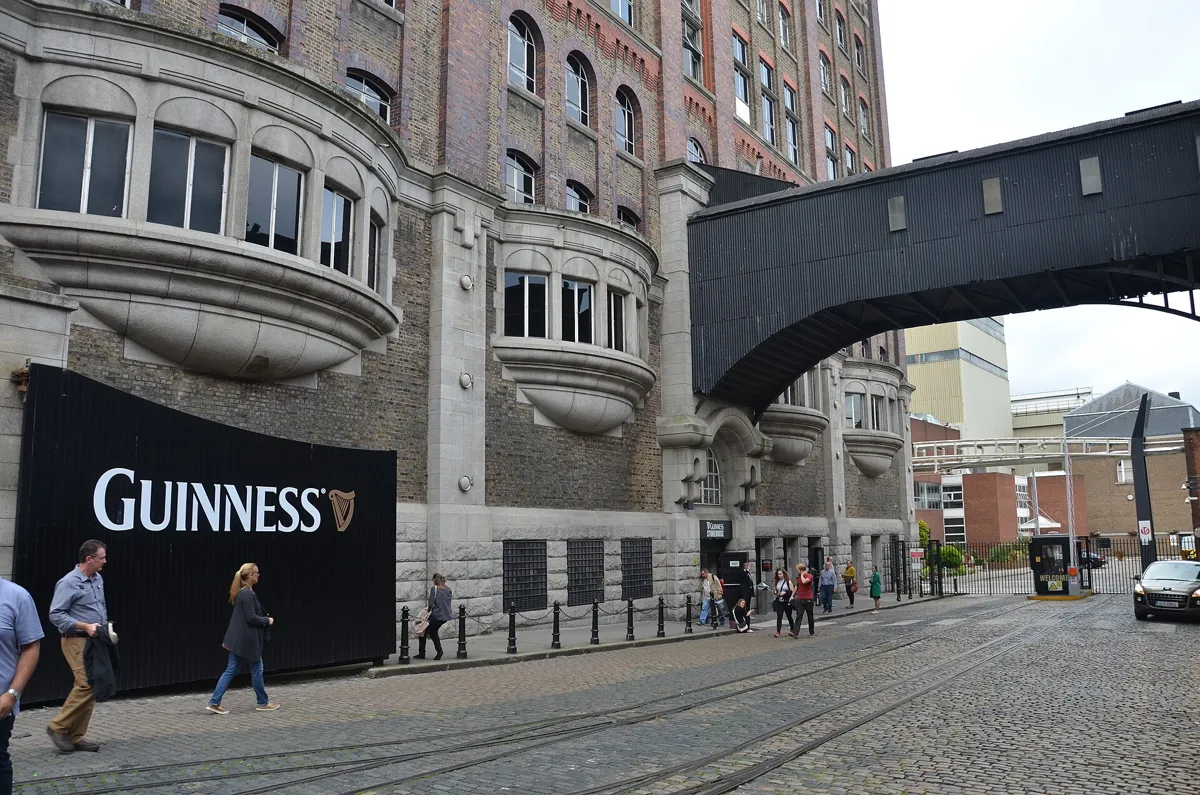
The Storehouse on Market Street. Photo: Steven Lek, CC BY-SA 4.0, via Wikimedia Commons (resized). Keep west on Thomas Street, then turn left down Thomas Court and follow Rainsford Street and Crane Street to the Storehouse entrance where Belview meets Market Street. On Thomas Street, close to the brewery, the old brewery power house became the Roe & Co whiskey distillery in 2019, named after George Roe, whose Thomas Street distillery was once the largest in Britain and Ireland. Arthur Guinness began brewing at St James's Gate in 1759. On 31 December that year he signed a 9,000-year lease on an unused brewery, at £45 a year. The lease no longer applies: the company has since bought the property outright. By 1886 it was the largest brewery in the world. The Storehouse building went up in 1902 as the brewery's fermentation plant, in the style of the Chicago School, and was the first multi-storey steel-framed building in Ireland. It worked until 1988 and opened as the visitor centre on 2 December 2000. Its seven floors wrap around a glass atrium shaped like a pint glass, with a copy of the lease at the bottom and the Gravity Bar at the top, with views across the city. Book a time slot ahead, and allow at least 90 minutes inside.
More history
In 1899 the brewery hired the statistician William Sealy Gosset. Writing as "Student", he gave his name to Student's t-test. In 1932 the company moved its headquarters to London.
Sources: Wikipedia, Guinness Storehouse; Wikipedia, St. James's Gate Brewery; Wikipedia, Roe & Co Distillery. Visiting: the Storehouse's FAQs.
-
The Royal Hospital Kilmainham and IMMA
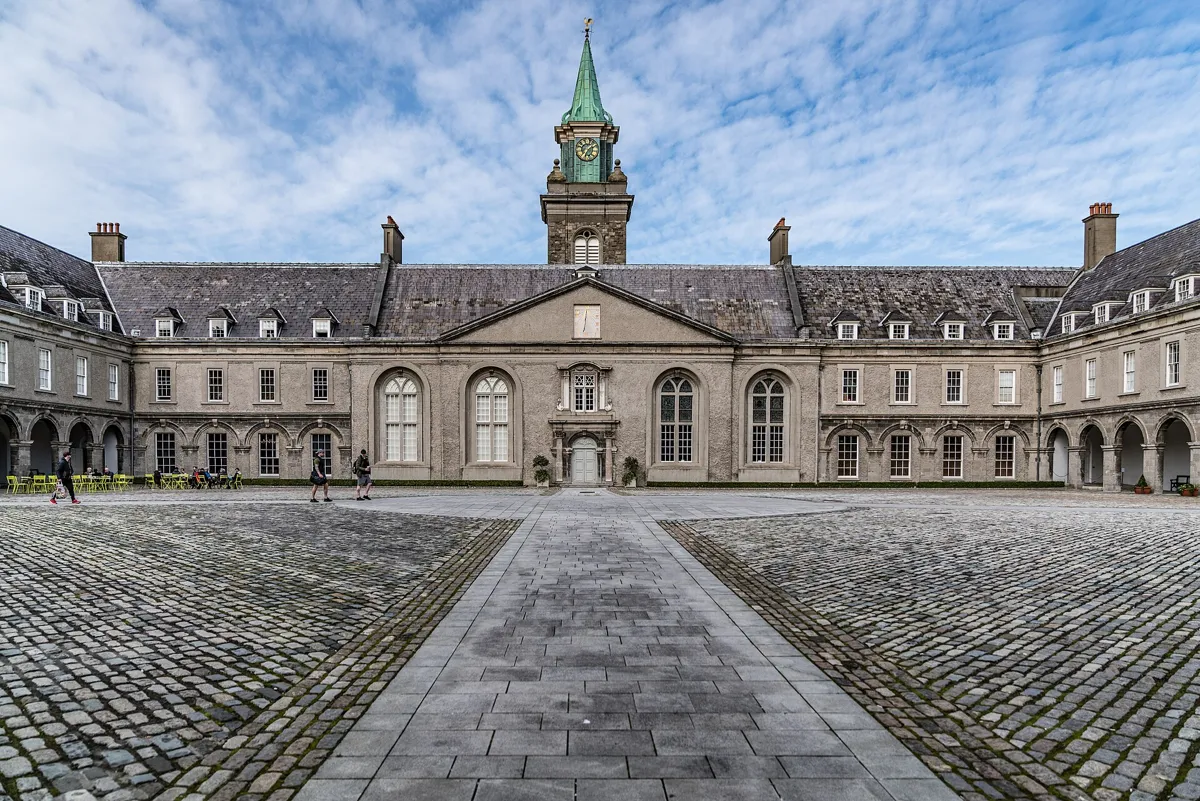
The courtyard and clock tower. Photo: William Murphy, CC BY-SA 2.0, via Wikimedia Commons (resized). Walk along Market Street South and Grand Canal Place, turn right up Echlin Street and left along James's Street. After about 150 m, turn right and then left into Bow Lane West. Follow it to Irwin Street and turn right; at the top, the east gate on Military Road leads into the grounds, and the path up is steep. The site held an early Christian settlement and then a priory of the Knights Hospitallers. The building you see was begun in 1680 as a home for retired soldiers, for James Butler, Duke of Ormond, the Lord Lieutenant. Its architect was Sir William Robinson, who later designed Marsh's Library, and it was inspired by Les Invalides in Paris, with a formal front and a large closed courtyard. It is counted as the first large classical building in Ireland. Army pensioners lived here for 247 years, until the hospital closed in 1927. The state restored it in 1984, and in 1991 it became the Irish Museum of Modern Art, IMMA, which holds the national collection of modern and contemporary art. Entry to the museum and the grounds is free. The Great Hall and chapel are closed for the rest of 2026 while the building hosts Ireland's EU Presidency.
More history
At the end of the formal avenue stands the Richmond Tower, a gateway by Francis Johnston. It first stood by the Liffey and was moved here after the railway came in 1844. Johnston had hidden his own coat of arms above the arch under painted wood, hoping it would appear when the wood rotted, but the trick was found when the gate was taken down.
Sources: Heritage Ireland (OPW), Royal Hospital Kilmainham; Wikipedia, Royal Hospital Kilmainham; Wikipedia, Irish Museum of Modern Art. Visiting: IMMA's visitor information.
-
Kilmainham Gaol, where the 1916 leaders were shot
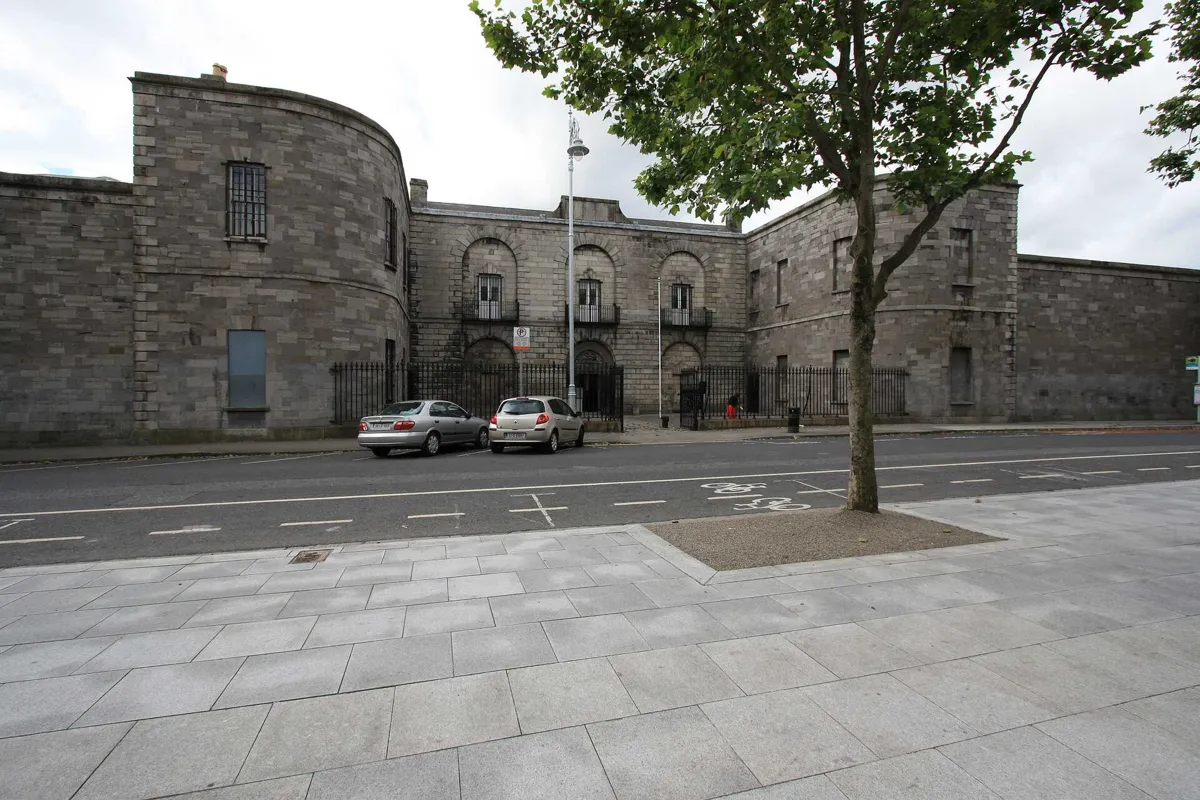
The main front on Inchicore Road. Photo: Nol Aders, CC BY-SA 3.0, via Wikimedia Commons (resized). Cross the grounds to the west, where Bully's Acre, the hospital's old graveyard, lies, and come out onto Inchicore Road; the gaol is about 50 m along it. It opened in 1796 as the "New Gaol" for County Dublin, replacing an older prison near today's Mount Brown. Building began in 1786 on Gallows Hill, to designs by John Trail, and cost £22,000. Over the main door writhe five carved monsters, called dragons, demons or serpents; they are said to stand for the five worst crimes: murder, rape, theft, treason and piracy. Public hangings took place just outside this door until the late 19th century. Most prisoners were ordinary criminals, but political prisoners came too: Robert Emmet and Anne Devlin in 1803, Charles Stewart Parnell in 1881–82, Countess Markievicz, and the leaders of the 1916 Easter Rising, 14 of whom were shot by firing squad in the Stonebreakers' Yard, Patrick Pearse among them. The gaol closed in 1924. Volunteers restored it from 1960, it opened to visitors on 10 April 1966, and the Office of Public Works now runs it. Visits are by guided tour only, and you must book.
More history
The east wing, opened in 1861, follows the Victorian idea of the panopticon: from one central point you can see all 96 cells, under a huge skylight. In March 1923, during the Civil War, 97 women prisoners went on hunger strike here.
Sources: Kilmainham Gaol Museum (OPW); Kilmainham Gaol Museum, the building; Heritage Ireland (OPW), Kilmainham Gaol; Wikipedia, Kilmainham Gaol.


Practical details
- Terrain
- Mostly flat, with a gentle rise as you head west from the cathedral to Kilmainham. The one steep part is the way up to the Royal Hospital: Heritage Ireland describes the route from James's Street as going via steps to Bow Lane, then Irwin Street and Military Road, and calls the pedestrian entrance by the east gate on Military Road steep.
- Step-free
- OpenStreetMap maps a few steps around St Patrick's Cathedral, at the start, and none elsewhere near the route. But the approach to the Royal Hospital described above is not step-free. The galleries of Marsh's Library are up stairs and not accessible to wheelchairs; the Storehouse building and the IMMA grounds both say they are accessible, with lifts or ramps.
- Water
- OpenStreetMap maps no drinking fountains on the route, so bring water. The Storehouse and IMMA both have cafés.
- Toilets
- OpenStreetMap maps a free, step-free toilet by the Royal Hospital and IMMA, and two toilets near St Patrick's Cathedral, both for customers only (second one). It also maps one near Tailors' Hall with no details.
- Sit and eat
- The Storehouse has a coffee shop on its first floor and restaurants on level five, and IMMA has a café, Fruition, with tables in the Royal Hospital's courtyard and in its vaults. The Royal Hospital grounds and formal gardens are a good place to rest.
- When to go
- Marsh's Library opens Tuesday to Friday 9:30–17:00 and Saturday 10:00–17:00, closed Sundays and bank holidays; adult tickets cost €8. The Guinness Storehouse opens Monday to Friday 10:00–17:00 and Saturday and Sunday from 9:30. IMMA is closed on Mondays except bank holidays. The Royal Hospital's gates close at 18:30, and on Sundays its western entrance, the way out to the gaol, does not open until 12:00. Kilmainham Gaol is open all year except 24–27 December. Hours change, so check before you go.
- Shorter walk
- Finish at stop 5, the Guinness Storehouse: 1.9 km, about 50 minutes.
- Getting back
- OpenStreetMap shows no station near the start or the finish. Heritage Ireland lists the Red line to Heuston Station, an 8-minute walk from the Royal Hospital via Military Road; the gaol is another 650 m past the hospital.
Walking distances and times from the OSRM foot router on OpenStreetMap data. Stations, fountains, steps and toilets from OpenStreetMap; opening hours and prices from Marsh's Library, the Guinness Storehouse, IMMA and the Office of Public Works. Checked 5 October 2026.
Questions people ask
How long does the Liberties to Kilmainham walk take, and is there a map?
About 90 minutes without going inside anywhere: 3.8 km, 51 minutes of walking and seven stops, from St Patrick's Cathedral to Kilmainham Gaol. The Guinness Storehouse and Kilmainham Gaol each suggest about 90 minutes for a visit, so with both it fills most of a day. The map is on this page, and you can print it or save it as a PDF.
Can you walk from the city centre to the Guinness Storehouse?
Yes. On this route the Storehouse is 1.9 km from St Patrick's Cathedral, about 26 minutes of walking along Thomas Street. Book a time slot online before you go: the Storehouse strongly recommends it, and tickets are €2 cheaper online than at the door.
Do you need to book Kilmainham Gaol?
Yes. Entry is by guided tour only, and you must book online at kilmainhamgaolmuseum.ie, the only site allowed to sell tickets. Some tickets are released 28 days ahead from midnight Irish time, and extra tickets go online from 9:15 on the day. An adult ticket costs €8. Allow about 90 minutes: the tour lasts an hour, then you can see the museum.
Is IMMA free?
Yes. Entry to the Irish Museum of Modern Art is free, as are most of its exhibitions, and the grounds of the Royal Hospital Kilmainham are free to walk in. IMMA is closed on Mondays except bank holidays. The Royal Hospital's Great Hall and chapel are closed for the rest of 2026 while the building hosts Ireland's EU Presidency.
What are the Liberties in Dublin?
An old neighbourhood in the south-west of Dublin's inner city. The name comes from medieval manors that were joined to the city but kept their own courts and rights, chiefly the Archbishop's Liberty of St Sepulchre and the Liberty of Thomas Court and Donore, later the Earl of Meath's Liberty. Those privileges ended in 1840. The area is known for brewing, distilling, weaving, markets and, in the past, tenements.
Walk it with Strolio
Open Strolio at St Patrick's Cathedral and ask for 90 minutes through the Liberties to Kilmainham. Strolio builds walks in any city with mapped streets, so its route may pick different stops from this page. Stories play as you reach each place, and you can ask about anything else you pass, by voice or with a photo. You can also start from your hotel and choose your own time and interests.
More walks in Dublin
- Georgian and medieval: ~90 min, 8 stops. Oscar Wilde's square, the Book of Kells, the old Parliament, Temple Bar and both medieval cathedrals.
- Literary Dublin: ~1 h 40 min, 8 stops. From Joyce's bust on St Stephen's Green past Bloom's pub, the Abbey and the Gate to the James Joyce Centre.
- O'Connell Street and the 1916 Rising: ~1 h, 8 stops. The GPO, Moore Street and the 1916 Rising, from O'Connell Bridge to the Famine memorial.
- All Dublin walks, with maps side by side.
- Walks in other cities.
Sources
- Office of Public Works: Kilmainham Gaol Museum and its page on the building; Heritage Ireland pages for Kilmainham Gaol and the Royal Hospital Kilmainham. We used their facts and wrote our own text.
- Marsh's Library: history of the library and visiting
- Wikipedia: The Liberties, Marsh's Library, Tailors' Hall, Catholic Committee, John's Lane Church, St Catherine's Church, Thomas Street, Robert Emmet, Roe & Co Distillery, St. James's Gate Brewery, Guinness Storehouse, Royal Hospital Kilmainham, Irish Museum of Modern Art, Kilmainham Gaol
- Opening times and visits: Marsh's Library, Guinness Storehouse FAQs, IMMA visitor information, Royal Hospital Kilmainham, Kilmainham Gaol Museum
- Map data and places: © OpenStreetMap contributors, ODbL; walking route from the OSRM foot router run by FOSSGIS
- Photos: Wikimedia Commons contributors Sitomon, William Murphy, Diliff, DubhEire, Steven Lek and Nol Aders, credited under each photo