
Dublin self-guided walking tour · 90 minutes · map
Georgian and medieval Dublin on foot: from Oscar Wilde's square to Swift's cathedral
This 90-minute walk crosses Dublin from its Georgian squares to its medieval heart: Oscar Wilde's Merrion Square, Trinity College and the Book of Kells, the old Irish Parliament, the Ha'penny Bridge, Temple Bar, City Hall and the two cathedrals, Christ Church and St Patrick's.
The walk runs east to west and back in time. In the 1700s the rich left the north side for new squares such as Merrion Square, and the Irish Parliament built on College Green. Further west is the older city: Dublin Castle, begun in 1204, and two medieval cathedrals.
A note on accuracy: both cathedrals were heavily rebuilt by the Victorians, and we say where. Dublin Castle is closed until January 2027, and most books are off the shelves of Trinity's Long Room. Every fact links to its source.
- Start
- The north-west corner of Merrion Square, by the Oscar Wilde statue
- Finish
- St Patrick's Cathedral, Patrick Street
- Distance
- 3 km, one way
- Time
- About 90 minutes: 40 min walking and 8 stops, plus any visits inside
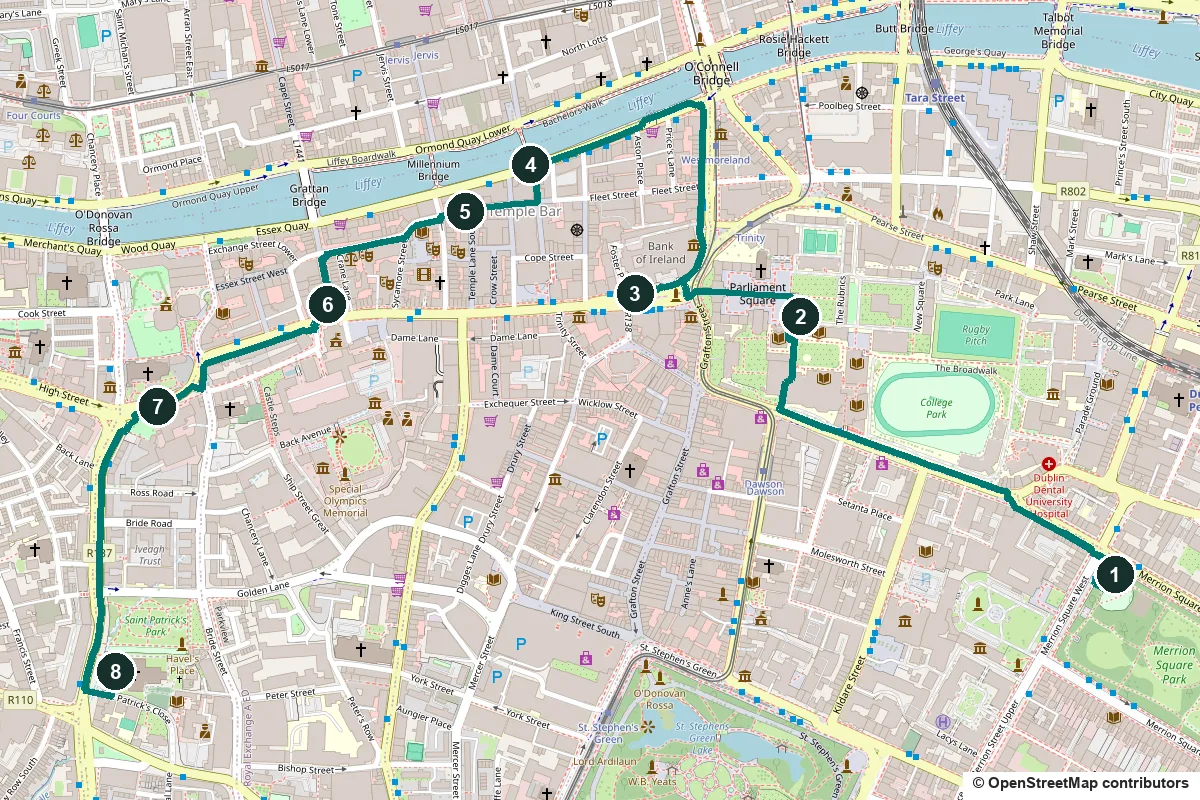
Terrain, water, opening times and a shorter version ↓
What to see: the stops
-
Merrion Square and Oscar Wilde on his rock
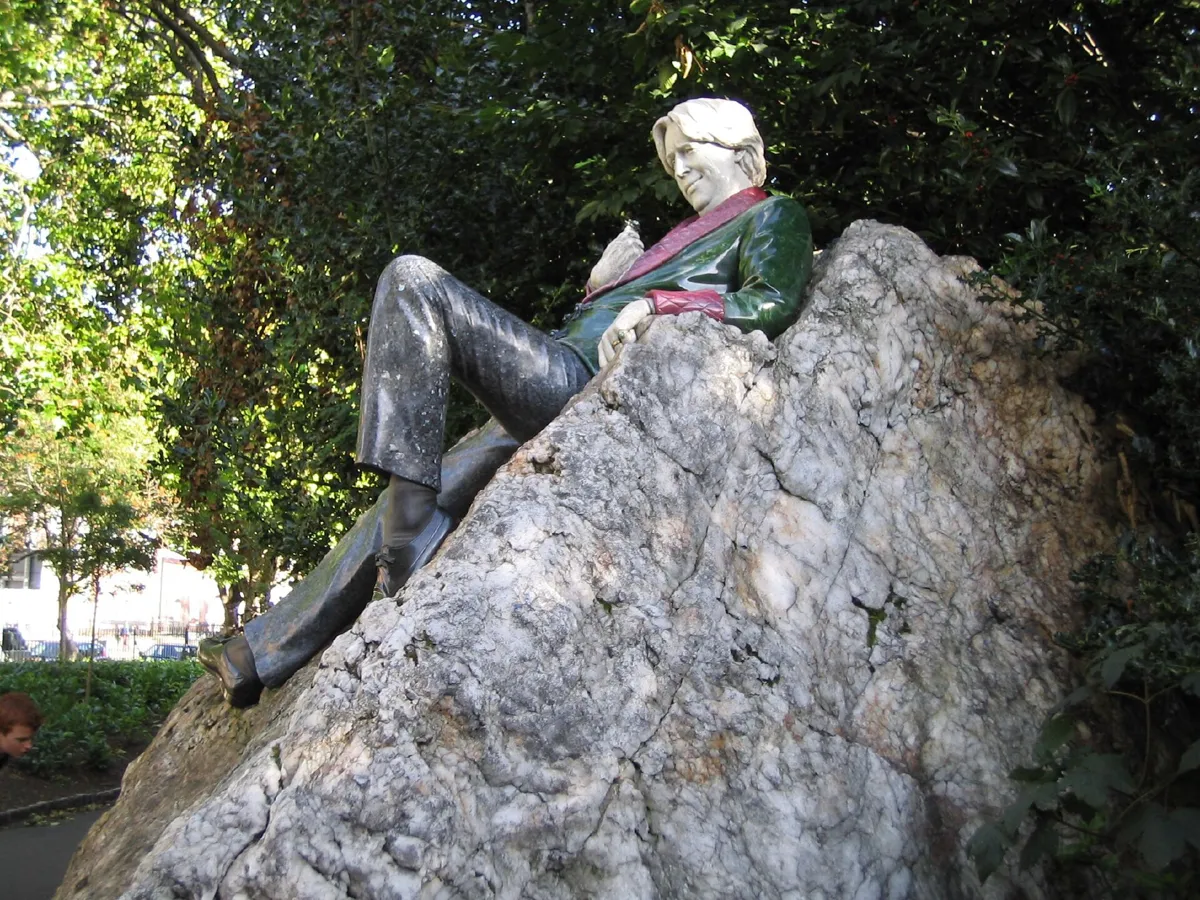
Danny Osborne's Wilde, inside the north-west gate. Photo: William Murphy, CC BY-SA 2.0, via Wikimedia Commons (resized). Start inside the park gate at the north-west corner of Merrion Square. The square was laid out in 1762 for Viscount FitzWilliam's estate, to a plan by John Smyth and Jonathan Barker. Georgian red-brick terraces line three sides; the fourth backs onto Leinster House, the seat of the Oireachtas, Ireland's parliament, and the National Gallery. Oscar Wilde lived close by, at No. 1 Merrion Square, from 1855 to 1876. Danny Osborne's statue shows him lounging on a quartz boulder that the sculptor fetched from the Wicklow Mountains. His torso is jade from British Columbia and pink thulite from Norway, and he wears a Trinity College tie of glazed porcelain. Unveiled in 1997 by his grandson, Merlin Holland, 97 years after Wilde's death, it was Dublin's first statue of him.
More history
Two pillars flank the boulder: one topped by his wife Constance, pregnant, the other by a male torso of Dionysus. Their lines from Wilde are copied in the handwriting of Seamus Heaney, Michael D. Higgins and others. W. B. Yeats lived at No. 82 and Daniel O'Connell at No. 58. Soup kitchens fed the hungry in the park during the Famine of the 1840s, but until 1974 only residents with a key could go in.
Sources: Wikipedia, Merrion Square; Wikipedia, Oscar Wilde Memorial Sculpture.
-
Trinity College, the Old Library and the Book of Kells
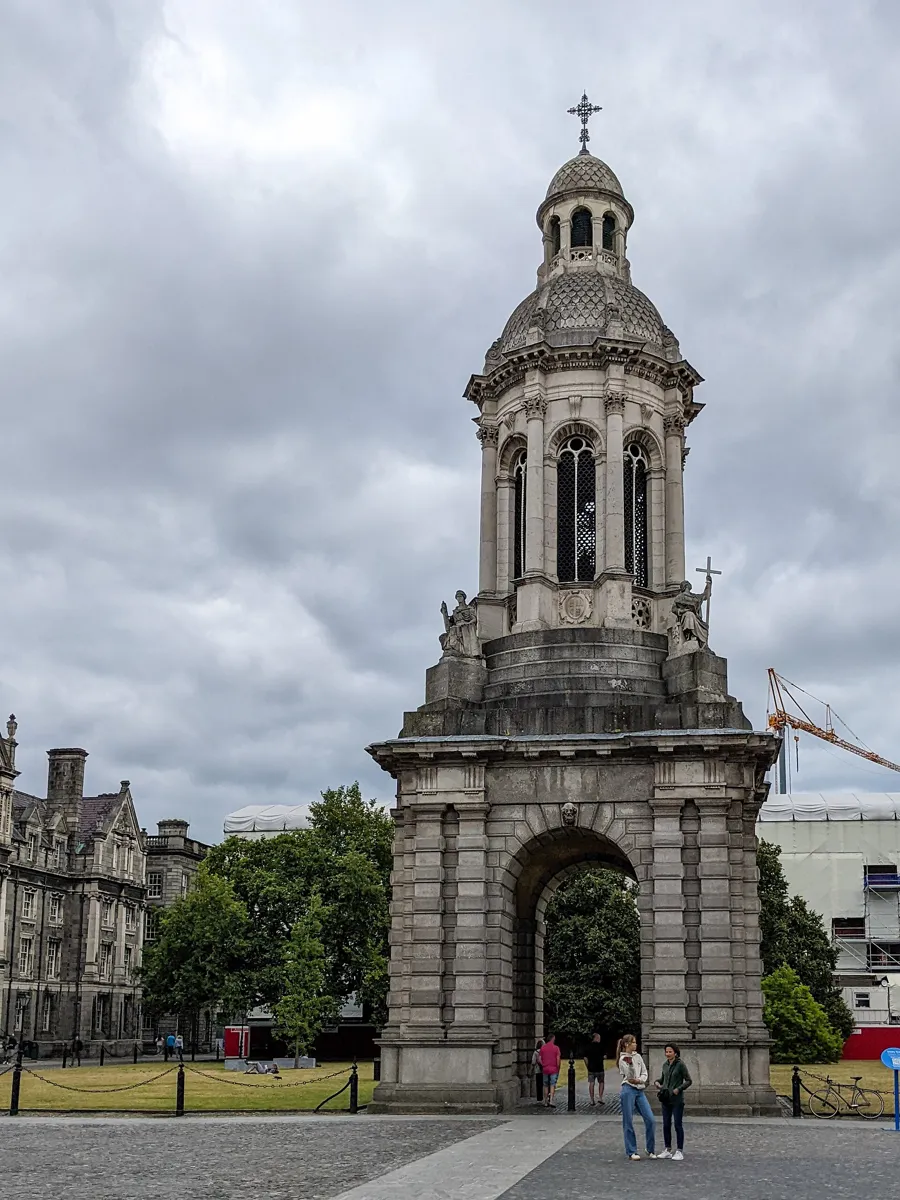
The Campanile, finished in 1853. Photo: The wub, CC BY-SA 4.0, via Wikimedia Commons (resized). Walk west along Merrion Square North, Clare Street and Nassau Street, and enter Trinity College through the gate by the Arts Building. Walk north past the Old Library to the Campanile, the bell tower. Queen Elizabeth I granted Trinity its charter in 1592, on the site of the Augustinian priory of All Hallows, which Henry VIII had closed, just outside the city walls. Thomas Burgh's Old Library was built between 1712 and 1732; its main hall, the Long Room, is 65 m long. Here lies the Book of Kells, the four Gospels in Latin, made around 800 by monks linked to Iona and named after the abbey of Kells in County Meath. When Cromwell's cavalry was quartered at Kells in 1654, the book was sent to Dublin for safety, and Bishop Henry Jones gave it to Trinity in 1661. Seeing it needs a timed ticket, from €19; book online. For a restoration project, all but about 20,000 of the Long Room's books have been moved out, but the Book of Kells stays on show. The Old Library stays open until the end of 2027; during the building works after that, the book is to be shown in Trinity's Printing House.
More history
Charles Lanyon designed the 30.5 m Campanile; the keystones of its arches carry the heads of Homer, Socrates, Plato and Demosthenes. The book has been bound in four volumes since 1953, and one is on display at a time. Trinity's former students include Jonathan Swift, Oliver Goldsmith, Bram Stoker, Oscar Wilde and Samuel Beckett.
Sources: Wikipedia, Trinity College Dublin; Wikipedia, Library of Trinity College Dublin; Wikipedia, Book of Kells; Wikipedia, Campanile. Visiting: tickets and hours on Visit Trinity; the Long Room's books: Visit Trinity; the closure in 2027: Trinity College, Old Library project.
-
Bank of Ireland, the old Irish Parliament House
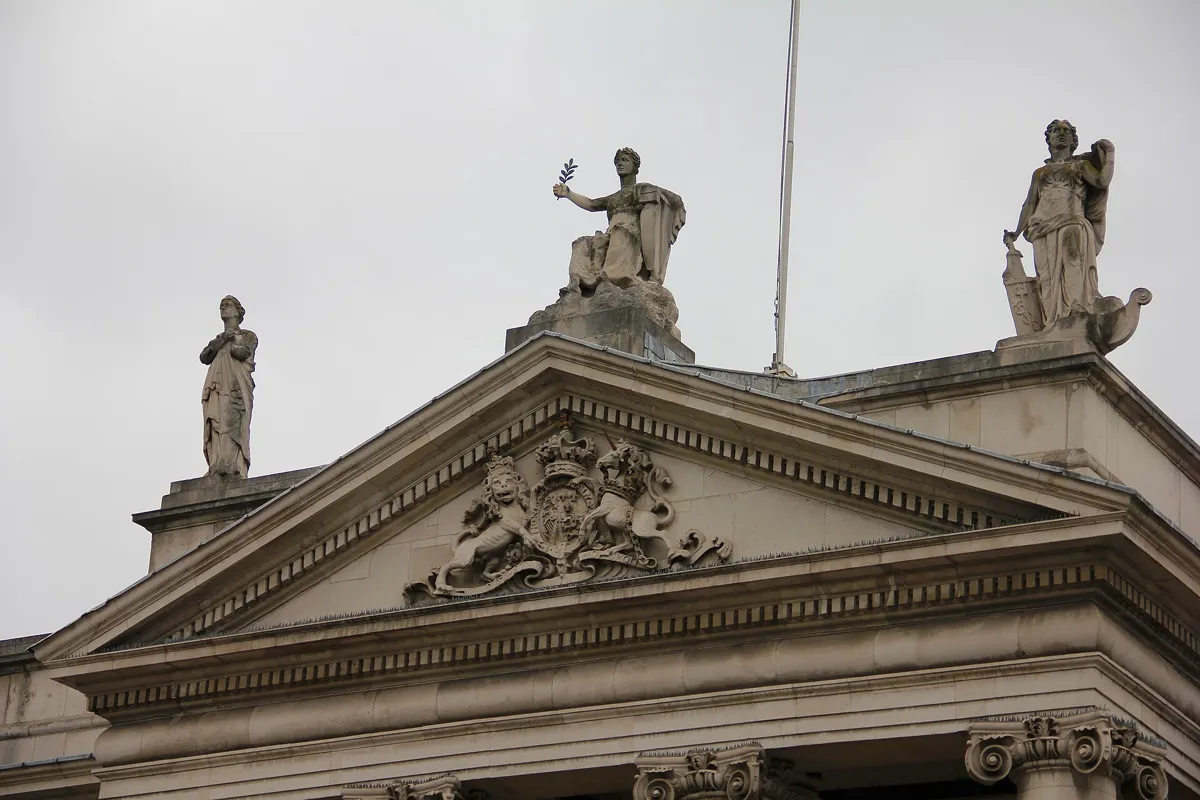
Hibernia, Fidelity and Commerce above the portico. Photo: J.-H. Janßen, CC BY-SA 3.0, via Wikimedia Commons (resized). Walk west through Parliament Square, between the matching fronts of the Chapel and the Examination Hall, both by William Chambers, and out through the Front Gate onto College Green. The great curved building across the road was the Irish Parliament House. Edward Lovett Pearce's design, begun in 1729, was Europe's first purpose-built parliament house with two chambers. Statues of Hibernia, Fidelity and Commerce stand above the Ionic portico. In the 1780s James Gandon added a House of Lords entrance on Westmoreland Street with Corinthian columns, because the peers wanted a door unlike the Commons'. This Anglican-only parliament met here for the last time in August 1800; under the Act of Union it ceased to exist on 1 January 1801. In 1803 the Bank of Ireland bought the building for £40,000.
More history
The bank's architect, Francis Johnston, broke up the Commons chamber into offices and a cash office, but the House of Lords survived and was the bank's boardroom until the 1970s. Its two tapestries, from about 1733, show the Battle of the Boyne and the Defence of Londonderry. The Commons chandelier now hangs in Trinity's Examination Hall. In 2023 the bank announced free guided visits to the House of Lords on Tuesday mornings, warning that restoration works from 2024 might change the hours; check before you go.
Sources: Wikipedia, Parliament House, Dublin; Wikipedia, Trinity College Dublin; National Inventory of Architectural Heritage. Visiting: Bank of Ireland, 2023.
-
The Ha'penny Bridge, a toll bridge for a century
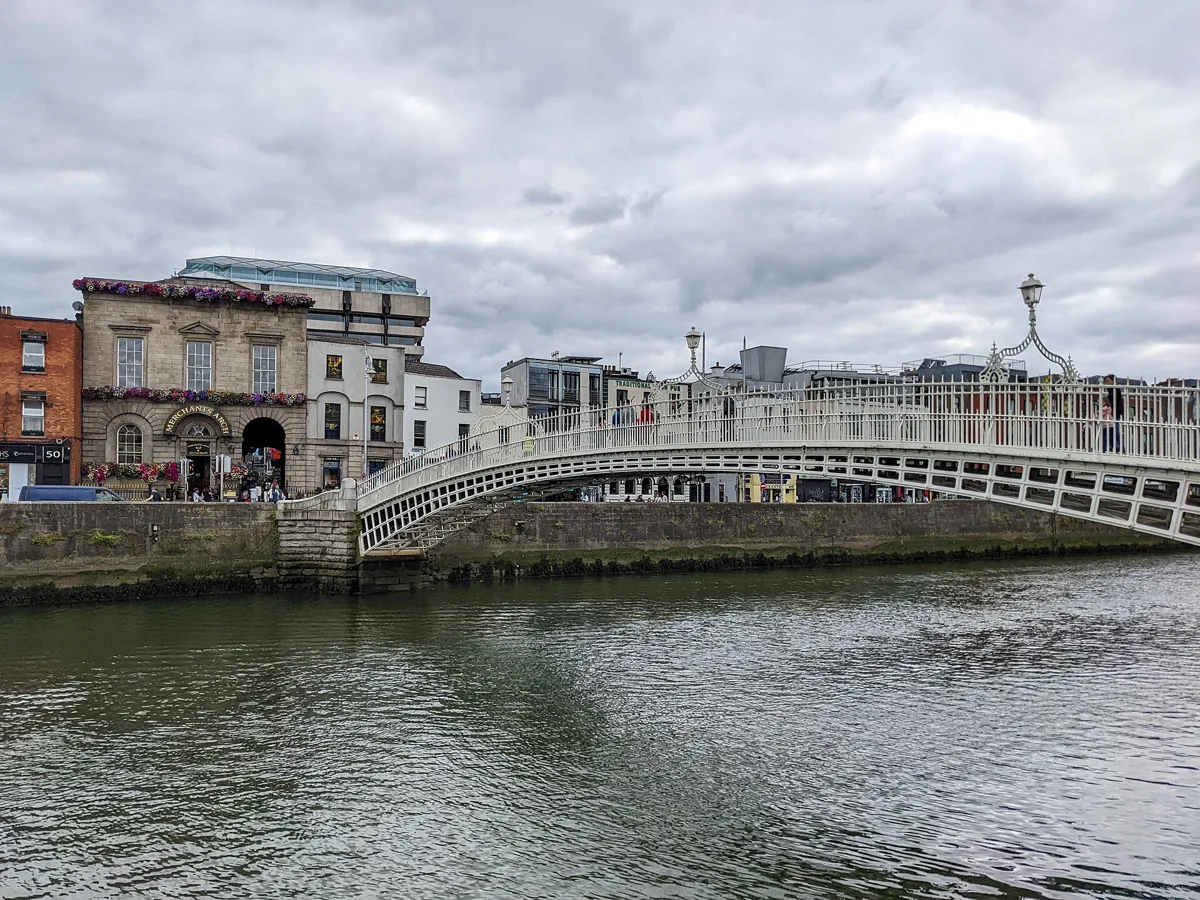
The bridge, with Merchant's Arch on the south bank. Photo: The wub, CC BY-SA 4.0, via Wikimedia Commons (resized). Walk north up Westmoreland Street to the river and turn left along Aston Quay to the white iron footbridge. Before it opened in May 1816, William Walsh ran seven ferries here. Told to mend them or build a bridge, he built one, and could charge a ha'penny toll for 100 years, the same as the ferry fare, with turnstiles at each end. The Coalbrookdale Company cast it in Shropshire, in 18 sections shipped to Dublin, from ore mined at Sliabh an Iarainn in County Leitrim. It was first named Wellington Bridge; since 1922 its official name has been the Liffey Bridge. The toll rose for a time to a penny-ha'penny and was dropped in 1919.
More history
By 2001, 27,000 people crossed it every day. It closed that year for repairs and reopened in December, painted its original white. Please don't add a padlock: in 2013 the city council cut more than 300 kg of love locks off the bridge.
Sources: Wikipedia, Ha'penny Bridge.
-
Temple Bar, saved by a bus station that was never built
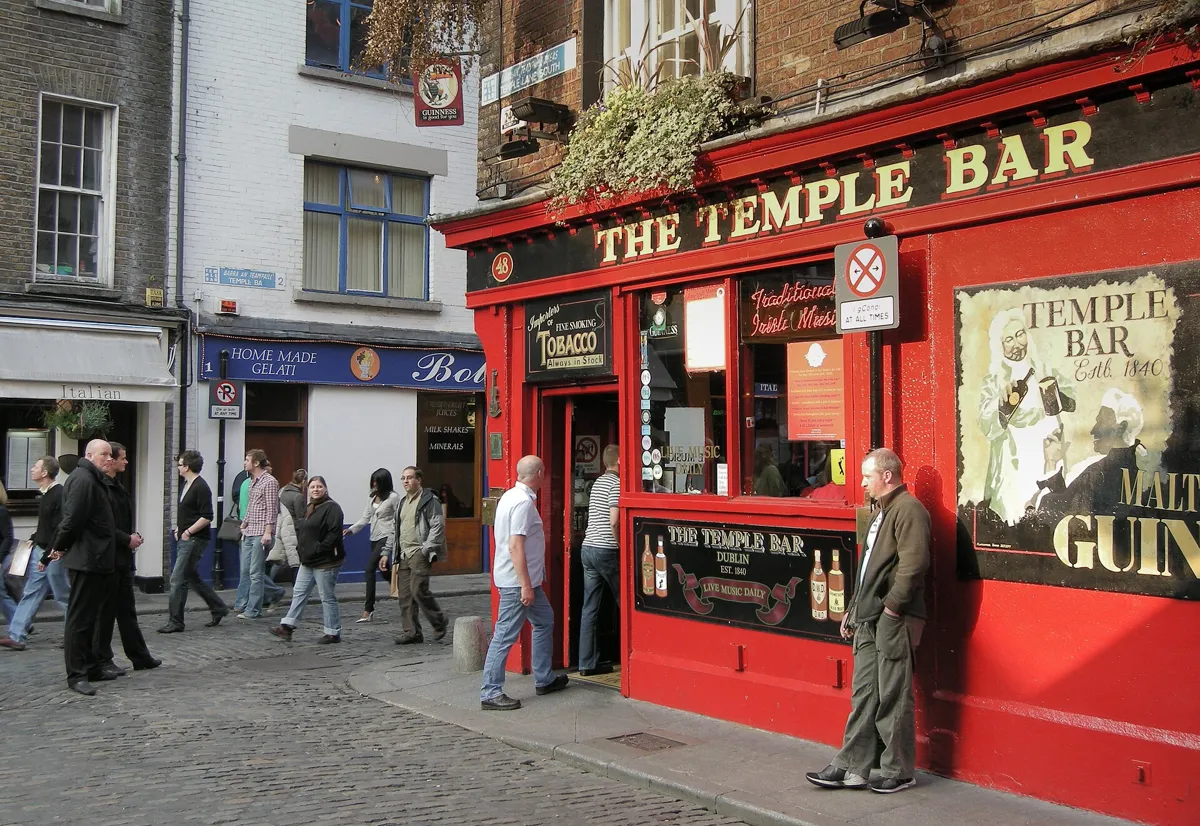
The Temple Bar pub at the corner of Temple Lane South. Photo: Gordon Leggett, CC BY-SA 4.0, via Wikimedia Commons (resized). From the south end of the bridge, go through Merchant's Arch and turn right along the cobbled street called Temple Bar to the corner of Temple Lane South. The street's name first appears on Bernard de Gomme's map of 1673. In the 1600s the river reached roughly this line; the marsh beyond was walled in and filled, and back yards ran down to the water until Wellington Quay was built in 1812. The name may honour Sir William Temple, later provost of Trinity, who had a house and gardens here, and it echoes London's Temple Bar, which also sits between an Essex Street and a Fleet Street. In the 1970s and 1980s the state transport company, CIÉ, planned to demolish much of the area for a bus station. It let the old buildings cheaply meanwhile, artists and small shops moved in, and protests stopped the plan. In 1991 the government set up Temple Bar Properties to renew the area as a cultural quarter.
More history
In the 18th century it was the centre of the city's prostitution, and by the 20th many buildings were derelict.
Sources: Wikipedia, Temple Bar, Dublin.
-
City Hall and the gates of Dublin Castle
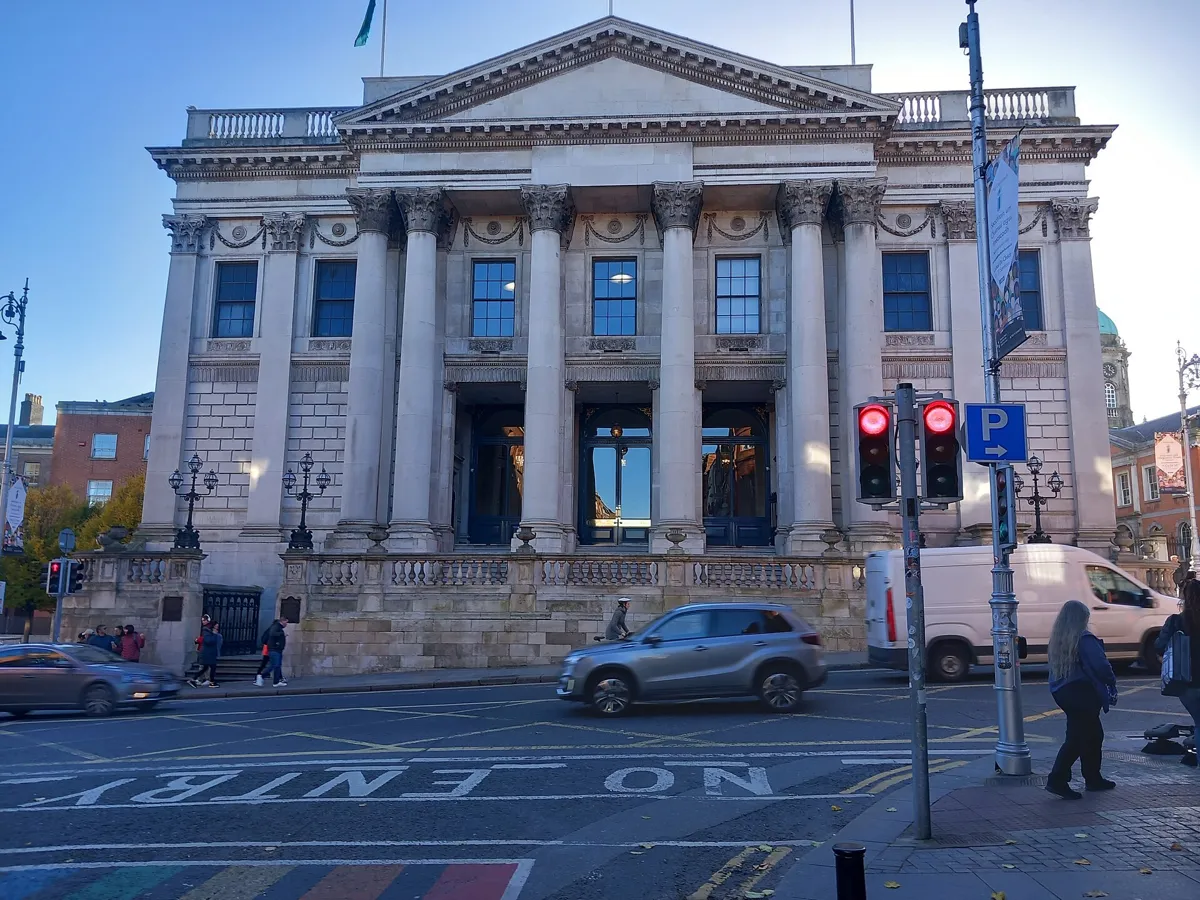
City Hall, built as the Royal Exchange. Photo: Darren J. Prior, CC BY-SA 4.0, via Wikimedia Commons (resized). Keep west along Temple Bar and Essex Street East, crossing Eustace Street, where the Society of United Irishmen was founded at a tavern meeting in 1791. Then go up to Dame Street. City Hall, at the top of Parliament Street, was built in 1769–79 as the Royal Exchange, for the city's merchants, to Thomas Cooley's design. The Irish Parliament paid for it, hence the initials SPQH, for "the senate and people of Ireland". It became City Hall in 1852. Its domed hall is open Monday to Saturday. Behind it stands Dublin Castle, the seat of English and then British rule from 1204, when King John ordered it, until 16 January 1922, when the last viceroy handed it to Michael Collins. After a fire in 1684 it was rebuilt as a Georgian palace, but the Medieval Tower of 1204–28, with walls up to 4.8 m thick, survives. The whole castle campus is closed until January 2027 for Ireland's EU Council Presidency, and the Chester Beatty museum inside it until the end of 2026.
More history
In the 1916 Rising the Irish Citizen Army held City Hall, and Sean Connolly shot James O'Brien, a guard at the castle, the Rising's first casualty. The castle gardens lie on or near the dubh linn, the "black pool" that gave Dublin its name. Bram Stoker, author of Dracula, worked in the castle from 1866 to 1878.
Sources: Wikipedia, City Hall, Dublin; Wikipedia, Temple Bar; Dublin Castle (OPW), history; the Medieval Tower; the Castle Gardens. Visiting: Dublin City Council, City Hall; closure notices on Dublin Castle and Chester Beatty.
-
Christ Church Cathedral and its medieval crypt
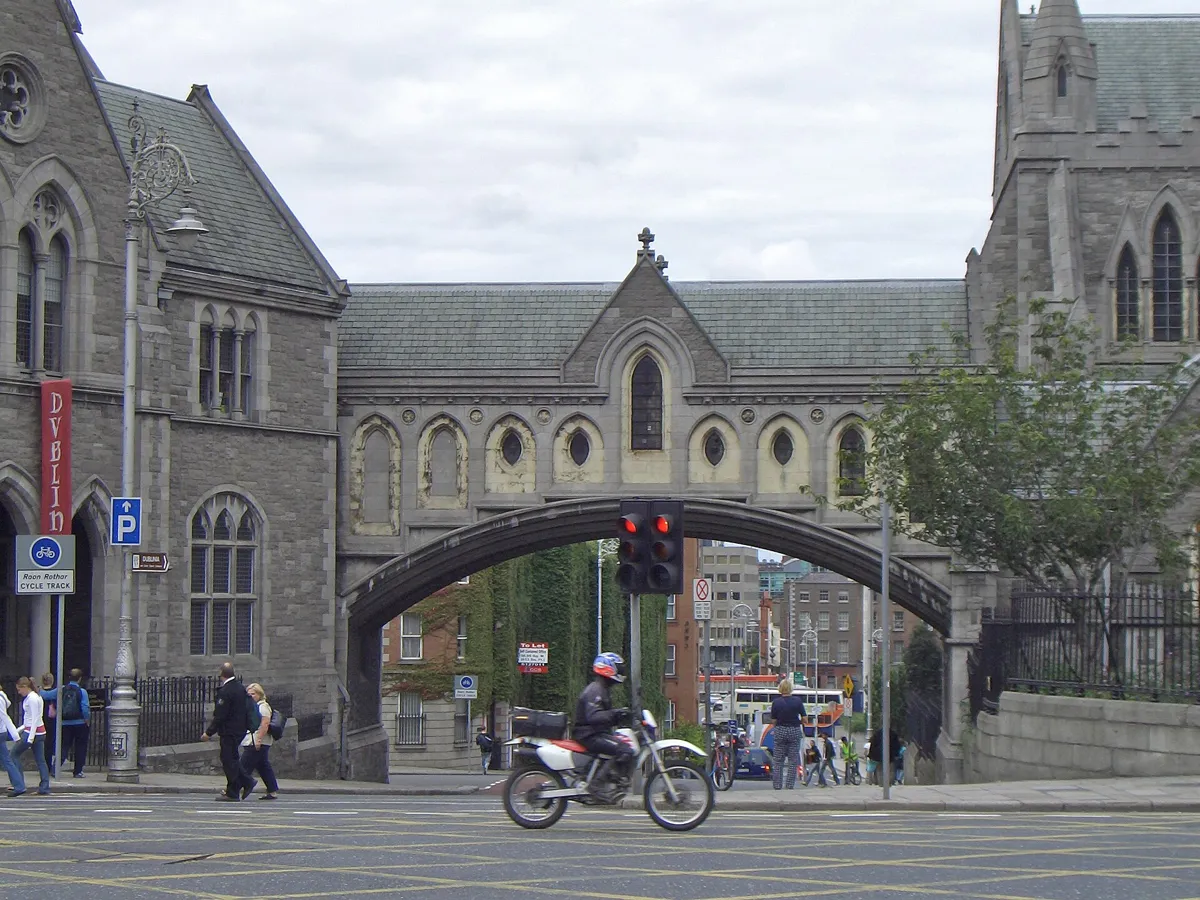
George Edmund Street's bridge to the Synod Hall, now Dublinia. Photo: Mike Peel, CC BY-SA 4.0, via Wikimedia Commons (resized). Walk west up Lord Edward Street to Christ Church, the older of Dublin's two medieval cathedrals. The cathedral's own history puts a church here around 1028, founded by Sitriuc, the Norse king of Dublin, and Dúnán, the first bishop. After the Anglo-Normans took the city in 1170, the church was rebuilt in stone. In 1562 the nave vault fell in and smashed Strongbow's tomb; the one inside now is a replacement from Drogheda, and the north wall still leans out by 46 cm. Much of what you see is Victorian: George Edmund Street rebuilt much of it in 1871–78, paid for by the whiskey distiller Henry Roe. Street also built the Synod Hall and the covered bridge to it; the hall now houses Dublinia, an exhibition on Viking and medieval Dublin. Under the church lies the 12th-century crypt, 63.4 m long, which the cathedral calls the city's oldest building still in use. Adult tickets, €11.50, include the crypt and its mummified cat and rat.
More history
In 1487 a boy pretender, Lambert Simnel, was "crowned" here as Edward VI. A letter of 1633 complains that the crypt had been turned into "tippling houses for beer, wine and tobacco". In 1742 the cathedral's choir, with St Patrick's, sang at the first performance of Handel's Messiah in nearby Fishamble Street.
Sources: Christ Church Cathedral, history; Wikipedia, Christ Church Cathedral; Wikipedia, Dublinia. Visiting: the cathedral's visiting page.
-
St Patrick's Cathedral, where Jonathan Swift was dean
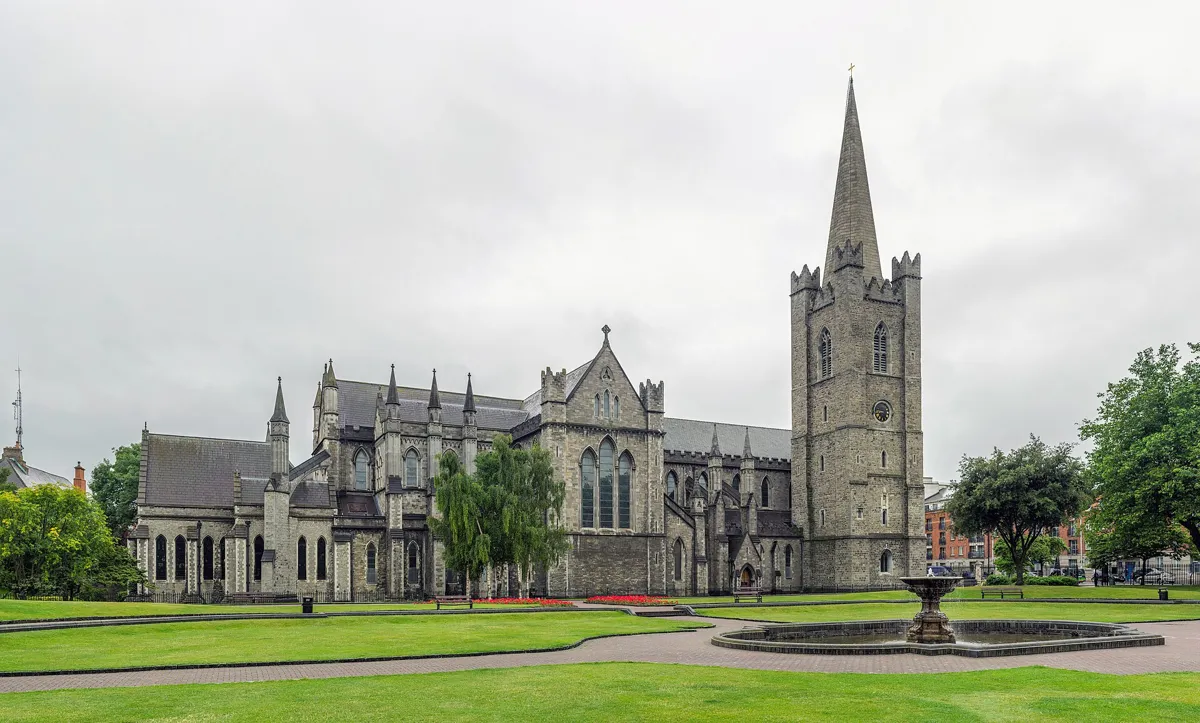
The cathedral from St Patrick's Park. Photo: Diliff, CC BY-SA 3.0, via Wikimedia Commons (resized). Walk south down Nicholas Street and Patrick Street; St Patrick's Park opens on your left, with the cathedral behind it. A church stood here by a holy well of St Patrick, on an island between two branches of the River Poddle. It was dedicated on 17 March 1191, and Archbishop John Comyn made it a collegiate church. The present building, the largest church in Ireland, was raised between 1191 and 1270. The river kept the ground so wet that it has no crypt. The tower was rebuilt after a fire in 1362–70, and the spire added in 1749. Jonathan Swift, author of Gulliver's Travels, was dean from 1713 to 1745; his grave and epitaph are inside, beside those of his friend Stella. Much of what you see is Victorian, as at Christ Church: Benjamin Guinness paid for a rebuilding in 1860–65, and his statue stands by the south door. Edward Guinness laid out the park in 1901 on a site of run-down housing. Adult tickets cost €11.50.
More history
Legend says "chancing your arm" began here in 1492, when the Earl of Kildare cut a hole in a door, still on show, and put his arm through to make peace with the Earl of Ormond. Cromwell stabled his horses in the nave. Since 1870 it has been the national cathedral of the Church of Ireland, while the Archbishop of Dublin's seat is at Christ Church, about 400 m away.
Sources: Wikipedia, St Patrick's Cathedral. Visiting: the cathedral's visit page.


.jpg)


Practical details
- Terrain
- Nearly level: Open-Meteo puts every stop between 4 and 17 m above sea level. Temple Bar's streets are cobbled.
- Step-free
- OpenStreetMap maps no steps on the route. It marks Pearse station, about 300 m from the start, as wheelchair accessible. Christ Church says that, as a medieval building, it has some access limits inside.
- Water
- OpenStreetMap lists free bottle-refill fountains in Fellows' Square at Trinity (stop 2) and near the south end of the Ha'penny Bridge (stop 4).
- Toilets
- OpenStreetMap shows free toilets open to the public inside Trinity, near the Nassau Street entrance (stop 2), and toilets for visitors at St Patrick's Cathedral.
- When to go
- Trinity's gate by the Arts Building opens 07:00–22:30 on weekdays and 08:00–18:00 at weekends; the Front Gate opens daily 07:00–midnight. The Book of Kells opens from 08:30 (09:00 on Sunday). City Hall closes on Sundays and bank holidays. Both cathedrals open daily, with shorter Sunday hours around services. Dublin Castle is closed until January 2027 and the Chester Beatty until the end of 2026.
- Shorter walk
- Skip Merrion Square and start at Trinity's Nassau Street gate: about 2.4 km and just over 30 minutes of walking.
- Getting back
- OpenStreetMap shows no rail or tram stop within 400 m of the cathedral. The St Stephen's Green Luas stop (Green Line), marked wheelchair accessible, is about 900 m east, a 12-minute walk.
Walking distances and times from the OSRM foot router on OpenStreetMap data. Elevations from Open-Meteo. Fountains, toilets and stations from OpenStreetMap; opening times from Trinity College, Visit Trinity, Dublin City Council, Dublin Castle (OPW) and the two cathedrals. Checked 4 October 2026.
Questions people ask
How long does a self-guided walking tour of Dublin take, and is there a map?
This one takes about 90 minutes: 3 km, 40 minutes of walking and eight stops, from Merrion Square to St Patrick's Cathedral. Add time for any visit inside the Old Library or the cathedrals. The map is on this page, and you can print it or save it as a PDF.
Is Dublin walkable? Can you see it on foot in a day?
The historic centre is. This walk links Merrion Square, Trinity College, the old Parliament House, the Ha'penny Bridge, Temple Bar, City Hall and both medieval cathedrals in 3 km, on nearly level ground. That leaves most of a day for going inside.
Where is the Book of Kells?
At Trinity College Dublin, which has kept it since 1661; it is shown in the college's Old Library. It is bound in four volumes, and one is on show at a time. Entry is by timed ticket, from €19 for the book and the Old Library; book online. Most books have been taken off the Long Room's shelves for a restoration project, but the Book of Kells stays on display. The Old Library stays open until the end of 2027; during the works after that, the book is to be shown in Trinity's Printing House.
Is Dublin Castle free?
The State Apartments are not: when the castle is open, adult tickets cost €8 self-guided and €12 guided, and the Viking Excavation and Chapel Royal are seen only on the guided tour. The Chester Beatty museum in the castle grounds is free. But the whole castle campus is closed until January 2027 for Ireland's EU Council Presidency, and the Chester Beatty is closed until the end of 2026.
What is the oldest building in Dublin?
Two strong candidates are on this walk. Christ Church Cathedral calls its 12th-century crypt the city's oldest building still in use, and Dublin Castle dates its Medieval Tower to 1204–28. St Patrick's Cathedral was built between 1191 and 1270, though much of it was rebuilt in the 1860s.
Walk it with Strolio
Open Strolio at Merrion Square and ask for 90 minutes through Georgian and medieval Dublin. Strolio builds walks in any city with mapped streets, so its route may pick different stops from this page. Stories play as you reach each place, and you can ask about anything else you pass, by voice or with a photo. You can also start from your hotel and choose your own time and interests.
More self-guided walks
- All Strolio walks: every self-guided walk with map, by city.
- Madrid's Barrio de las Letras: about an hour, from Lope de Vega's church to the press that printed Don Quixote.
- Barcelona's Gothic Quarter and El Born: about 90 minutes, from Roman columns to the cathedral and El Call.
Sources
- Official sites: Dublin Castle (Office of Public Works), Heritage Ireland, Christ Church Cathedral, St Patrick's Cathedral, Visit Trinity, Trinity College gate times, Trinity College Old Library project, National Inventory of Architectural Heritage, Dublin City Council, Chester Beatty, Bank of Ireland. We used their facts and wrote our own text.
- Wikipedia (English): Merrion Square, Oscar Wilde Memorial Sculpture, Trinity College Dublin, Library of Trinity College Dublin, Book of Kells, Campanile, Parliament House, Dublin, Ha'penny Bridge, Temple Bar, City Hall, Dublin, Dublin Castle, Christ Church Cathedral, Dublinia, St Patrick's Cathedral
- Map data and places: © OpenStreetMap contributors, ODbL; walking route from the OSRM foot router
- Elevations: Open-Meteo
- Photos: Wikimedia Commons contributors William Murphy, The wub, J.-H. Janßen, Gordon Leggett, Darren J. Prior, Mike Peel and Diliff, credited under each photo