
Hometown walks · Poblenou
A 60-minute walk through Poblenou
Poblenou's factories made cloth, chemicals and twine for fishing nets. Most of the machines are long gone, but the chimneys stayed, and each one now stands over something new: a university campus, an art museum, an innovation centre, artists' studios.
This walk is for people who live or work around here and pass these chimneys without knowing what they were. Five stops, flat all the way, from Llacuna metro towards Pere IV.
- Start
- Llacuna metro (L4), Carrer de Pujades
- Finish
- La Escocesa, Carrer de Pere IV
- Distance
- 2.4 km, one way
- Time
- About 60 min: 32 min walking, 5 stops
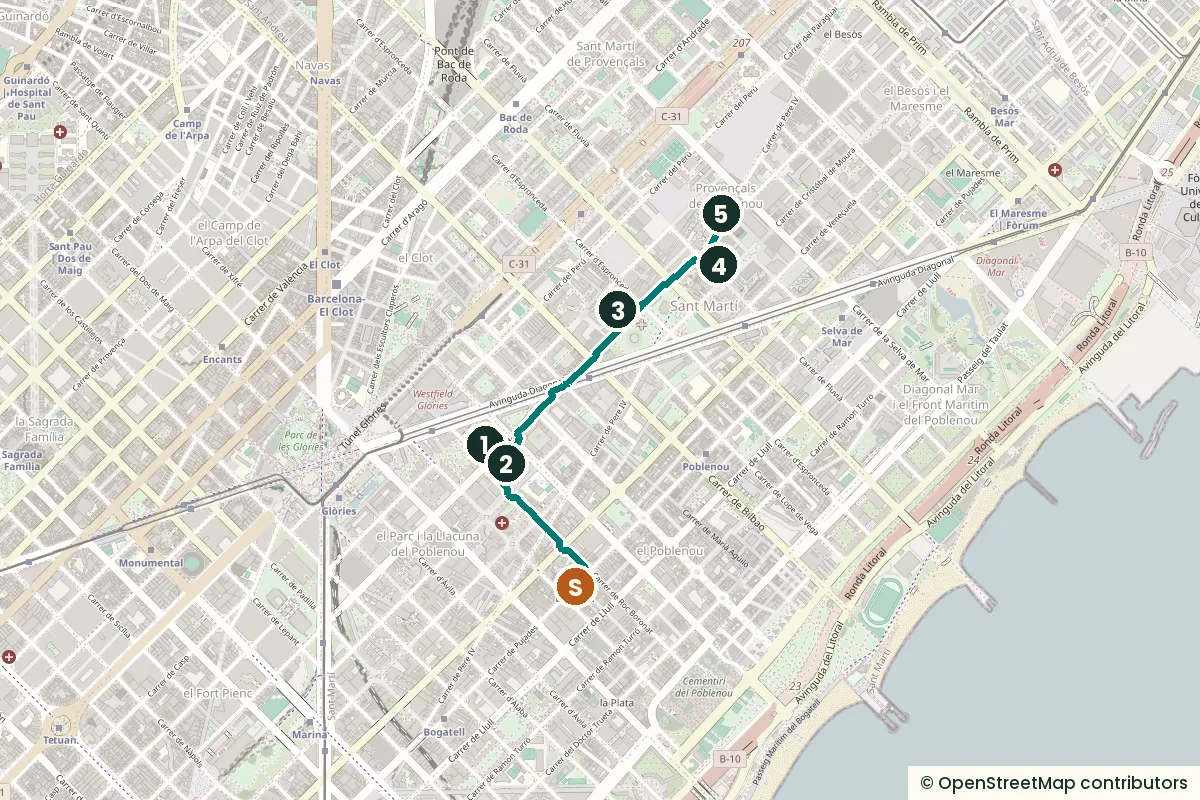
The stops
-
Ca l'Aranyó, the English mill
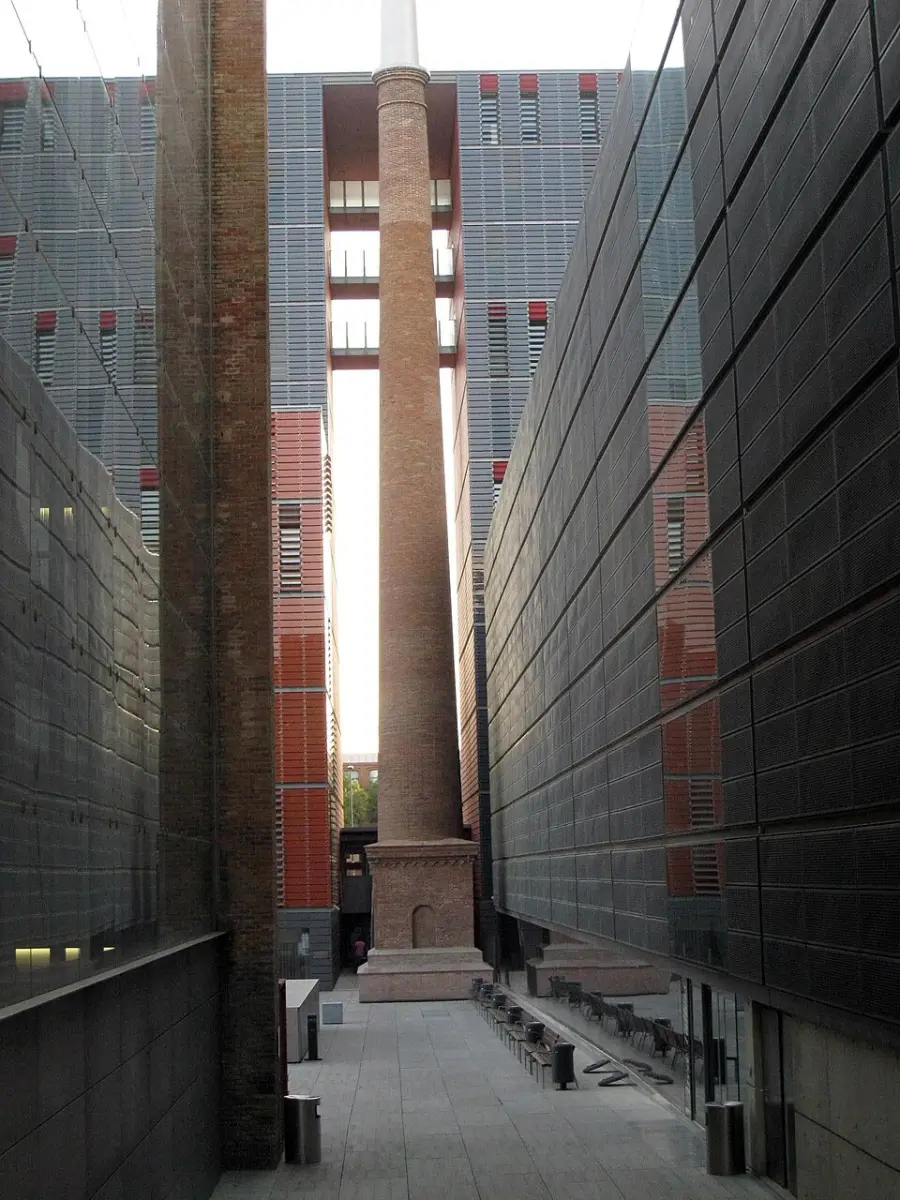
Photo: Enfo, CC BY-SA 3.0, via Wikimedia Commons (resized). This mill was imported almost whole from England. The British firm Prince Smith and Son of Keighley supplied the plans, the style, the machinery, the structure and the technicians, and the master builder Josep Marimon i Cot finished it in 1874. It spun and wove using the English Bradford system, in a multi-storey building on the Manchester model. The company closed it in 1984. After a plan to turn it into a motorcycle museum fell through, it was given in 2004 to Pompeu Fabra University's audiovisual department and restored as part of the 22@ district. The tapering chimney inside the complex is its standout feature, and the building is listed as local heritage.
Source: Viquipèdia, Ca l'Aranyó.
-
Can Framis, the bleaching works
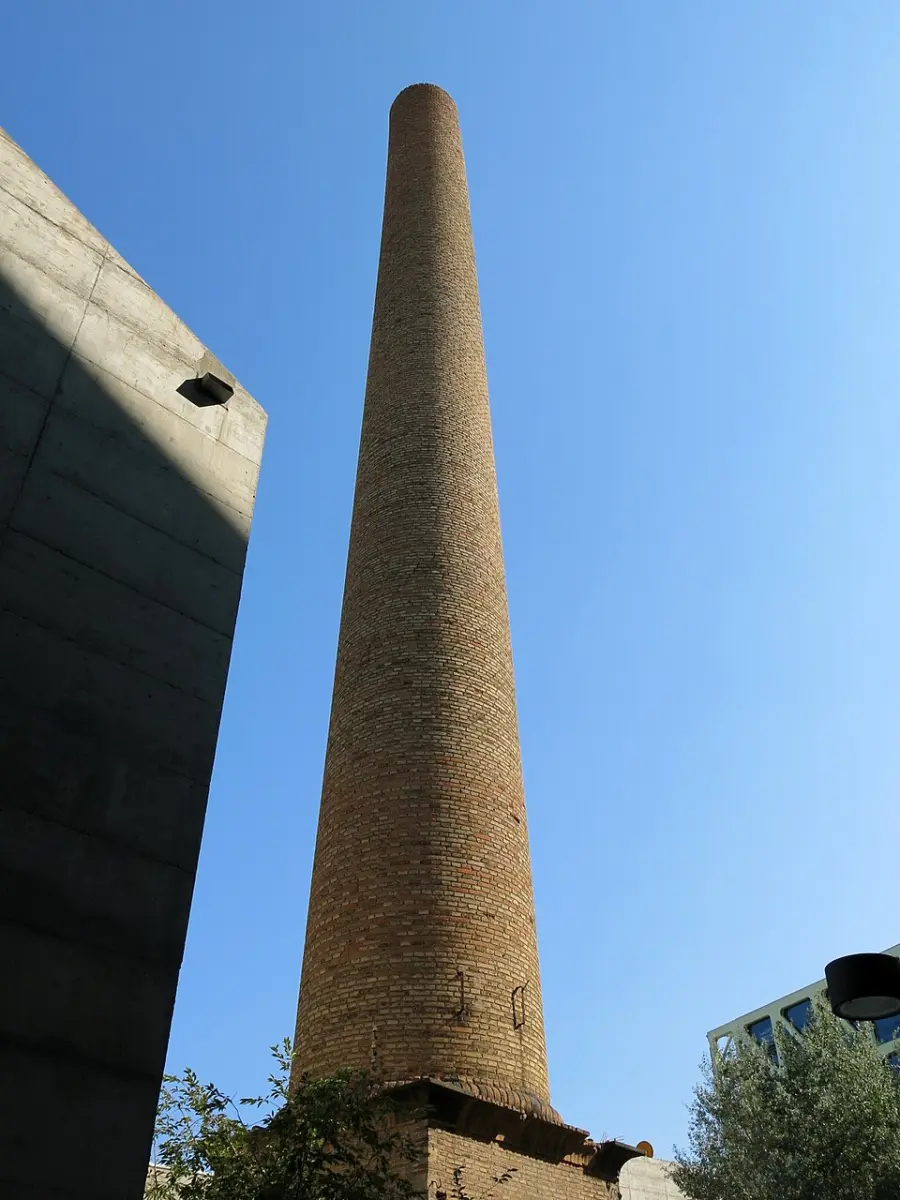
Photo: Enfo, CC BY-SA 3.0, via Wikimedia Commons (resized). By 1861 Joan Framis i Torrents was running a bleaching works here, using the water of the Llacuna irrigation channel beside it. The architect Antoni Rovira i Trias drew up its industrial sheds in 1855 and 1865 and workers' cottages in the 1870s. In 1896 three boilers exploded, part of the factory collapsed, and it had to be rebuilt. In 2009 it reopened as the Museu Can Framis of the Fundació Vila Casas: the architect Jordi Badia replaced the central block with a new one. The museum shows about 250 works by artists born or living in Catalonia, and a cast-iron sculpture by Jaume Plensa stands in the courtyard. The old chimney stands on its own, its brick base topped by an Egyptian-style cornice.
Sources: Viquipèdia, Can Framis (Poblenou); Museus de Barcelona, Museu Can Framis.
-
Can Ricart, the printing works
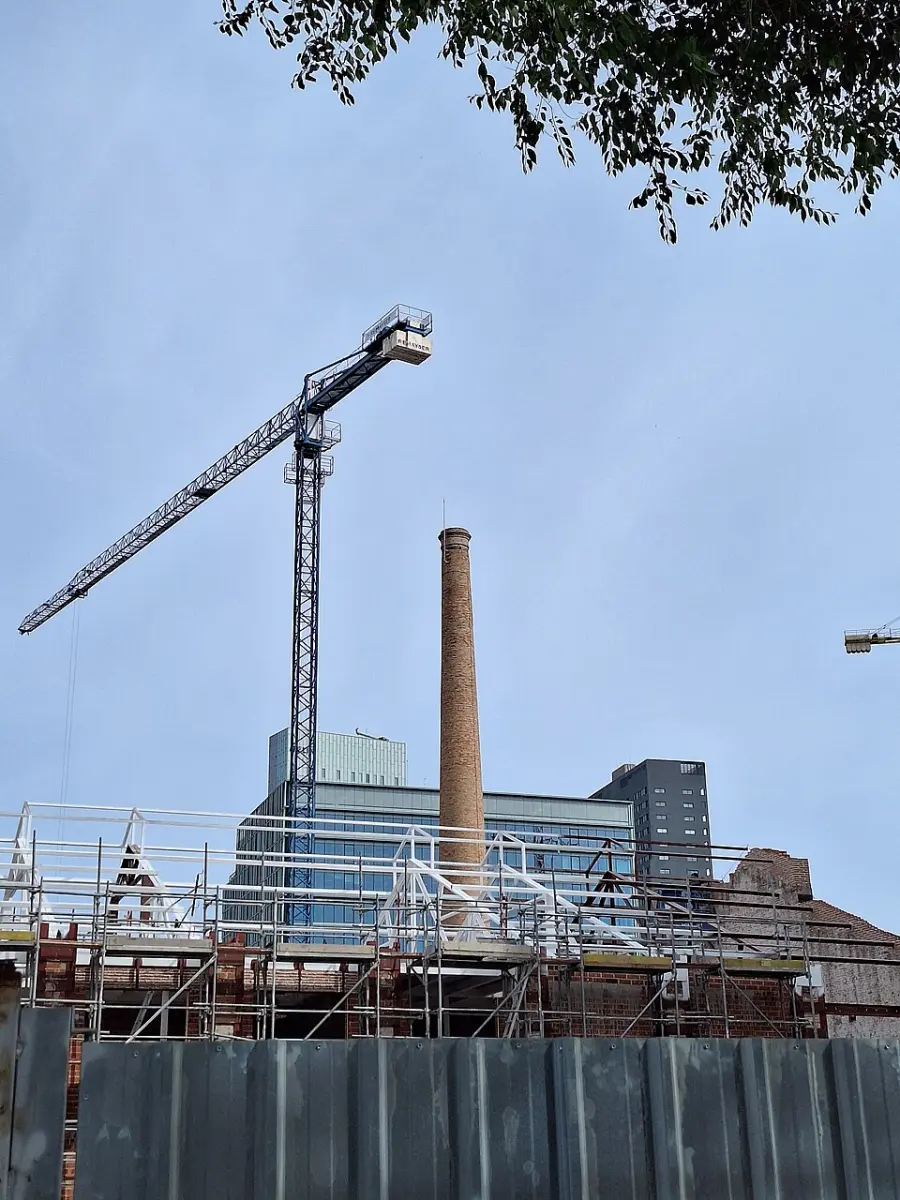
Photo: Pere López Brosa, CC BY-SA 4.0, via Wikimedia Commons (resized). Can Ricart has Catalonia's highest heritage protection, and it covers the equivalent of four blocks of the Eixample grid. On 14 March 1853 Jaume Ricart took land near the old Mataró road, today's Carrer de Pere IV, to build a steam-driven textile printing works. The architect Josep Oriol i Bernadet designed a T-shaped building; he is the same architect behind the former asylum on our Nou Barris walk. After his death in 1860, Josep Fontserè i Mestre took over. By 1884 the site covered 39,770 square metres. From 1922 the single factory was split into rented industrial units. The chimney, once connected to the steam engine and boiler rooms, still towers over the complex, alongside its clock tower.
Source: Viquipèdia, Can Ricart (Poblenou).
-
Ca l'Alier, from fishing-net twine to urban innovation
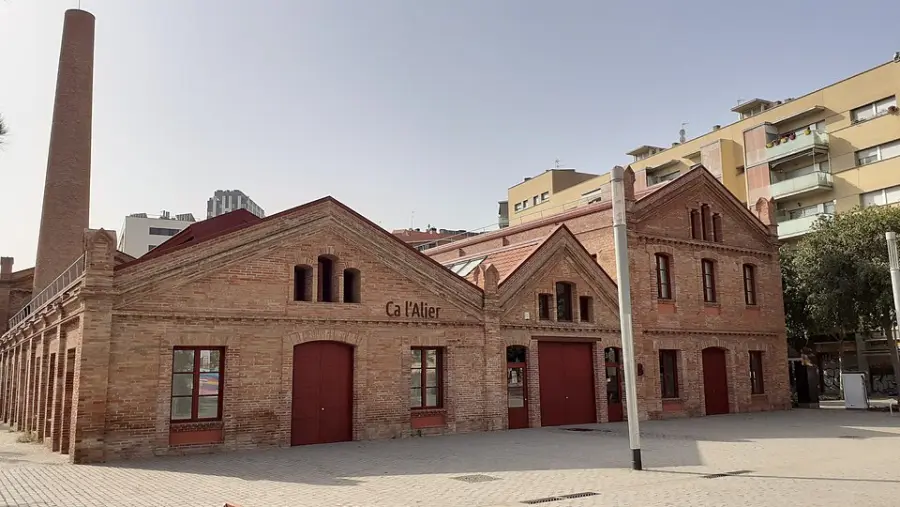
Photo: Herodotptlomeu, CC BY-SA 4.0, via Wikimedia Commons (resized). In 1852 the calico printer Josep Lucena i Parés set up a company here with his sons. In 1909 the engineer Pere Alier i Amar bought the site to make linen and hemp twine for fishing nets, along with sacks and linen and jute cloth. Between 2005 and 2007 four fires brought the roofs down. A restoration of about 10 million euros by the architects Jaume Arderiu and Tomàs Morató was finished in 2018, and the building became the home of BIT Habitat, the city's urban innovation foundation, and an innovation centre for Cisco. Its round, tapering chimney of exposed brick is a Poblenou landmark.
Sources: Viquipèdia, Ca l'Alier; Ajuntament de Barcelona press release, 7 June 2018.
-
La Escocesa, the Scottish factory
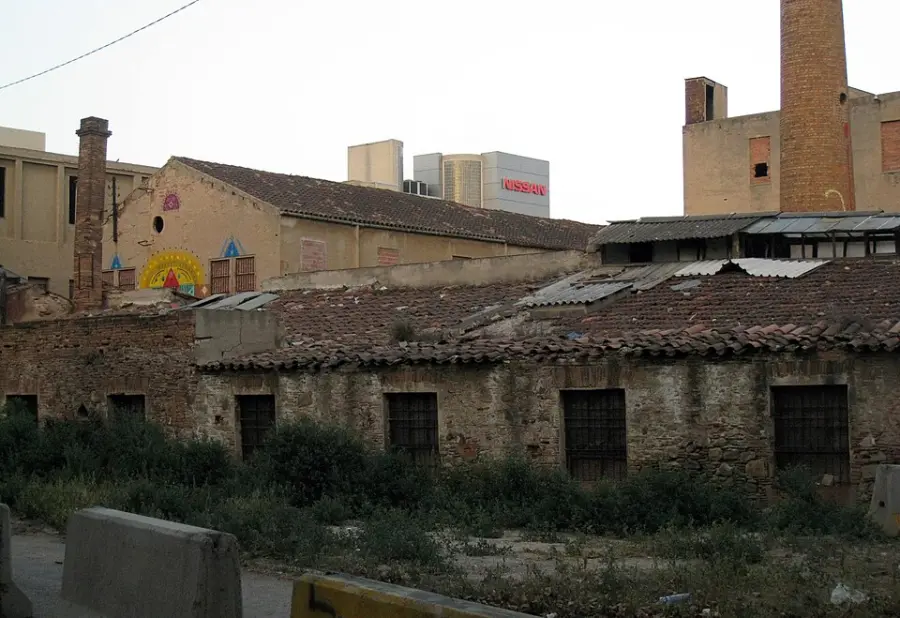
Photo: Enfo, CC BY-SA 3.0, via Wikimedia Commons (resized). The last stop began in 1852 as a chemical works. In 1894 an engineer from Nottingham and a Scottish industrialist rented its central sheds for a Catalan branch of Johnston, Shields & Co., and because the money came from Scotland the neighbourhood started calling it La Escocesa, the Scottish one. In 1922 the architect Enric Sagnier, who also built the church on our Horta walk, added two sheds on the corner of Pere IV. When the textile crisis ended production in 1984, the workers set up their own company and kept going until 1998. Artists arrived in the late 1990s. In 2017 the city completed its purchase of 93% of the protected complex, and today La Escocesa is a public centre with workspace for more than 30 resident artists and a programme of free public events. Its exposed-brick chimney gives the site its look.
Sources: Viquipèdia, La Escocesa; Fàbriques de Creació, La Escocesa; Ajuntament de Barcelona press release, 30 August 2017.


Practical details
- Getting there
- Metro L4 to Llacuna, exit at Carrer de Pujades.
- Length
- 2.4 km one way, about 32 minutes of walking. Allow an hour with the stops.
- Terrain
- Flat: every stop is between 5 and 14 m above sea level.
- Coffee
- Siberia, Carrer de la Selva de Mar 84, about five minutes from La Escocesa.
- Getting in
- Can Framis is a museum with opening hours and a ticket; check the city museums page. The other stops are seen from the street.
- Getting home
- Selva de Mar metro is about 740 m, ten minutes, from La Escocesa.
Longer walk: two more chimneys by the sea
With about 30 more minutes, continue roughly 1.1 km towards the coast. The Torre de les Aigües del Besòs was built in 1882 under the architect Pere Falqués, who also designed the Mercat de Sants, to supply water to the factories. In 1889 its water was declared undrinkable; later the metalworks MACOSA used it for cooling, and today it houses the Poblenou Historical Archive, with guided climbs to the top listed by the city. A few minutes on is Palo Alto, a spinning mill from the 1870s. The designer Xavier Mariscal set up his studio there in 1990 and argued for keeping it as a creative space; a foundation has run it since 1997. That makes seven stops and about 85 minutes in total.
Sources: Viquipèdia, Torre de les Aigües del Besòs; Ajuntament de Barcelona, Torre de les Aigües del Besòs; Viquipèdia, Gal i Puigsech.
Walking distance and times from the OSRM foot router on OpenStreetMap data. Elevations from Open-Meteo. Checked 15 September 2026.
Walk it with Strolio
Open Strolio at Llacuna metro and ask for an hour of Poblenou's industrial history. Stories play as you reach each place, and you can ask about any chimney you pass, by voice or with a photo.
Sources
- Museus de Barcelona: Museu Can Framis – Fundació Vila Casas
- Ajuntament de Barcelona: Finalitzen les obres a Ca l'Alier (7 June 2018)
- Fàbriques de Creació: La Escocesa
- Ajuntament de Barcelona: L'Ajuntament compra tres parcel·les de La Escocesa (30 August 2017)
- Ajuntament de Barcelona: Torre de les Aigües del Besòs
- Viquipèdia: Ca l'Aranyó, Can Framis (Poblenou), Can Ricart (Poblenou), Ca l'Alier, La Escocesa, Torre de les Aigües del Besòs, Gal i Puigsech, Estació de Llacuna
- Map data and places: © OpenStreetMap contributors, ODbL
- Photos: Wikimedia Commons contributors Enfo, Pere López Brosa and Herodotptlomeu, credited under each photo