
Jewish Quarter self-guided walking tour · 75 minutes · map
Amsterdam's Jewish Quarter on foot: from Rembrandt's house to the Hollandsche Schouwburg
For three and a half centuries, the streets east of the Nieuwmarkt were Amsterdam's Jewish Quarter, the Jodenbuurt. This 75-minute walk goes from Rembrandt's house past the flea market and two 17th-century synagogues to the memorials of the Weesperstraat and the Plantage, where the Hollandsche Schouwburg held Jews before they were deported in 1942 and 1943.
Sephardic Jews from Portugal and Spain settled around the Breestraat and Vlooienburg in 1593. Ashkenazi Jews from central and eastern Europe followed in the 17th century, and in 1616 the city made their presence legal. In February 1941 the German occupiers sealed off the Jodenhoek, where more than 25,000 Jews lived, and put up signs reading "Judenviertel / Joodsche Wijk". About three in four of Amsterdam's Jews were murdered. In the Hunger Winter of 1944–45 people tore the wood out of the empty houses for fuel, and after the war much of what was left made way for wide roads and the metro.
A note on accuracy: several stops are memorials, and some mark the site of what they remember. Where a building has been rebuilt or rearranged, we say so, and every fact links to its source. The Anne Frank House is not here but on the Prinsengracht; it is a stop on our Jordaan walk.
- Start
- The south side of the Nieuwmarkt, 23 m from the Nieuwmarkt metro entrance
- Finish
- The Hollandsche Schouwburg, Plantage Middenlaan 24, 15 m from the Artis tram stop
- Distance
- 2.0 km, one way
- Time
- About 75 minutes: 27 min walking and 8 stops, plus any visit to the museums or the Portuguese Synagogue
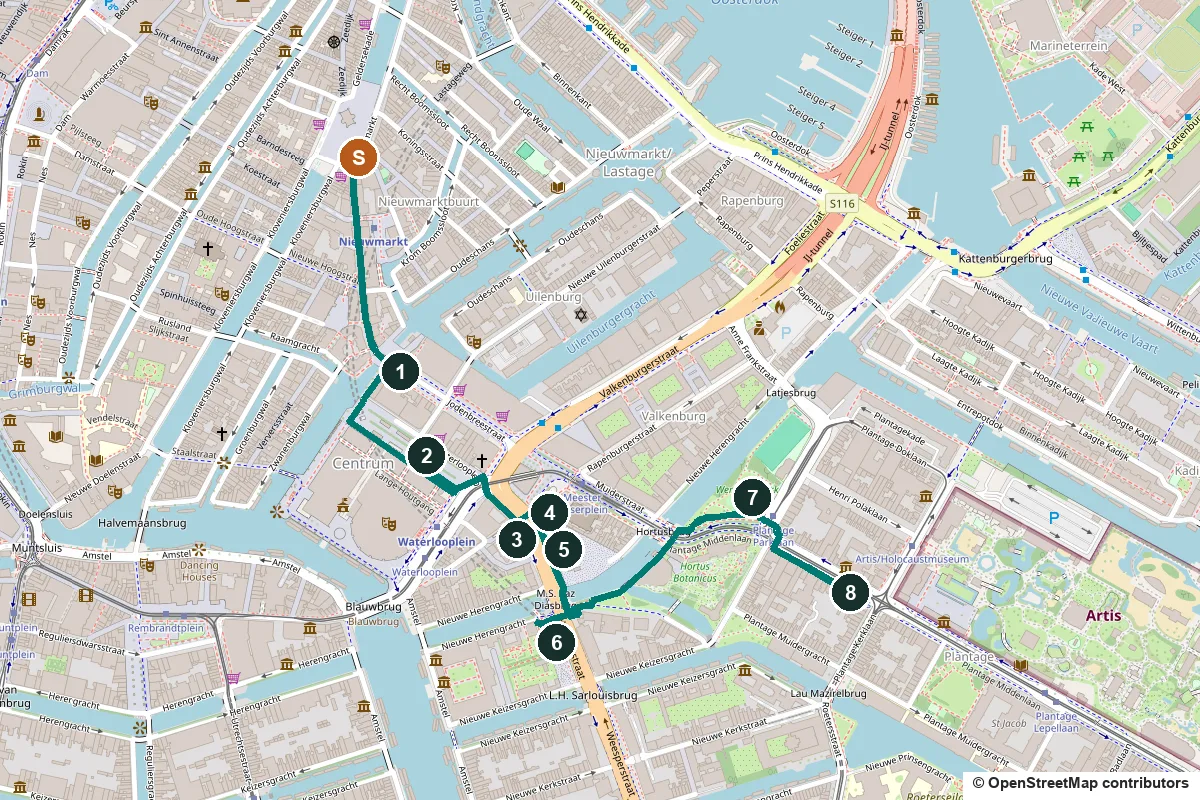
Terrain, water, opening days and a shorter version ↓
What to see: the stops
-
The Rembrandt House on the Jodenbreestraat
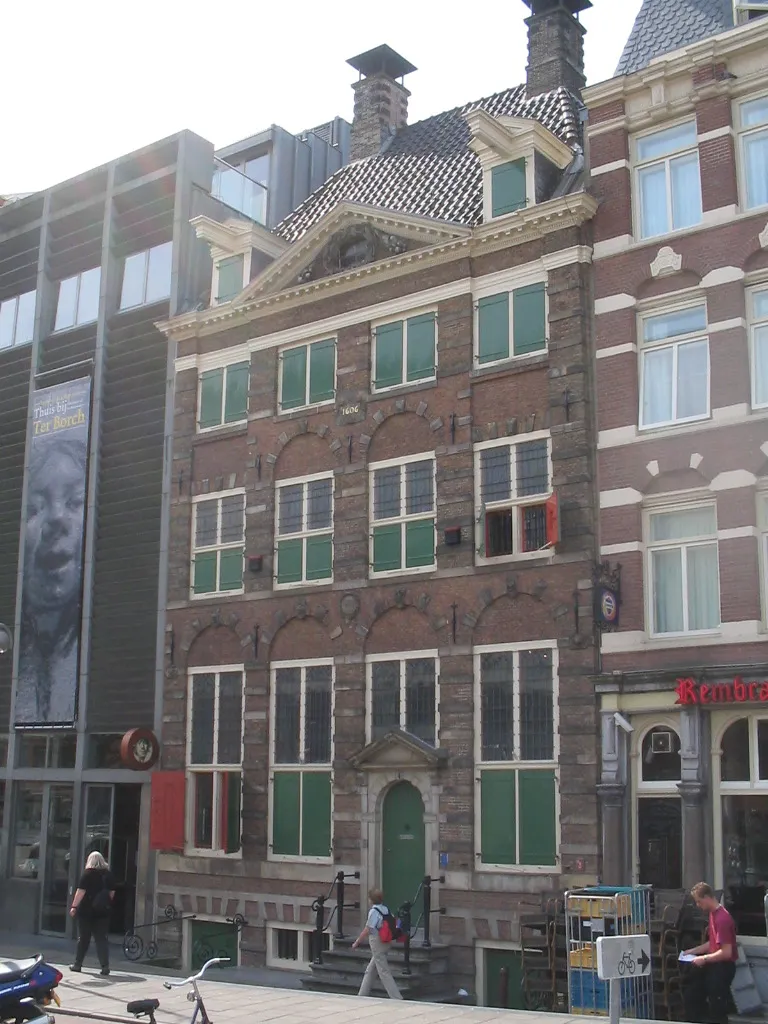
Jodenbreestraat 4. Photo: M.Minderhoud, CC BY-SA 3.0, via Wikimedia Commons (resized). From the south side of the Nieuwmarkt, where our old centre walk stops at the Waag, walk down the Sint Antoniesbreestraat. The monumental Huis De Pinto on this street was due to be demolished in 1975 but was saved, which is why the street keeps its narrow shape here, and turns wide after the lock bridge. Beyond the bridge, the old Breestraat became the Jodenbreestraat after many Jews settled here from 1619. Rembrandt lived at number 4 from 1639 to 1658. It was built around 1606 and given an extra floor and a new front with a triangular pediment around 1627, probably under Jacob van Campen. Rembrandt bought it on 5 January 1639 for 13,000 guilders and had his studio and art dealership here. After his bankruptcy it was auctioned in 1658 for 11,000. The city bought the run-down house in 1907, Karel de Bazel restored it, and it opened as a museum on 10 June 1911. The rooms are a reconstruction, furnished from the inventory drawn up at the bankruptcy in 1656. It opens every day from 10:00, except King's Day and 25 December.
More history
The museum owns an almost complete set of Rembrandt's etchings and some of his original copper plates. The street outside was widened from 12 to 40 metres in the 1960s and 1970s by pulling down its north side.
Sources: Wikipedia (nl), Rembrandthuis; Wikipedia, Rembrandt House Museum; Wikipedia (nl), Jodenbreestraat. Visiting: the Rembrandt House Museum's visitor information.
-
The Waterlooplein market
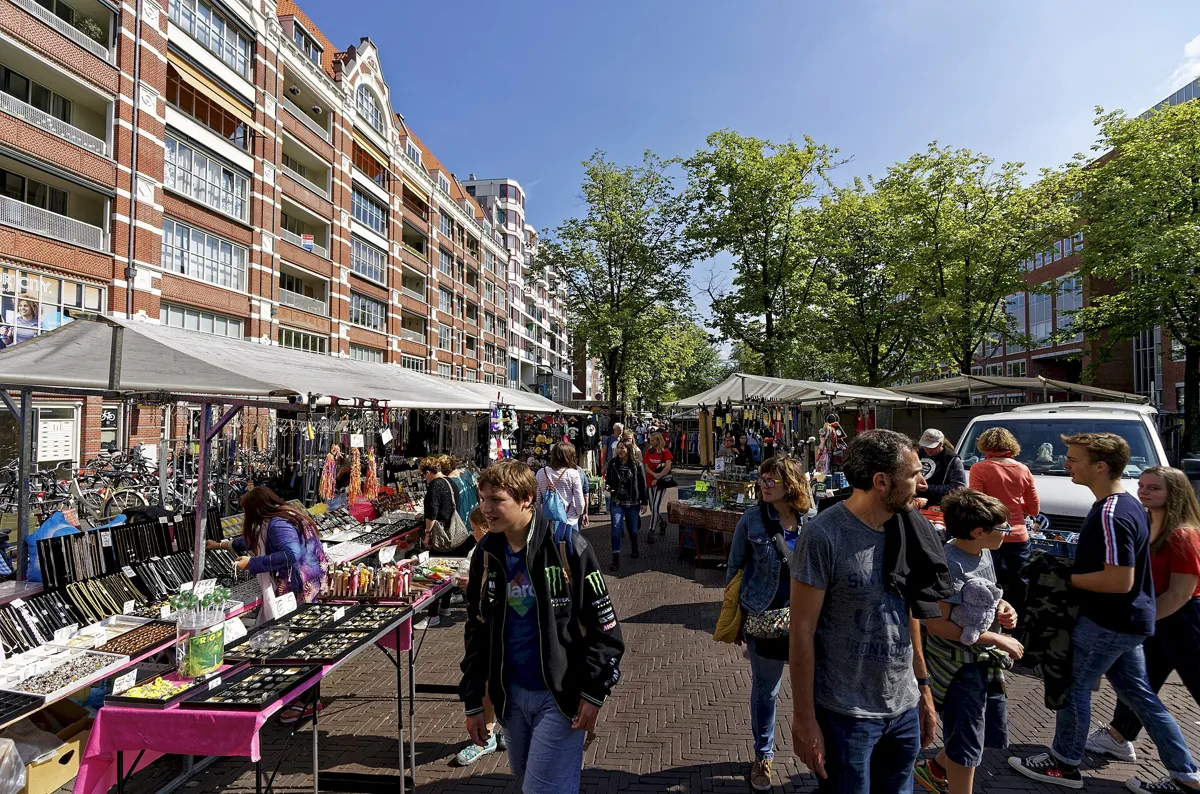
The flea market on the Waterlooplein. Photo: Txllxt TxllxT, CC BY-SA 4.0, via Wikimedia Commons (resized). Go back to the lock bridge, the Sint Antoniessluis, and follow the Zwanenburgwal into the market. The square lies on Vlooienburg, one of the islands that formed the old Jodenhoek. The philosopher Baruch Spinoza was born in 1632 on the Houtgracht, a canal now under this square, and in 1639 the Portuguese Jews built their first synagogue that could be seen from the street on the same canal. The square was made in 1882 by filling in two canals, and named after the Battle of Waterloo. The city ordered the mostly Jewish street traders of the Jodenbreestraat to move here, and from 1893 it was a daily market, closed only on Saturdays, the Sabbath. By 1941 that market had gone. After the war it became a flea market, today about 300 stalls, open Monday to Saturday. Most of the old square disappeared when the metro and the Stopera, the city hall and opera house standing here since 1986, were built.
More history
On 11 February 1941 the Waterlooplein saw a pitched battle between the WA, the militia of the Dutch Nazi party, and Jewish self-defence groups. A WA man died of his injuries. The next day German troops and Dutch police cut the old Jewish neighbourhood off with barbed wire, raised bridges and checkpoints.
Sources: Wikipedia (nl), Waterlooplein; Wikipedia, Waterlooplein; Wikipedia (nl), Jodenbreestraat; Wikipedia (nl), Portugees-Israëlietische Synagoge; Wikipedia, February strike. Market days: I amsterdam.
-
The Great Synagogue, now the Jewish Museum
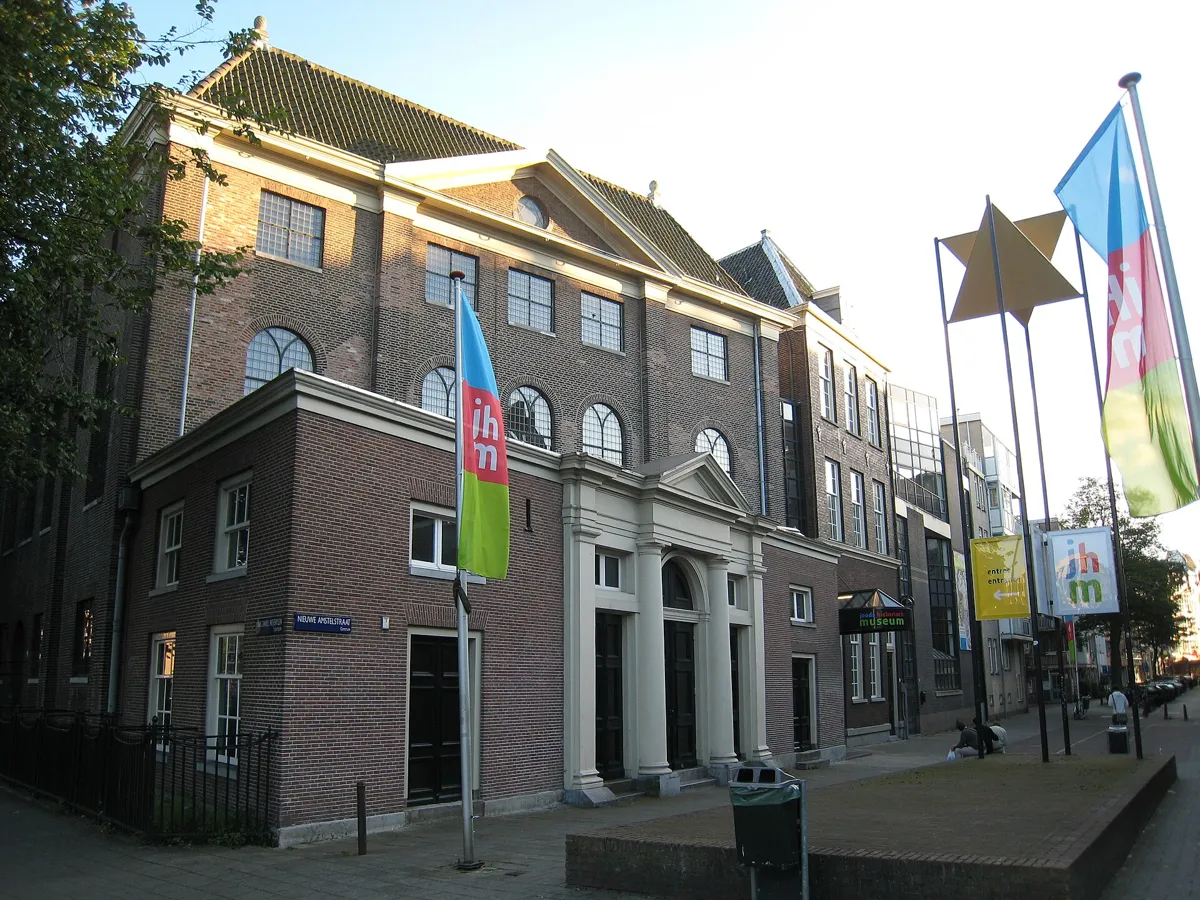
The Great Synagogue's porch on Nieuwe Amstelstraat, with the museum's old "jhm" flags. Photo: S Sepp, CC BY-SA 3.0, via Wikimedia Commons (resized). Leave the market at its south-east corner and follow the footpath to Nieuwe Amstelstraat 1. The brick building with the white columned porch is the Great Synagogue, the Grote Sjoel, of the Ashkenazi community founded in 1635. Elias Bouman built it, and it was consecrated on 25 March 1671, the first day of Passover. It cost 33,000 guilders, partly lent by the city. A synagogue so plainly on a public street was rare in 17th-century Europe. As the community grew, three more were built beside it: the Obbene Sjoel (1685), the Dritt Sjoel (1700) and the Neie Sjoel (1752). The porch dates from 1822–23. In September 1943 the occupiers closed the synagogue; the last service was held on 28 September. In the Hunger Winter its galleries were torn out for firewood, but its marble ark survived. Since 1987 the four buildings have housed the Jewish Museum, called the Jewish Historical Museum until 2021. It is open every day from 11:00 to 17:00.
More history
Inside, the silver Rintel chanukiah, given to the Great Synagogue by Sara Rintel in 1753, still stands where it stood for more than two hundred years.
Sources: Wikipedia (nl), Grote Synagoge; Wikipedia (nl), Joods Museum; Wikipedia, Joods Historisch Museum; Wikipedia (nl), Jodenbuurt. Visiting: Jewish Cultural Quarter, Jewish Museum.
-
The Portuguese Synagogue of 1675
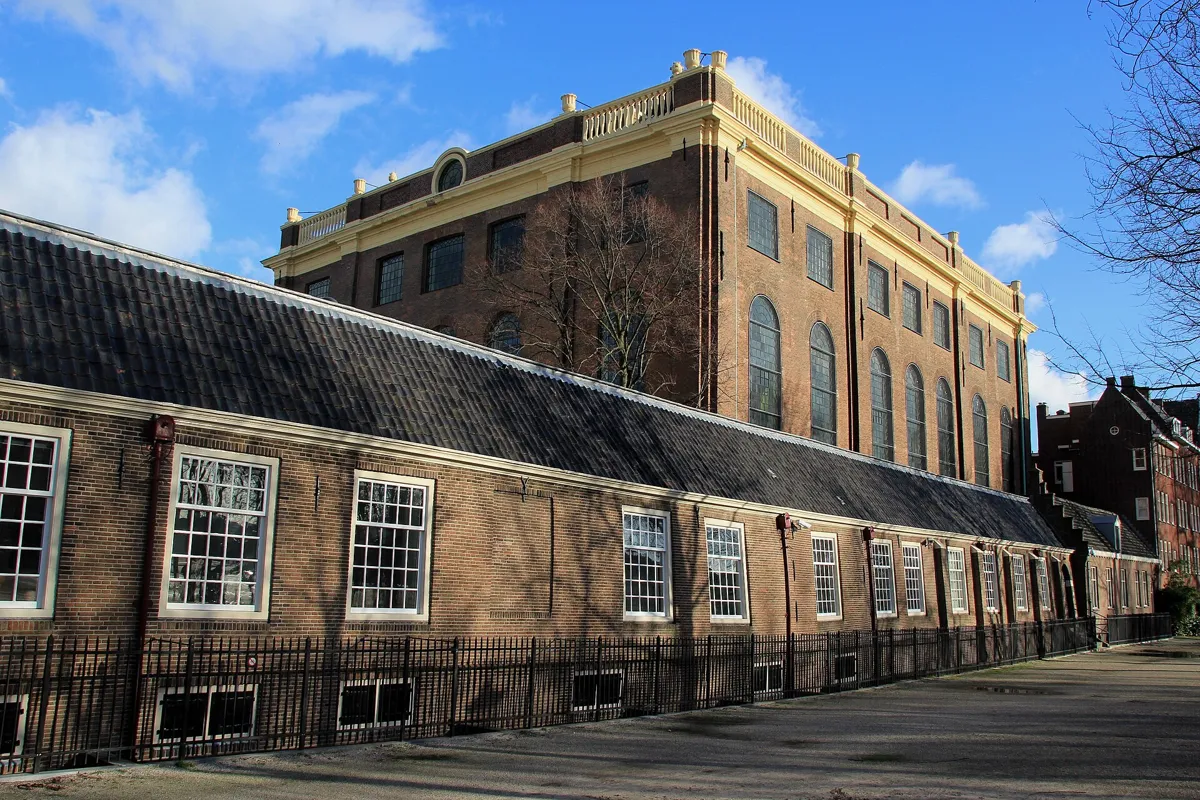
The synagogue behind its low outbuildings. Photo: A.A.W.J. Rietman, CC BY-SA 4.0, via Wikimedia Commons (resized). The big brick block across the Jonas Daniël Meijerplein is the Portuguese Synagogue, the Esnoga; its entrance is at Mr Visserplein 3. Rabbi Isaac Aboab da Fonseca started the project in 1671 and Elias Bouman designed it. It was inaugurated on 2 August 1675 with eight days of ceremonies, after the dedication of the Temple in Jerusalem. It was then the largest synagogue in the world. Low buildings close in the synagogue and its forecourt on three sides, a layout that recalls Solomon's Temple. Over the door are a verse from Psalm 5, the year 1672, when it was meant to be finished, and the name Aboab. The congregation, formed in 1639 from three Portuguese congregations, still worships here. Hundreds of candles, not electric lights, light the inside. Visits are Sunday to Thursday 11:00 to 17:00, shorter on Fridays, closed on Saturdays and some Jewish holidays.
More history
In the war the Nazis planned to use it as a deportation centre; Leo Palache and a team of volunteers talked them out of it, and ritual objects of deported Jews were hidden in its ceiling and attic. The Ets Haim library in the outbuildings, founded in 1616 and here since 1675, was added to UNESCO's Memory of the World register in 2003.
Sources: Wikipedia (nl), Portugees-Israëlietische Synagoge; Wikipedia, Portuguese Synagogue. Visiting: Jewish Cultural Quarter, Portuguese Synagogue.
-
The Dokwerker and the February Strike
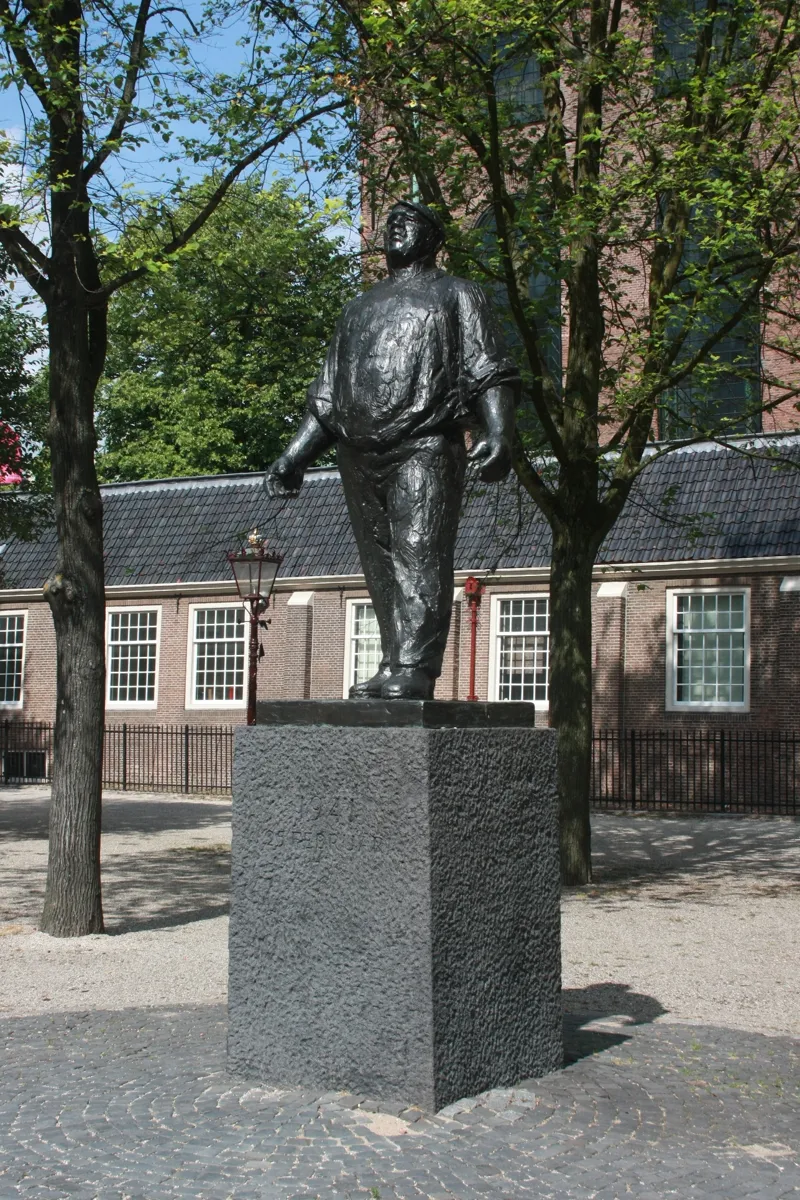
Mari Andriessen's Dokwerker on the Jonas Daniël Meijerplein. Photo: A.A.W.J. Rietman, CC BY-SA 4.0, via Wikimedia Commons (resized). Walk back onto the square to the bronze docker. On this square, on 22 and 23 February 1941, the Germans rounded up Jewish men in the first big raids in Amsterdam. In all 425 men aged 20 to 35 were taken and sent to Buchenwald and Mauthausen; only two survived the war. On 25 February the city went on strike, starting with the trams. The banned Communist Party called it with leaflets headed "STAAKT!!! STAAKT!!! STAAKT!!!" ("Strike!"), and it spread to the Zaan towns, Haarlem, Hilversum and Utrecht. The occupiers broke it in two days, killing nine people. Dutch Wikipedia calls it the only mass, open protest against the persecution of the Jews in occupied Europe. The city commissioned Mari Andriessen's statue, an ordinary docker rather than an idealised worker; the Haarlem carpenter Willem Termetz posed for it. Queen Juliana unveiled it on 19 December 1952. The strike is remembered here every 25 February.
More history
The square was the Deventer Houtmarkt until the 19th century, when it was named after Jonas Daniël Meijer (1780–1834), the first Jewish lawyer in the Netherlands. On 14 August 1942 the occupation-era mayor renamed it "Houtmarkt"; the old name came back in 1945.
Sources: Wikipedia (nl), De Dokwerker; Wikipedia (nl), Februaristaking; Wikipedia, February strike; Wikipedia (nl), Jonas Daniël Meijerplein.
-
The National Holocaust Names Memorial
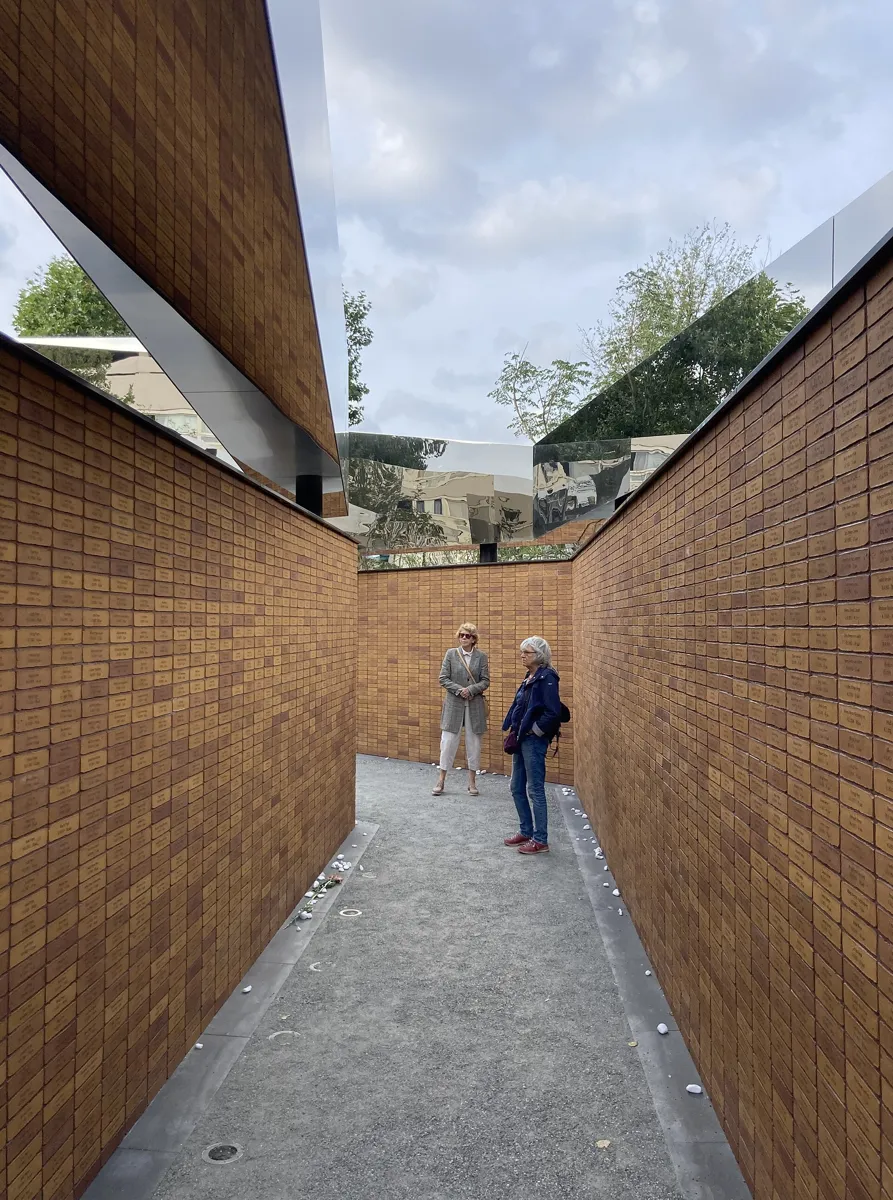
Between the walls of names. Photo: Christian Michelides, CC BY-SA 4.0, via Wikimedia Commons (resized). Cross the square southwards and take the bridge, the M.S. Vaz Diasbrug, over the Nieuwe Herengracht to the Weesperstraat; the memorial runs along the west side of the street. Before the war almost everyone on the Weesperstraat was Jewish; afterwards its houses were pulled down for a through road. Here, on 19 September 2021, King Willem-Alexander and Jacques Grishaver of the Dutch Auschwitz Committee, who proposed the memorial in 2006, unveiled Daniel Libeskind's design. It names more than 102,000 Jews and 220 Sinti and Roma from the Netherlands who were killed and have no grave. Each brick carries one name, a date of birth and an age at death, in alphabetical order. The walls form four Hebrew letters meaning "In memory of", repeated in mirrored steel on top. A narrow gap makes the letters seem to float, a sign of the break in the history and culture of the Dutch people. Entry is free, from 8:00 to 20:00 (21:00 from 1 March to 1 October). A QR code on site helps you find a name.
More history
Libeskind's first design was meant for the Wertheimpark, the next stop, but residents rejected it, and in 2014 the city chose this strip. A wall of 1,000 blank bricks keeps space for victims identified later.
Sources: Holocaust Namenmonument, concept; site; news of the unveiling; Wikipedia (nl), Holocaust Namenmonument; Wikipedia, National Holocaust Names Memorial. Visiting: Visit the Monument.
-
The Wertheimpark and the Auschwitz monument
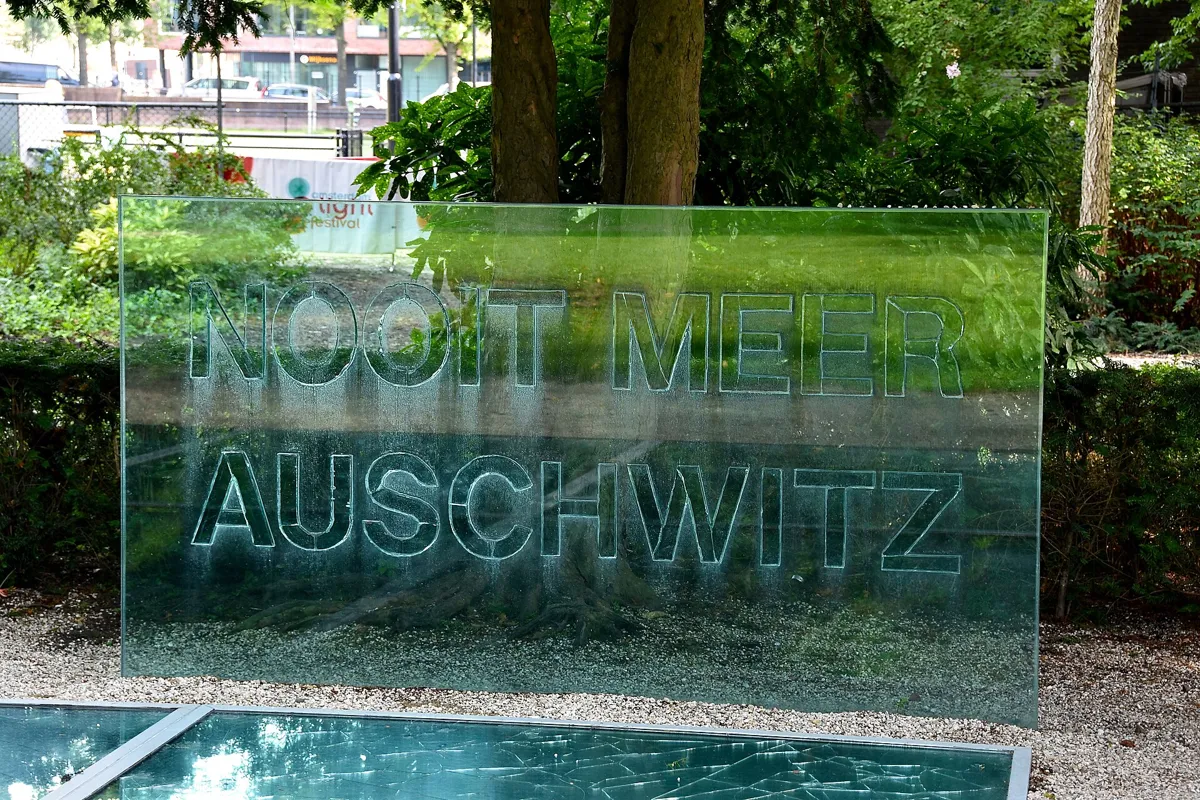
"Nooit meer Auschwitz", Never again Auschwitz. Photo: FaceMePLS from The Hague, The Netherlands, CC BY 2.0, via Wikimedia Commons (resized). Walk back to the Nieuwe Herengracht and follow the Hortusplantsoen east, alongside the Hortus Botanicus, a botanical garden here since 1682, then the Dr. D.M. Sluyspad into the Wertheimpark. This green strip has been a park since 1812, when the city architect Abraham van der Hart laid it out, and it is the only park in the city-centre district. In 1898 it was named after Abraham Carel Wertheim (1832–1897), a Jewish businessman and philanthropist. From 14 August 1942 until May 1945 the occupation-era mayor renamed it "Parktuin". In the park lies Jan Wolkers' Auschwitz monument: cracked mirrors on the ground, which reflect the sky, and the words "Nooit meer Auschwitz", Never again Auschwitz. Wolkers said the broken glass shows that after Auschwitz the sky can never be whole again. Under it is an urn of ashes collected at Auschwitz-Birkenau in January 1952. The National Holocaust Remembrance is held here on the last Sunday of January, close to 27 January, the day Auschwitz was liberated in 1945.
More history
The urn was first placed under a simple gravestone at De Nieuwe Ooster cemetery. Wolkers' mirror monument replaced that stone in 1977, and in 1993 it was moved here in a larger form. It has been smashed several times since.
Sources: Wikipedia (nl), Wertheimpark; Wikipedia (nl), Auschwitzmonument; Wikipedia (nl), Plantage.
-
The Hollandsche Schouwburg and the National Holocaust Museum
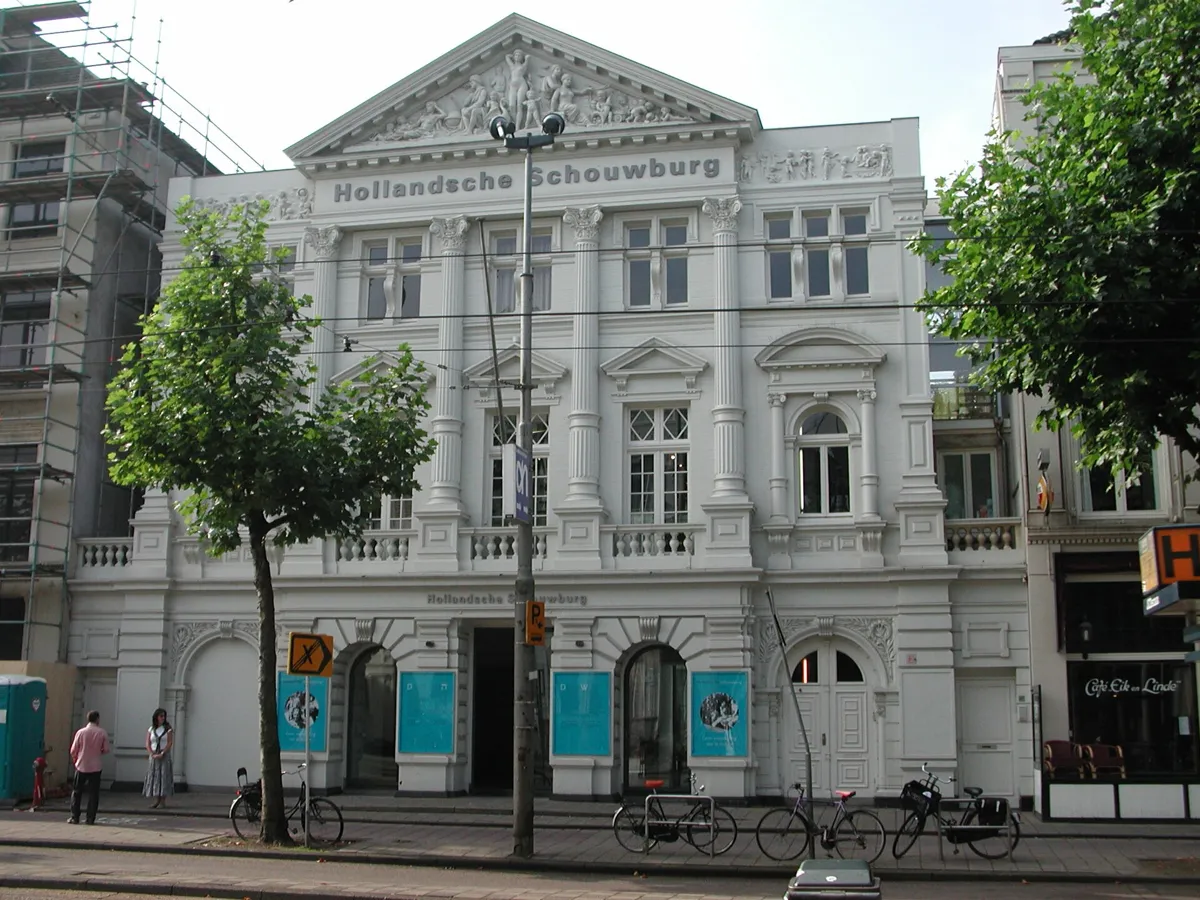
The theatre front at Plantage Middenlaan 24. Photo: P.H. Louw, CC BY 2.5, via Wikimedia Commons (resized). Leave the park on the Plantage Middenlaan and walk east to the white front at number 24. It opened on 5 May 1892 as the Artis Schouwburg; as the Hollandsche Schouwburg it staged the premieres of Herman Heijermans' plays. In 1941 the occupiers renamed it the Joodsche Schouwburg, for Jewish performers and Jewish audiences only; the last performance was on 12 July 1942. From July 1942 Jews ordered to report for deportation were held here, for hours, days or weeks, before being sent on through Westerbork and Vught to the camps. Tens of thousands passed through these doors. Children were held opposite, in a crèche at number 31. Its director Henriëtte Pimentel and the theatre's manager Walter Süskind, with others, smuggled them out, in bags and baskets, when a passing tram hid the door from the guards, or through the garden of the teacher training college at number 27, whose head, Johan van Hulst, helped. Estimates run from about 500 to over 1,000 children saved. Since 1962 the theatre has been a memorial: its auditorium is an open courtyard with a pillar where the stage stood, and a wall lists about 6,700 family names. Entry is free, every day from 10:00 to 17:00.
More history
The college at number 27 is now the National Holocaust Museum, the first to tell the story of the persecution of the Jews across the whole Netherlands. King Willem-Alexander opened it on 10 March 2024. It opens every day from 10:00 to 17:00; adult tickets are €20.
Sources: Wikipedia (nl), Hollandsche Schouwburg; Wikipedia (nl), Kindersmokkel Hollandsche Schouwburg; Wikipedia, Hollandsche Schouwburg; Wikipedia (nl), Nationaal Holocaustmuseum. Visiting: Jewish Cultural Quarter, Hollandsche Schouwburg and National Holocaust Museum.


Practical details
- Terrain
- Flat, on paved streets, squares and short footpaths, with a few canal bridges. The Waterlooplein is a market square, so expect crowds and stalls in the way on market days.
- Step-free
- OpenStreetMap maps several flights of steps around the Names Memorial, one of 15 steps about 30 m from our pin. The memorial's own entrances on the Nieuwe Keizersgracht and the Nieuwe Herengracht are wheelchair accessible, but the Weesperstraat exit of Waterlooplein metro has no lift. The Rembrandt House has steep, narrow stairs and no lift in the historic house; a lift serves only its modern wing. The Jewish Cultural Quarter says its buildings have lifts. OpenStreetMap marks the Nieuwmarkt metro entrance at the start as wheelchair accessible.
- Water
- OpenStreetMap lists Waternet drinking taps at the Nieuwmarkt, near the Dokwerker and by the Auschwitz monument in the Wertheimpark. There is also an unlabelled fountain near the Waterlooplein market.
- Toilets
- OpenStreetMap shows only one toilet near the route, a customers-only toilet about 145 m from the Auschwitz monument. The Rembrandt House has toilets, including one for wheelchair users.
- When to go
- The Rembrandt House opens daily from 10:00, except King's Day and 25 December. The Waterlooplein market is open Monday to Saturday, so go on a day other than Sunday. The Jewish Museum opens daily 11:00–17:00. The Portuguese Synagogue opens Sunday to Thursday 11:00–17:00, Friday 11:00–16:00, and is closed on Saturdays and some Jewish holidays. The Hollandsche Schouwburg (free) and the National Holocaust Museum open daily 10:00–17:00. The Names Memorial is free and open from 8:00. Tickets for the Jewish Museum, the synagogue and the Holocaust Museum cost money; check before you go.
- Shorter walk
- Finish at stop 6, the Names Memorial: 1.3 km, about 17 minutes of walking. Waterlooplein metro (lines 51, 53 and 54) is close by, but its Weesperstraat exit has no lift.
- Getting back
- The Artis tram stop is 15 m from the Hollandsche Schouwburg, and the Artis/Holocaustmuseum stop 113 m. According to the Jewish Cultural Quarter, tram 14 runs from there to Centraal Station.
Walking distances and times from the OSRM foot router on OpenStreetMap data. Stations, fountains, toilets and steps from OpenStreetMap; opening times, prices and access from the Jewish Cultural Quarter, the Rembrandt House Museum, the Holocaust Namenmonument and I amsterdam. Checked 5 October 2026.
Questions people ask
How long does the Jewish Quarter walking tour in Amsterdam take?
About 75 minutes: 2.0 km, 27 minutes of walking and eight stops, from the Nieuwmarkt to the Hollandsche Schouwburg. Allow more if you go inside the Rembrandt House, the Jewish Museum, the Portuguese Synagogue or the National Holocaust Museum. The map is on this page, and you can print it or save it as a PDF.
Where is the Jewish Quarter in Amsterdam?
East of the Nieuwmarkt. The old Jodenbuurt ran along the Jodenbreestraat, the Waterlooplein, the islands of Uilenburg, Vlooienburg and Rapenburg and the Nieuwe Herengracht, and later spread into the Weesperstraat and the Plantage. Many of its houses were pulled down after the Second World War; the 17th-century synagogues on the Jonas Daniël Meijerplein survive. The Anne Frank House is not in the Jewish Quarter but on the Prinsengracht, on our Jordaan walk.
Can you visit the Portuguese Synagogue in Amsterdam?
Yes. It is still a working synagogue, open to visitors when there is no service: Sunday to Thursday 11:00 to 17:00, shorter hours on Friday, closed on Saturday and some Jewish holidays. Tickets come from the Jewish Cultural Quarter: €20 for adults with the Jewish Museum, or €30 for all four of its sites, €2 more at the desk. Check before you go.
What is the Holocaust Names Memorial in Amsterdam?
A national memorial on the Weesperstraat, designed by Daniel Libeskind and unveiled on 19 September 2021. Its brick walls carry the names of more than 102,000 Jews and 220 Sinti and Roma from the Netherlands who were killed in the Holocaust and have no grave, one name, birth date and age per brick. It is free and open daily from 8:00.
What was the February Strike of 1941?
A strike on 25 and 26 February 1941 against the first round-ups of Jews in Amsterdam, after 425 Jewish men were rounded up on the Jonas Daniël Meijerplein and taken away. Called by the banned Communist Party, it began with the trams and spread to other towns. The occupiers crushed it in two days. Dutch Wikipedia calls it the only mass, open protest against the persecution of the Jews in occupied Europe. It is remembered every 25 February at the Dokwerker statue.
Walk it with Strolio
Open Strolio at the Nieuwmarkt and ask for 75 minutes through the Jewish Quarter. Strolio builds walks in any city with mapped streets, so its route may pick different stops from this page. Stories play as you reach each place, and you can ask about anything else you pass, by voice or with a photo. You can also start from your hotel and choose your own time and interests.
More walks in Amsterdam
- The Jordaan: ~80 min, 8 stops. The Nine Streets, Rembrandt's Westerkerk, the Anne Frank House, a 1650 widows' courtyard and the Brouwersgracht.
- Old Centre and Red Light District: ~75 min, 8 stops. From Centraal Station through De Wallen, past Amsterdam's oldest church and a hidden attic church, to the Dam and the Begijnhof.
- The Canal Ring to Museumplein: ~90 min, 8 stops. From the Munttoren and the Golden Bend to the Magere Brug, then a walk through the Rijksmuseum itself.
- All Amsterdam walks, with maps side by side.
- Walks in other cities.
Sources
- Jewish Cultural Quarter (Joods Cultureel Kwartier): Portuguese Synagogue, Jewish Museum, Hollandsche Schouwburg, National Holocaust Museum, opening hours and tickets
- Holocaust Namenmonument: concept, site, visiting
- Rembrandt House Museum: visitor information, accessibility; I amsterdam: Waterlooplein Market
- Wikipedia (Dutch): Jodenbuurt, Jodenbreestraat, Rembrandthuis, Waterlooplein, Grote Synagoge, Joods Museum, Portugees-Israëlietische Synagoge, De Dokwerker, Februaristaking, Jonas Daniël Meijerplein, Holocaust Namenmonument, Wertheimpark, Auschwitzmonument, Plantage, Hollandsche Schouwburg, Kindersmokkel Hollandsche Schouwburg, Nationaal Holocaustmuseum
- Wikipedia (English): Rembrandt House Museum, Waterlooplein, Joods Historisch Museum, Portuguese Synagogue, February strike, National Holocaust Names Memorial, Hollandsche Schouwburg
- Map data and places: © OpenStreetMap contributors, ODbL; walking route from the OSRM foot router run by FOSSGIS
- Photos: Wikimedia Commons contributors M.Minderhoud, Txllxt TxllxT, S Sepp, A.A.W.J. Rietman, Christian Michelides, FaceMePLS and P.H. Louw, credited under each photo