
Rome self-guided walking tour · about 70 minutes · map
Rome's historic centre on foot: from Bruno's pyre to the Pantheon, the Trevi Fountain and the Spanish Steps
This walk crosses the old heart of Rome, from the market square where Giordano Bruno was burned to the foot of the Spanish Steps. On the way: a piazza shaped by a Roman stadium, a temple that has been a church since 609, Bernini's elephant, a painted dome, and the Trevi Fountain.
One thread runs through the first half. The Roman Inquisition sent Bruno to the stake in Campo de' Fiori in 1600. Cardinal Robert Bellarmine oversaw his trial and in 1616 summoned Galileo, who later recanted in 1633 in the convent on Piazza della Minerva. Bellarmine is buried in Sant'Ignazio, stop 5. The second half follows the Acqua Vergine, the aqueduct behind the fountains at Trevi and Piazza di Spagna.
A note on accuracy: some of what you see is not the original. The dome in Sant'Ignazio is an 1823 repainting, and the Pantheon's inscription names a builder whose temple burned down. Where that happens, we say so, and every fact links to its source.
- Start
- Campo de' Fiori, at the statue of Giordano Bruno; the Arenula/Cairoli tram stop is about 350 m away
- Finish
- The Spanish Steps, Piazza di Spagna, about 100 m from Spagna metro (line A)
- Distance
- 2.5 km, one way
- Time
- About 70 minutes: 33 min walking and 7 stops; about two hours with a visit inside the Pantheon
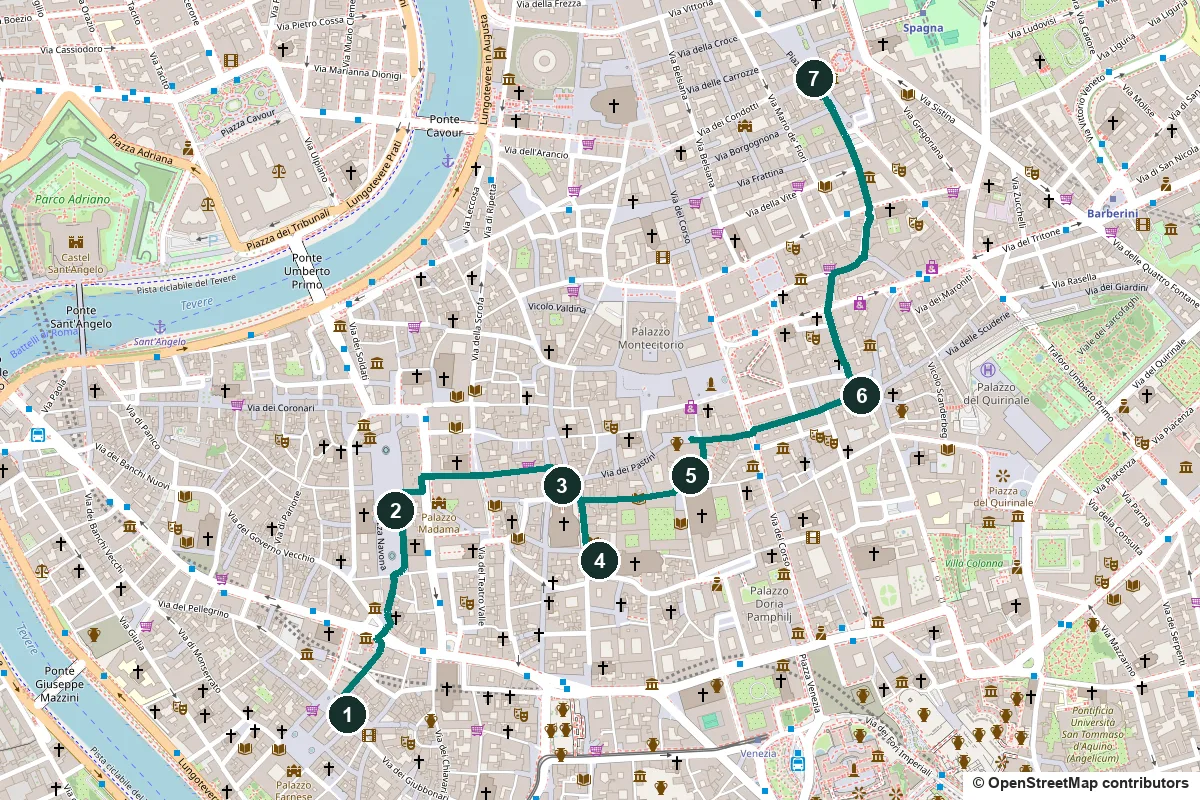
Terrain, water, tickets and a shorter version ↓
What to see: the stops
-
Campo de' Fiori and the statue of Giordano Bruno
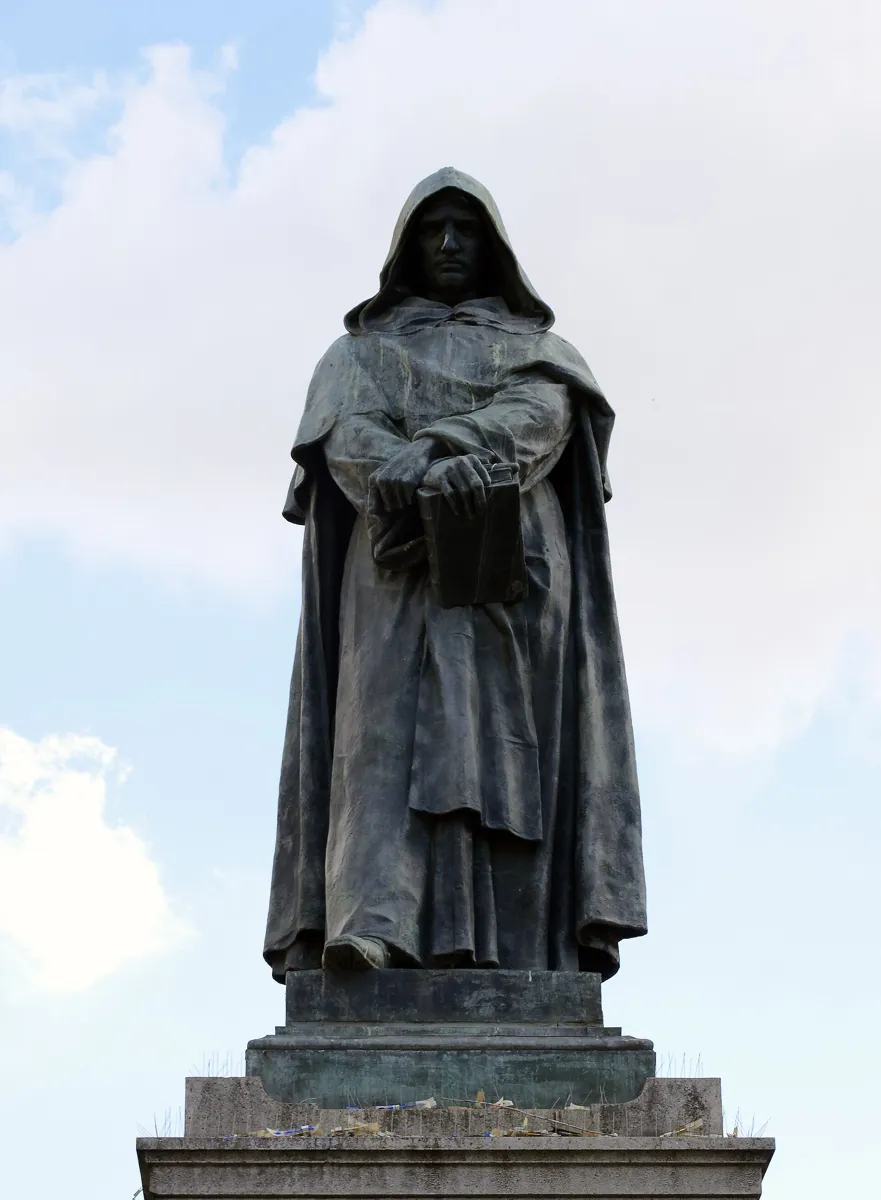
Ettore Ferrari's statue of Bruno, 1889. Photo: Livioandronico2013, CC BY-SA 4.0, via Wikimedia Commons (resized). Start at the hooded bronze figure in the middle of the square. The name means "field of flowers": until the 15th century this was a meadow, and Pope Callixtus III had it paved in 1456. Public executions were held here. On 17 February 1600 the philosopher Giordano Bruno, a Dominican friar from Nola, was burned alive for heresy, and his ashes were thrown into the Tiber. Ettore Ferrari's statue stands on the spot. Students began campaigning for it in 1876, against fierce Church opposition, and it was unveiled on 9 June 1889, facing the Vatican. The Italian words on the base read: "To Bruno, from the age he foresaw, here where the fire burned." The square has held a daily market since 1869, when it moved here from Piazza Navona.
More history
Bruno's trial lasted seven years and was overseen by Cardinal Bellarmine. The eight medallions on the base show thinkers who clashed with religious authority, among them Jan Hus, John Wycliffe and Michael Servetus, whom Calvinists burned in Geneva. One was meant to be Galileo, but he was left out because he had recanted.
Every 17 February freethinkers gather at the statue, and a representative of the city lays a wreath. A plaque from 2011 recalls that the Inquisition burned copies of the Talmud in this square on 9 September 1553.
Sources: Wikipedia (it), Campo de' Fiori; Wikipedia (it), Monumento a Giordano Bruno; Wikipedia, Campo de' Fiori; Wikipedia, Monument to Giordano Bruno; Wikipedia, Giordano Bruno.
-
Piazza Navona, a Roman stadium turned Baroque stage
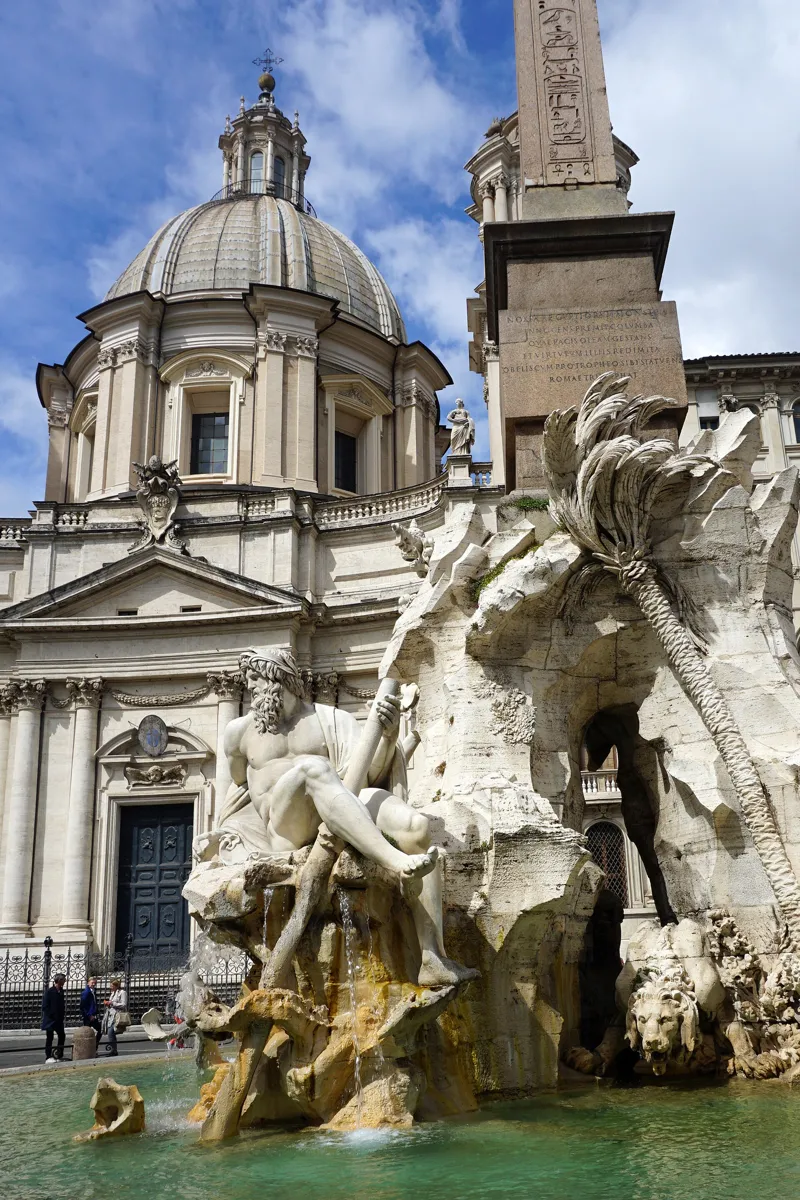
The Ganges, with Sant'Agnese in Agone behind. Photo: Mariordo (Mario Roberto Durán Ortiz), CC BY-SA 4.0, via Wikimedia Commons (resized). Walk up Via dei Baullari, cross Corso Vittorio Emanuele II and follow Via della Cuccagna into the south end of the square. Its long shape, rounded at the far end, is the outline of the Stadium of Domitian, built in the 80s AD for Greek-style athletics and holding about 30,000 people. The ancient ground lies about 5 m below your feet. Pope Innocent X, whose family palace, the Palazzo Pamphilj, faces the square, made it a Baroque showpiece. In the middle stands Bernini's Fountain of the Four Rivers (1648–51): an obelisk from the Circus of Maxentius on the Appian Way, set on a hollow rock. The four giants are the Danube, the Ganges, the Nile and the Río de la Plata, one for each continent then known. The Nile hides his head because no one knew where the river rose, not, as guides like to say, to avoid seeing Borromini's church: Sant'Agnese in Agone, behind, was only begun in 1652, after the fountain. It marks where Saint Agnes was said to have been martyred.
More history
The fountain was built during a famine, and Romans resented the cost. In 1648 notes were stuck to the obelisk's blocks: "We do not want obelisks and fountains, we want bread." From 1652 to 1866 the square was flooded on weekends in August. At the north end, on Piazza di Tor Sanguigna, you can look down from the street at arches of the stadium, uncovered in 1936.
Sources: Wikipedia (it), Piazza Navona; Wikipedia (it), Stadio di Domiziano; Wikipedia (it), Fontana dei Quattro Fiumi; Wikipedia, Fontana dei Quattro Fiumi; Wikipedia, Piazza Navona; Wikipedia, Sant'Agnese in Agone.
-
The Pantheon, a Roman temple that became a church
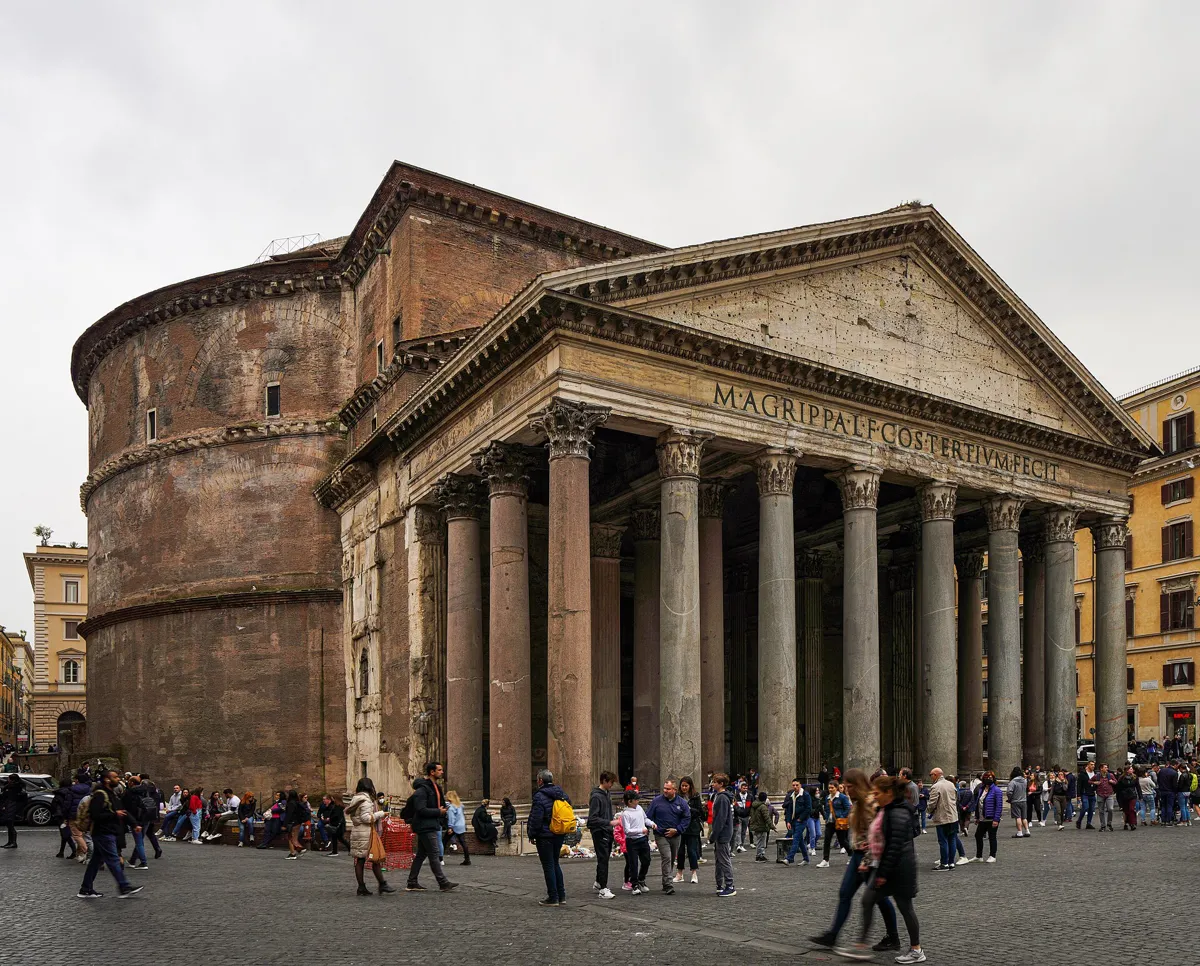
The porch and the brick rotunda. Photo: NikonZ7II, CC BY-SA 4.0, via Wikimedia Commons (resized). Leave by Corsia Agonale, opposite the fountain, then follow Via del Salvatore and Via Giustiniani east to Piazza della Rotonda. Marcus Agrippa built the first temple here under Augustus. After it burned down, the emperor Hadrian built the one you see, probably dedicated around AD 126, and kept Agrippa's inscription: "Marcus Agrippa, son of Lucius, consul for the third time, made this." The bronze doors are Roman originals, the oldest in Rome. Inside, the dome is 43.3 m across and the same height, and it is still the largest unreinforced concrete dome in the world. Its round opening, the oculus, has no cover: rain falls in, and the floor slopes to drains. In 609 the building became the church of Santa Maria ad Martyres, which is why it survived. The painter Raphael lies here, and so do two kings of Italy, Victor Emmanuel II and Umberto I. Since 1 July 2026 tickets cost €7, with timed slots; check before you go.
More history
The emperor Constans II stripped the bronze roof tiles in 663. Pope Urban VIII removed the bronze beams of the porch, most of it for cannon, which gave Rome the joke "What the barbarians did not do, the Barberini did." Every Pentecost, firefighters on the roof drop red rose petals through the oculus.
Sources: Ministero della Cultura, Pantheon; Wikipedia (it), Pantheon; Wikipedia, Pantheon. Tickets: Museiitaliani.
-
Piazza della Minerva: Bernini's elephant and the Gothic church
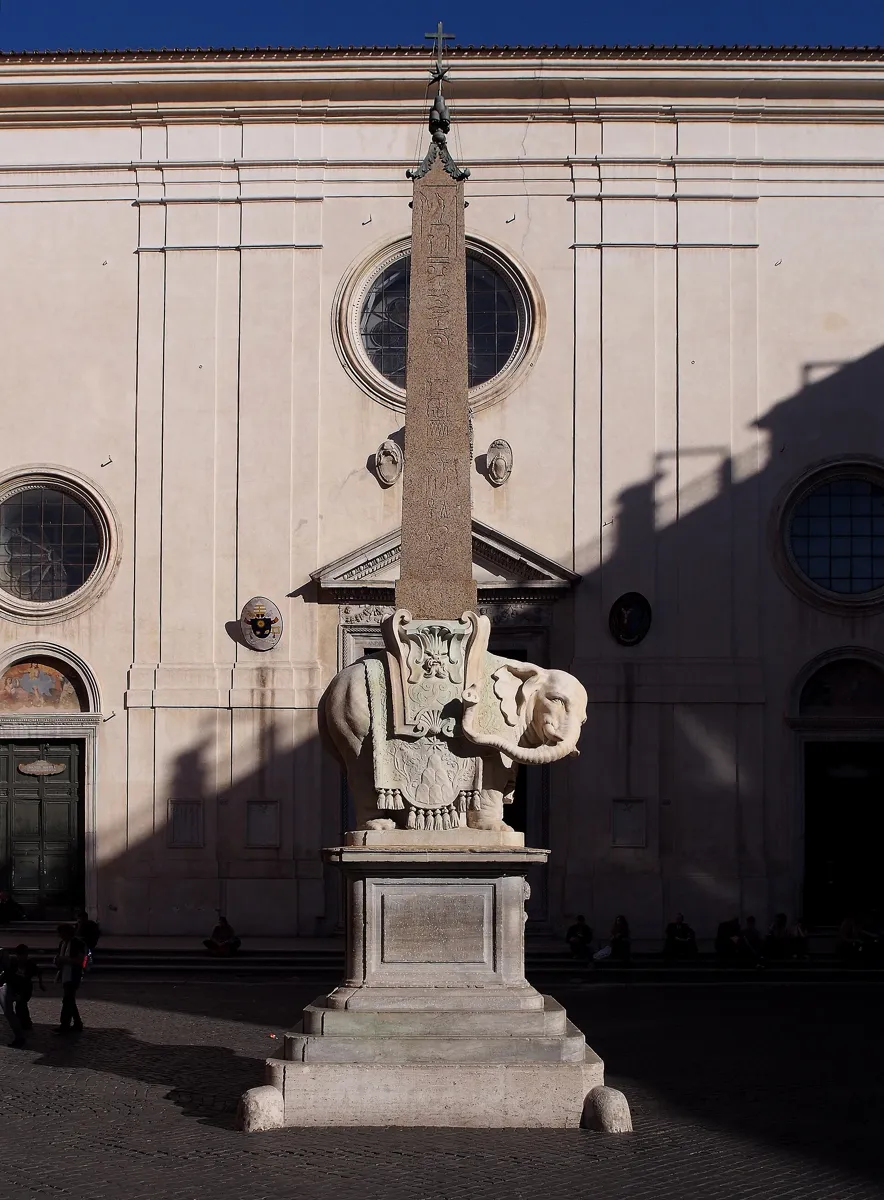
The elephant and obelisk, with the church front behind. Photo: Petar Milošević, CC BY-SA 4.0, via Wikimedia Commons (resized). Facing the Pantheon's porch, take Via della Minerva down its left side to the square behind. In 1665 an Egyptian obelisk was found buried in the garden of the Dominican convent here, probably from the temple of Isis that once stood nearby. It is the smallest of Rome's ancient obelisks. Bernini designed the elephant that carries it for Pope Alexander VII; it was unveiled in 1667. The Latin on the base says it takes a strong mind to carry solid wisdom. Romans call it the "Pulcin della Minerva", from porcino, little pig. The church, Santa Maria sopra Minerva, is named for a temple of Minerva once thought to be under it. The Dominicans began it in 1280, and it is one of the very few Gothic churches in Rome. Inside are Michelangelo's statue of Christ (1521) and the tombs of Saint Catherine of Siena and the painter Fra Angelico. Plaques on the front, to the right, mark how high Tiber floods rose, the oldest in 1422.
More history
In 1628 the convent became the seat of the Holy Office, the Inquisition. In one of its rooms, on 22 June 1633, Galileo Galilei renounced his Copernican views. The friars had also objected to Bernini's design, and a satirical verse of the time claimed the elephant turns its backside to their convent on purpose.
Sources: Wikipedia (it), Obelisco della Minerva; Wikipedia (it), Piazza della Minerva; Wikipedia (it), Santa Maria sopra Minerva; Wikipedia, Elephant and Obelisk; Wikipedia, Santa Maria sopra Minerva.
-
Sant'Ignazio and Andrea Pozzo's painted dome
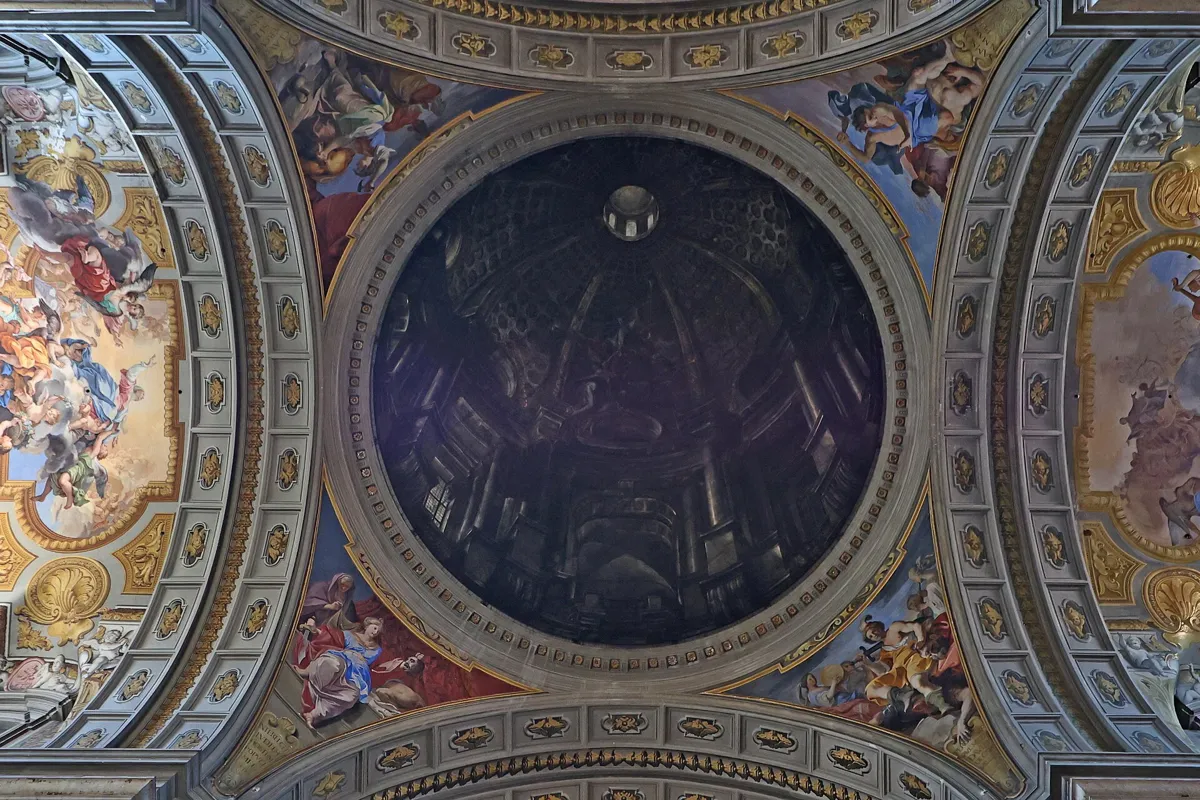
The "dome" is a flat painting. Photo: Monica_Rondoni, CC BY-SA 4.0, via Wikimedia Commons (resized). Walk back up Via della Minerva, turn right onto Via del Seminario and follow it east past Piazza di San Macuto into Piazza di Sant'Ignazio. Filippo Raguzzini laid out this little square in 1727–28 to surprise passers-by, its small houses set against the church's big travertine front. The church honours Ignatius of Loyola, founder of the Jesuits, made a saint in 1622. It was begun in 1626 as the church of the Jesuits' Roman College, opened for worship in 1650 and consecrated in 1722. There was no money for a dome, so in 1685 the Jesuit painter Andrea Pozzo painted one on a flat canvas over the crossing. That canvas was destroyed by fire; what you see was repainted in 1823 by Francesco Manno from Pozzo's drawings. Markers in the nave floor show where to stand for the best view of the dome and of Pozzo's ceiling. Cardinal Robert Bellarmine, who oversaw Bruno's trial, is buried here.
More history
By the early 17th century the Roman College had over 2,000 students, too many for its old church. Pope Gregory XV, a former pupil, and his nephew Cardinal Ludovico Ludovisi pushed for this one; both have funeral monuments here.
Sources: Wikipedia (it), Chiesa di Sant'Ignazio di Loyola in Campo Marzio; Wikipedia, Sant'Ignazio; Wikipedia, Giordano Bruno.
-
The Trevi Fountain, where an ancient aqueduct ends
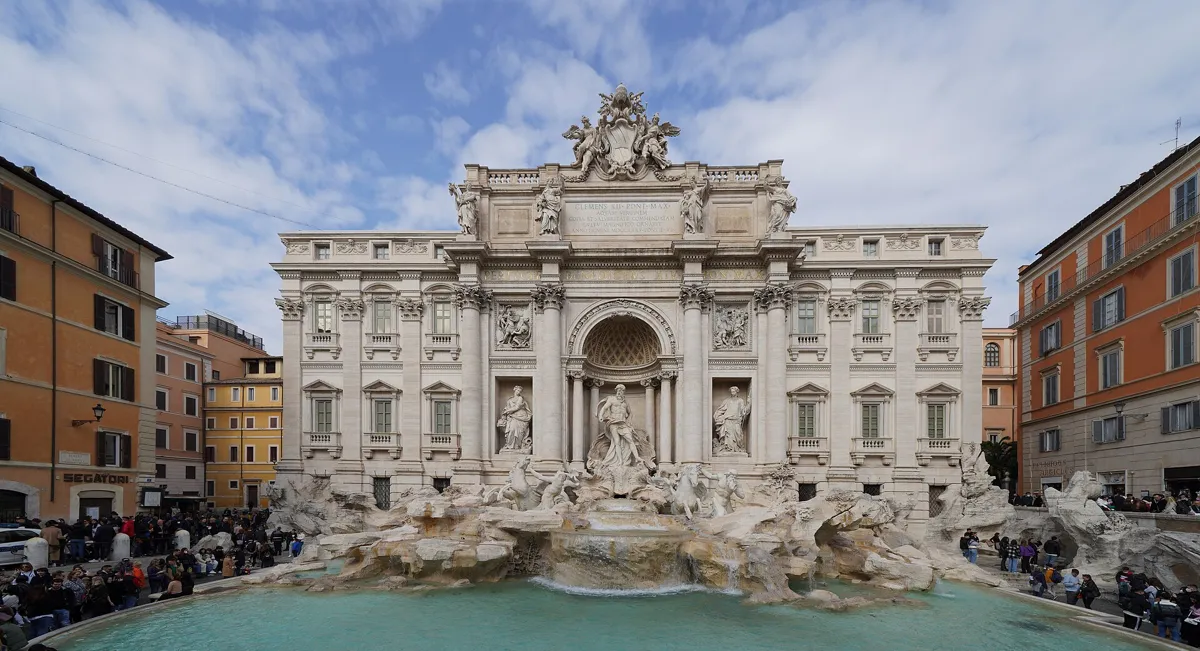
The fountain against Palazzo Poli. Photo: NikonZ7II, CC BY-SA 4.0, via Wikimedia Commons (resized). Take Via de' Burrò to Piazza di Pietra, where eleven 15-metre columns of the Temple of Hadrian, dedicated around 145, are built into the front of Rome's Chamber of Commerce. Cross Via del Corso and follow Via delle Muratte to the fountain. It is the end of the Acqua Vergine, the aqueduct built in 19 BC and the only ancient one in use ever since. Pope Clement XII held a competition in 1732 and chose Nicola Salvi, who set the fountain against the back of Palazzo Poli; Giuseppe Pannini finished it in 1762. Oceanus rides a shell chariot pulled by a wild horse and a calm one, held by tritons. The reliefs above tell the water's story: a girl showing Roman soldiers the spring, and Agrippa ordering the aqueduct. Since 2 February 2026, visitors who don't live in Rome or its metropolitan area pay €2 to go down by the basin, until 22:00 (opening times vary by day); the view from the square is free. Don't eat, sit on the rim or wade in. Custom says a coin thrown in means you will come back.
More history
The Temple of Hadrian columns were built into a papal customs house by Carlo Fontana in 1695; it became the stock exchange in 1831 and the Chamber of Commerce in 1874. At the fountain, Salvi died in 1751 with the work half done. Fendi paid for a 17-month restoration finished in 2015. The coins are given to the charity Caritas; in 2016 they came to an estimated €1.4 million. Anita Ekberg waded in here in Fellini's La Dolce Vita (1960).
Sources: Sovrintendenza Capitolina, Fontana di Trevi; Turismo Roma, Fontana di Trevi; Wikipedia (it), Fontana di Trevi; Wikipedia, Trevi Fountain. On the way: Wikipedia (it), Tempio di Adriano; Wikipedia, Temple of Hadrian. Tickets and rules: fontanaditrevi.roma.it.
-
The Spanish Steps and the Barcaccia fountain
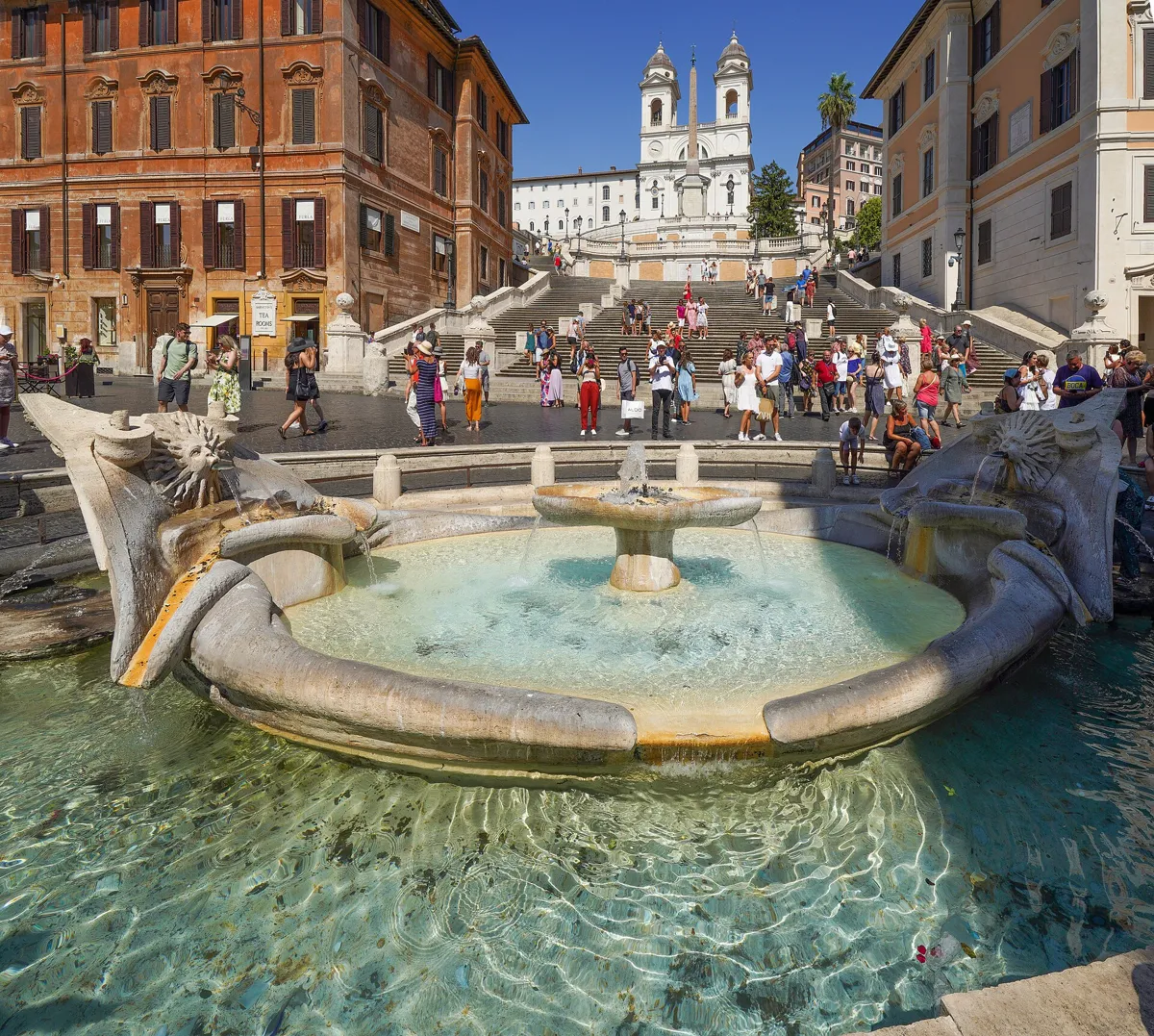
The Barcaccia and the steps up to Trinità dei Monti. Photo: WikiRomaWiki, CC BY-SA 4.0, via Wikimedia Commons (resized). Leave by the exit on the Via dei Crociferi side, cross Piazza dei Crociferi, and follow Via Poli, Via del Bufalo and Via di Propaganda into Piazza di Spagna. The fountain in front of the steps, the Barcaccia, was built in 1626–29 by Pietro Bernini for Pope Urban VIII; his son Gian Lorenzo may have helped. The Acqua Vergine had too little pressure for jets, so the fountain is a half-sunk boat set below street level, overflowing at the sides. Look for the Barberini bees on the papal arms. The steps came a century later, from 1723 to 1726, designed by Francesco De Sanctis. A French diplomat, Étienne Gueffier, who died in 1660, left money for them, but quarrels between the Pope and France held the work up for decades; French lilies and Innocent XIII's eagles share the posts at the bottom. Since 2019 city rules have banned sitting on the steps, with fines.
More history
The poet John Keats died in 1821 in the house on the right-hand corner as you face the steps; it is now a museum. The Spanish Embassy to the Holy See stands at the bottom of the steps, the church of Trinità dei Monti, long under the French kings' patronage, at the top. Bulgari paid for a restoration that reopened the steps in September 2016. From about mid-April to mid-May the city's gardeners line them with azaleas.
Sources: Sovrintendenza Capitolina, Fontana della Barcaccia; Sovrintendenza Capitolina, Scalinata di Trinità dei Monti; Turismo Roma, The Barcaccia Fountain; Turismo Roma, Scalinata di Trinità dei Monti; Wikipedia, Spanish Steps; Sky TG24 (2019), the sitting ban.


_-_Right_side_and_front.jpg)


Practical details
- Terrain
- Flat: Open-Meteo puts every stop between about 25 and 36 m above sea level. Expect cobbles, narrow streets and crowds, above all at Trevi and the Spanish Steps.
- Step-free
- OpenStreetMap maps no steps on the walking line itself; you look at the Spanish Steps from the square. It marks Spagna metro station as not wheelchair accessible.
- Water
- OpenStreetMap lists nasoni, Rome's free drinking fountains, on Piazza della Rotonda by the Pantheon and on Piazza di Pietra, between stops 5 and 6, plus several around Campo de' Fiori.
- Toilets
- OpenStreetMap shows paid toilets about 50 m from Piazza Navona, not wheelchair accessible. Otherwise, plan on a café.
- Tickets
- Pantheon: open daily 9:00–19:00, last entry 18:30, closed 25 December and 1 January; prices in the FAQ below. Trevi Fountain: card only if you buy at the entrance. Check both before you go.
- Shorter walk
- Finish at the Trevi Fountain, stop 6: 1.9 km and 25 minutes of walking, about an hour with stops.
- Getting back
- Spagna metro (line A) is about 100 m from the foot of the steps.
Walking distances and times from the OSRM foot router on OpenStreetMap data. Elevations from Open-Meteo. Stations, fountains and toilets from OpenStreetMap; Pantheon hours and prices from the Ministero della Cultura; Trevi rules from Roma Capitale. Checked 4 October 2026.
Questions people ask
How long does a self-guided walking tour of Rome's centre take, and is there a map?
This route is 2.5 km with about 33 minutes of walking and seven stops, so allow about 70 minutes, or around two hours if you go inside the Pantheon and the churches. The map is on this page, and you can print it or save it as a PDF.
Can you walk from the Pantheon to the Trevi Fountain?
Yes. The direct way is about 590 m, around 8 minutes on foot. This walk takes a longer line of about 1 km, past Bernini's elephant on Piazza della Minerva, the church of Sant'Ignazio and the Temple of Hadrian.
Do you need a ticket for the Pantheon or the Trevi Fountain?
For the Pantheon, yes: since 1 July 2026 a ticket costs €7, €2 for 18 to 25-year-olds and free under 18, booked by time slot on the Museiitaliani site or bought on site. At the Trevi Fountain, since 2 February 2026 tourists pay €2 to enter the area by the basin, until 22:00; opening times vary by day. Seeing it from the square is free. Check both official sites before you go.
Can you sit on the Spanish Steps?
No. Since 2019 Rome's urban police rules have banned sitting and eating on the steps, with fines. You can still walk up and down them.
Is Rome's historic centre walkable?
Yes. On this route every stop sits between about 25 and 36 m above sea level, and no stop is more than about 650 m from the next. Many of the streets are narrow and paved with cobbles.
Walk it with Strolio
Open Strolio at Campo de' Fiori and ask for an hour or two through Rome's historic centre. Strolio builds walks in any city with mapped streets, so its route may pick different stops from this page. Stories play as you reach each place, and you can ask about anything else you pass, by voice or with a photo. You can also start from your hotel and choose your own time and interests.
More self-guided walks
- All Strolio walks: every city and route in one place.
- Madrid's Barrio de las Letras: about an hour, from Lope de Vega's church to the press that printed Don Quixote.
- Barcelona's Gothic Quarter and El Born: about 90 minutes, from Roman columns to the cathedral and El Call.
Sources
- Roma Capitale: Sovrintendenza Capitolina pages for the Trevi Fountain, the Barcaccia and the Spanish Steps; Turismo Roma; fontanaditrevi.roma.it for Trevi tickets and rules. We used their facts and wrote our own text.
- Ministero della Cultura: Pantheon e Basilica di Santa Maria ad Martyres, for tickets and hours
- Wikipedia (Italian): Campo de' Fiori, Monumento a Giordano Bruno, Piazza Navona, Stadio di Domiziano, Fontana dei Quattro Fiumi, Pantheon, Obelisco della Minerva, Piazza della Minerva, Santa Maria sopra Minerva, Sant'Ignazio di Loyola in Campo Marzio, Tempio di Adriano, Fontana di Trevi
- Wikipedia (English): Campo de' Fiori, Monument to Giordano Bruno, Giordano Bruno, Piazza Navona, Fontana dei Quattro Fiumi, Sant'Agnese in Agone, Pantheon, Elephant and Obelisk, Santa Maria sopra Minerva, Sant'Ignazio, Temple of Hadrian, Trevi Fountain, Spanish Steps, Spagna (Rome Metro)
- News: Sky TG24, 6 August 2019, on the ban on sitting on the Spanish Steps
- Map data and places: © OpenStreetMap contributors, ODbL; walking route from the OSRM foot router at routing.openstreetmap.de
- Elevations: Open-Meteo
- Photos: Wikimedia Commons contributors Livioandronico2013, Mariordo, NikonZ7II, Petar Milošević, Monica_Rondoni and WikiRomaWiki, credited under each photo