
Lower Manhattan self-guided walking tour · 2 hours · map
Lower Manhattan on foot: where New York began, from the Battery to the Brooklyn Bridge
New York began at the southern tip of Manhattan. This two-hour walk starts by the harbour, where the Dutch built their fort, and ends at the bridge to Brooklyn. On the way: the tavern where Washington said goodbye to his officers, the site where he became president, Alexander Hamilton's grave and the 9/11 Memorial.
The Dutch West India Company built Fort Amsterdam here in 1626, and New Amsterdam grew up around it. The street plan survives, but few early buildings do: the Great Fire of 1776 burned the first Trinity Church, and another great fire in 1835 destroyed many of the early buildings around Stone Street.
A note on accuracy: where a building is not the original, as at Federal Hall and Fraunces Tavern, we say so, and every fact links to its source.
- Start
- South Ferry and Whitehall Street subway stations (1, R, W), by the Staten Island Ferry terminal
- Finish
- The Brooklyn Bridge walkway on Park Row, next to Brooklyn Bridge–City Hall station
- Distance
- 3.4 km (2.1 miles), one way
- Time
- About two hours: 46 min walking and 8 stops, plus any museum visits
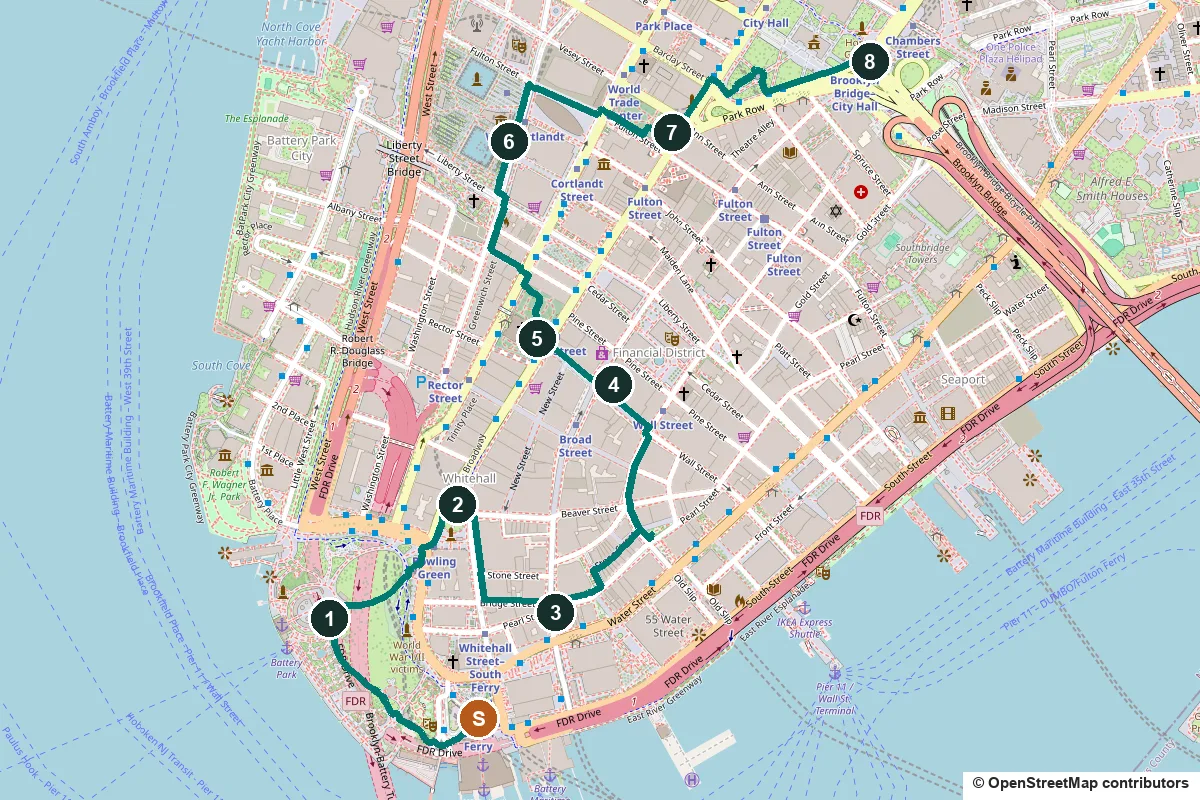
Terrain, toilets, opening hours and a shorter version ↓
What to see: the stops
-
Castle Clinton, the fort that became the immigrants' gateway
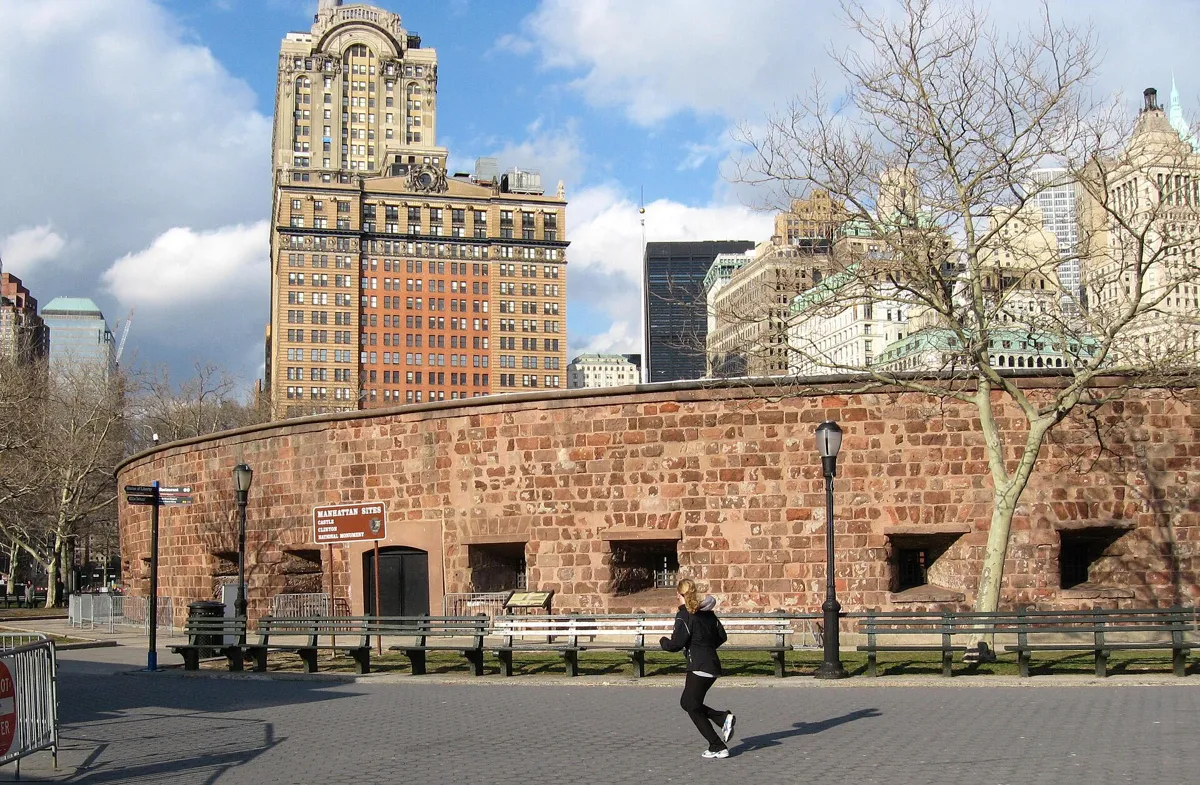
Castle Clinton in the Battery. Photo: Jim.henderson, public domain, via Wikimedia Commons (resized). From the station, walk west through the Battery, the park at the tip of Manhattan, with the harbour on your left. The round red sandstone fort is Castle Clinton, built from 1808 to 1811 on an artificial island just offshore to guard the harbour before the War of 1812. John McComb Jr. designed it. None of its 28 cannons ever fired at an enemy. In 1824 it reopened as Castle Garden, a place of entertainment, where the soprano Jenny Lind gave her first American concerts in 1850. From 1855 to 1890 it was the country's first immigrant landing depot, before Ellis Island; sources put the number who came through it at 7.5 or 8 million. Entry is free, and it sells the tickets for the boats to the Statue of Liberty and Ellis Island.
More history
In 1896 McKim, Mead & White turned it into the New York Aquarium, which moved to Coney Island in 1941. Saved from demolition, it became a national monument in 1946, and the National Park Service restored it, reopening it in 1975. German- and Yiddish-speaking immigrants called the depot Kesselgarten, a word that came to mean any noisy, confusing place.
Sources: National Park Service, Castle Clinton history; NYC Landmarks Preservation Commission, Castle Clinton (1965); Wikipedia, Castle Clinton. Visiting: National Park Service.
-
Bowling Green, the king's statue and the Custom House
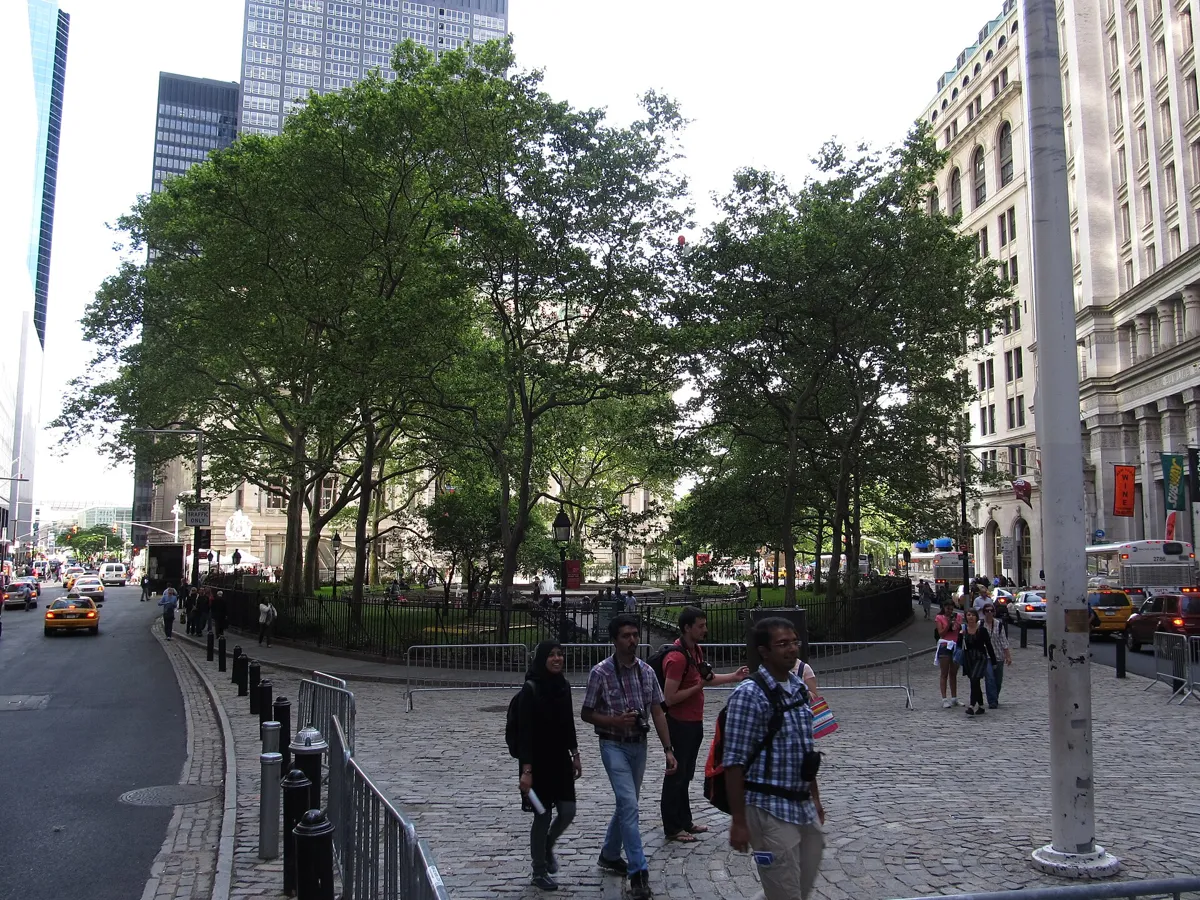
Bowling Green and its 18th-century fence, seen from the north. Photo: Ken Lund, CC BY-SA 2.0, via Wikimedia Commons (resized). Walk north-east out of the Battery to Bowling Green, the small teardrop-shaped park where Broadway begins. It is the city's oldest public park, leased out in 1733 for a peppercorn a year to neighbours who promised to lay out a park with a bowling green. Its iron fence, which the city's Landmarks Preservation Commission dates to 1771, was put up to protect a gilded lead statue of King George III on horseback. On 9 July 1776, after the Declaration of Independence was read to Washington's troops, a crowd pulled the statue down and hacked it apart; its lead is said to have become bullets. The bronze Charging Bull just north of the park arrived in December 1989: Arturo Di Modica left it outside the Stock Exchange without permission, and days later it was set up here. South of the park stands Cass Gilbert's Custom House, finished in 1907 on the site of Fort Amsterdam. Inside, the Smithsonian's National Museum of the American Indian is free to enter.
More history
The fence was taken away for subway works in 1914 and put back in 1919. Daniel Chester French's four statues by the Custom House steps stand for Asia, America, Europe and Africa; the building was renamed after Alexander Hamilton in 1990. Peter Minuit's purchase of Manhattan in 1626 probably took place here.
Sources: NYC Landmarks Preservation Commission, Bowling Green Fence (1970); NYC Landmarks Preservation Commission, United States Custom House (1965); Wikipedia, Bowling Green; Wikipedia, Charging Bull; Wikipedia, Alexander Hamilton U.S. Custom House. Visiting: National Museum of the American Indian, New York.
-
Fraunces Tavern, where Washington said goodbye
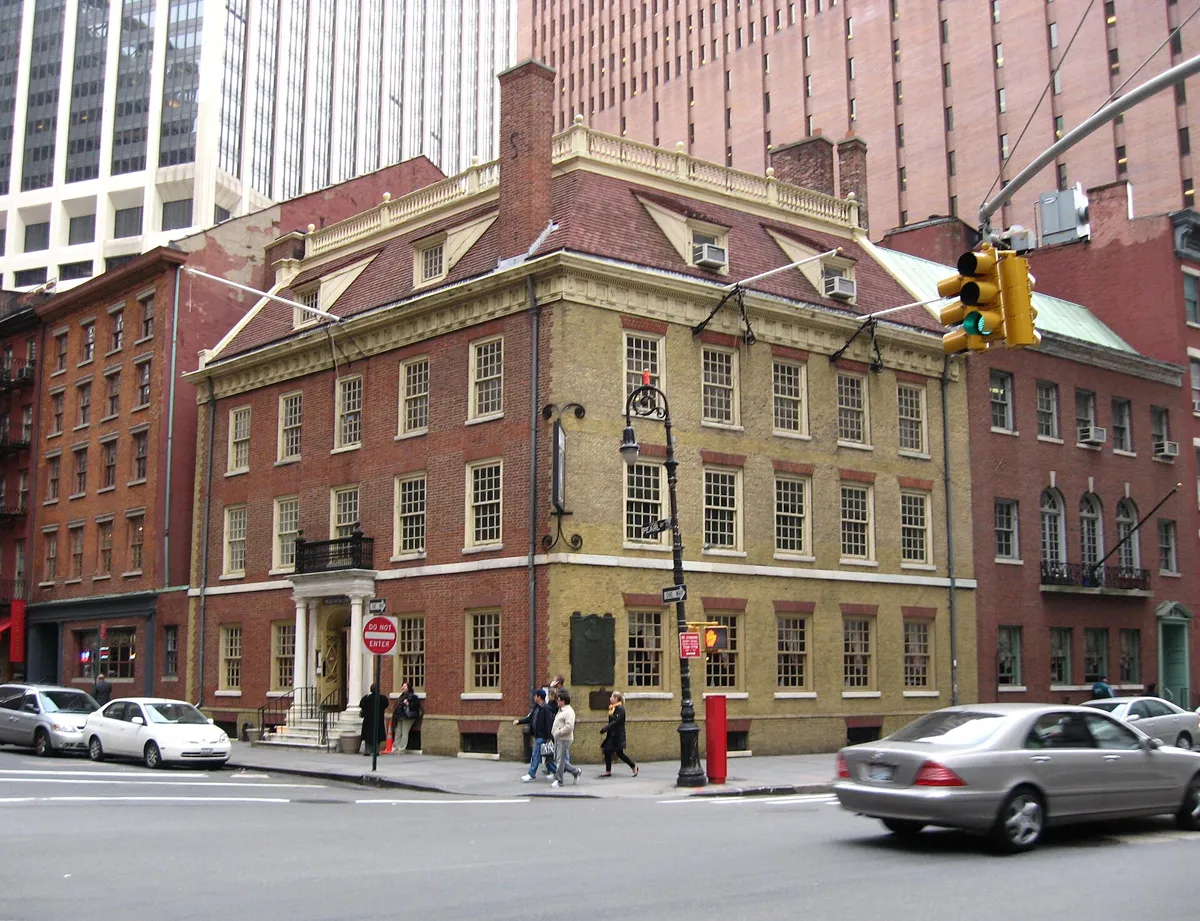
Fraunces Tavern on the corner of Pearl and Broad Streets. Photo: Jim.henderson, public domain, via Wikimedia Commons (resized). Walk down Whitehall Street beside the Custom House, turn left along Bridge Street and follow it to Broad Street. On the corner of Broad and Pearl Streets stands Fraunces Tavern. Stephen DeLancey built it as his house in 1719, and in the 1760s Samuel Fraunces made it a tavern. The Sons of Liberty met here, and on 4 December 1783, nine days after the British left New York, George Washington said farewell to his officers in its Long Room. What you see is largely a 1907 restoration by William Mersereau for the Sons of the Revolution, who bought it in 1904 after a campaign to save it from demolition, and still own it. Some architecture critics have called the restoration highly conjectural; a 2021 study commissioned by the museum found large sections of the original 1719 brickwork still in the front. The museum inside opens daily, 12:00 to 17:00.
More history
In August 1775 the British warship Asia fired on the city and put a cannonball through the tavern's roof. In 1975 a bomb, claimed by the Puerto Rican group FALN, killed four people at the Anglers' Club next door.
Sources: NYC Landmarks Preservation Commission, Fraunces Tavern (1965); Wikipedia, Fraunces Tavern. Visiting: Fraunces Tavern Museum.
-
Wall Street: Federal Hall and the Stock Exchange
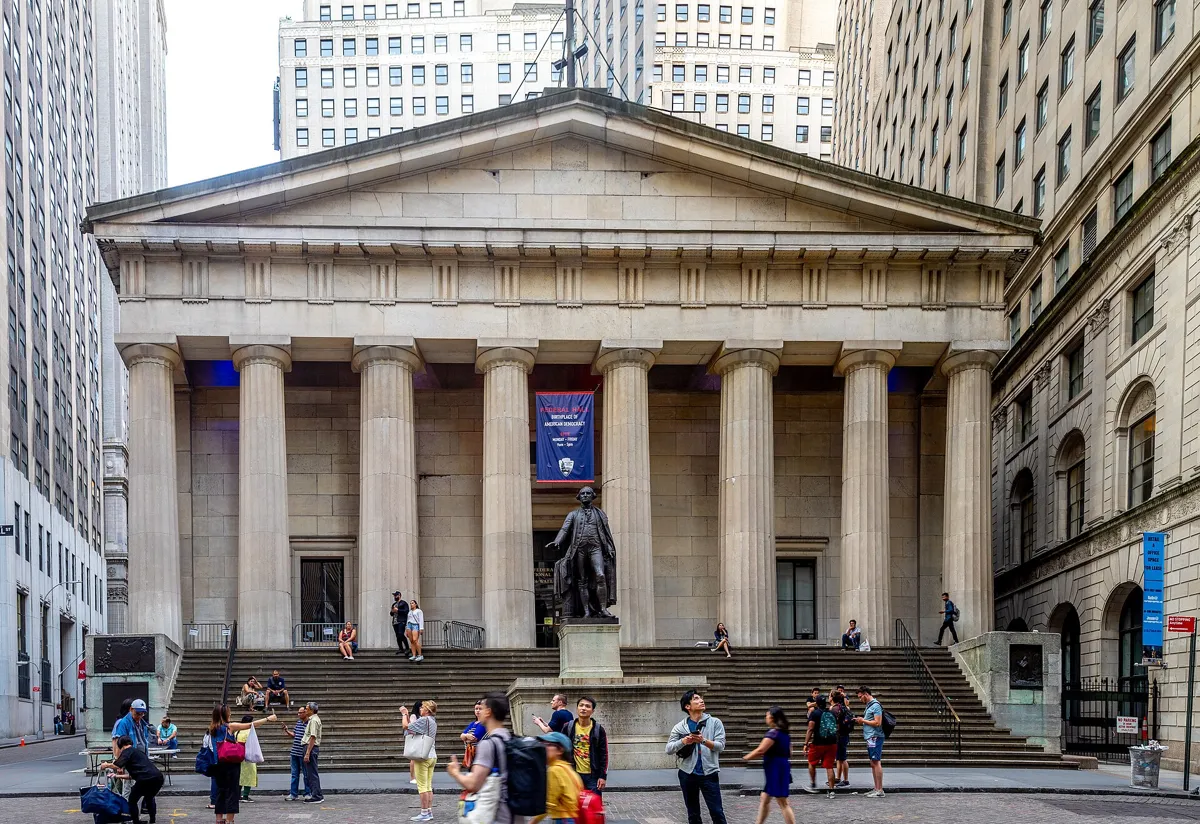
Federal Hall and Ward's statue of Washington, from Wall Street. Photo: Ajay Suresh, CC BY 2.0, via Wikimedia Commons (resized). From the tavern, walk up Coenties Alley and turn right into Stone Street, which closes to cars in summer for outdoor tables. Its western block, between Whitehall and Broad Streets, was Brewers Street in Dutch times, and in 1658 it became the first cobbled street in New Amsterdam. From Hanover Square, walk up William Street and left along Wall Street, named after a wall of earth and planks that the Dutch built in 1653 against the English; it was removed in 1699. At the head of Broad Street is Federal Hall. On this site stood the old Federal Hall, where the First Congress met, and on 30 April 1789 George Washington took the oath as the first president on its balcony. But this is not that building: it was sold for $425 and pulled down in 1812. The temple you see was finished in 1842 as the U.S. Custom House. John Quincy Adams Ward's 1883 statue of Washington stands at about the height of the old balcony, and inside, free on weekdays, is part of its railing and floor. Across Broad Street is the New York Stock Exchange, built in 1901–03.
More history
The old Federal Hall was built in 1699–1703 as the city hall. In 1735 the printer John Peter Zenger was tried there for libel and acquitted because what he had printed was true. Washington swore the oath on a Bible lent by St. John's Masonic Lodge No. 1. The Stock Exchange traces its origin to the Buttonwood Agreement of 1792.
Sources: NYC Landmarks Preservation Commission, Federal Hall National Memorial (1965); Wikipedia, Federal Hall; Wikipedia, First inauguration of George Washington; Wikipedia, New York Stock Exchange Building; Wikipedia, Wall Street; Wikipedia, Stone Street. Visiting: National Park Service, Federal Hall.
-
Trinity Church and Alexander Hamilton's grave
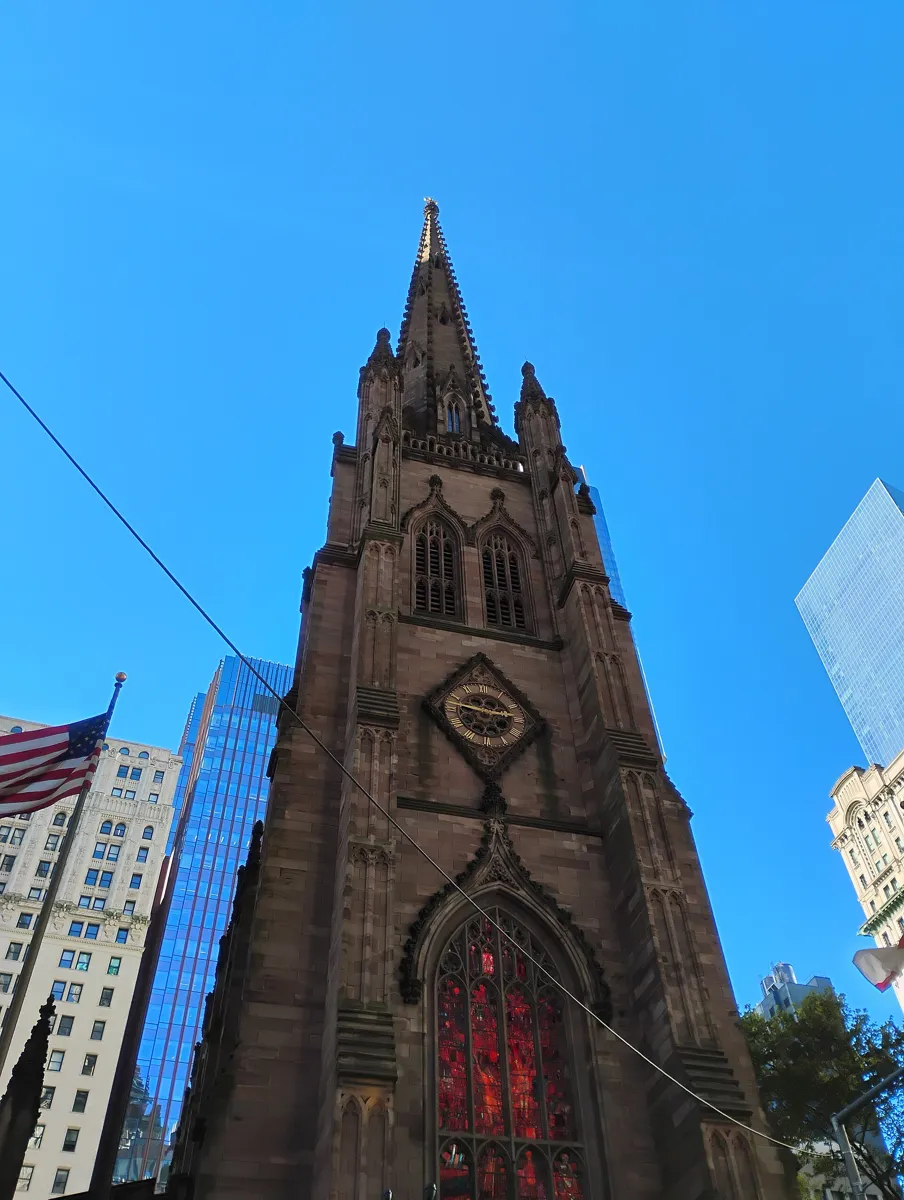
Trinity Church's tower, facing Wall Street. Photo: Ferfive, CC BY 4.0, via Wikimedia Commons (resized). Walk west along Wall Street to Trinity Church, the brownstone church that closes the view at Broadway. The parish's first church burned in the Great Fire of 1776, and the second was pulled down in 1839 after heavy snow weakened it. Richard Upjohn's Gothic Revival church was consecrated in 1846; its 281-foot (86 m) spire made it the tallest building in the United States until 1869. Alexander Hamilton is buried in the churchyard, near the south fence. On 11 July 1804 he was shot in a duel with Vice President Aaron Burr at Weehawken, New Jersey; he died the next afternoon, and his funeral was held here. His monument stands over the plain vault stone of his wife, Eliza, and her sister Angelica Schuyler Church is buried in the same churchyard. The church and churchyard usually open daily from 8:30 to 18:00, after a security check, but the church often closes early for services and concerts.
More history
The churchyard was probably a burial ground by the 1660s, under Dutch rule; its oldest readable gravestone is that of five-year-old Richard Churcher, who died in 1681. Robert Fulton lies here, and so does Francis Lewis, the only signer of the Declaration of Independence buried in Manhattan. Look too at the church's bronze doors, from 1893.
Sources: Trinity Church; Trinity Church, Alexander Hamilton; Trinity Church, churchyards; NYC Landmarks Preservation Commission, Trinity Church and Graveyard (1966); Wikipedia, Trinity Church; Wikipedia, Alexander Hamilton.
-
The 9/11 Memorial, in the footprints of the towers
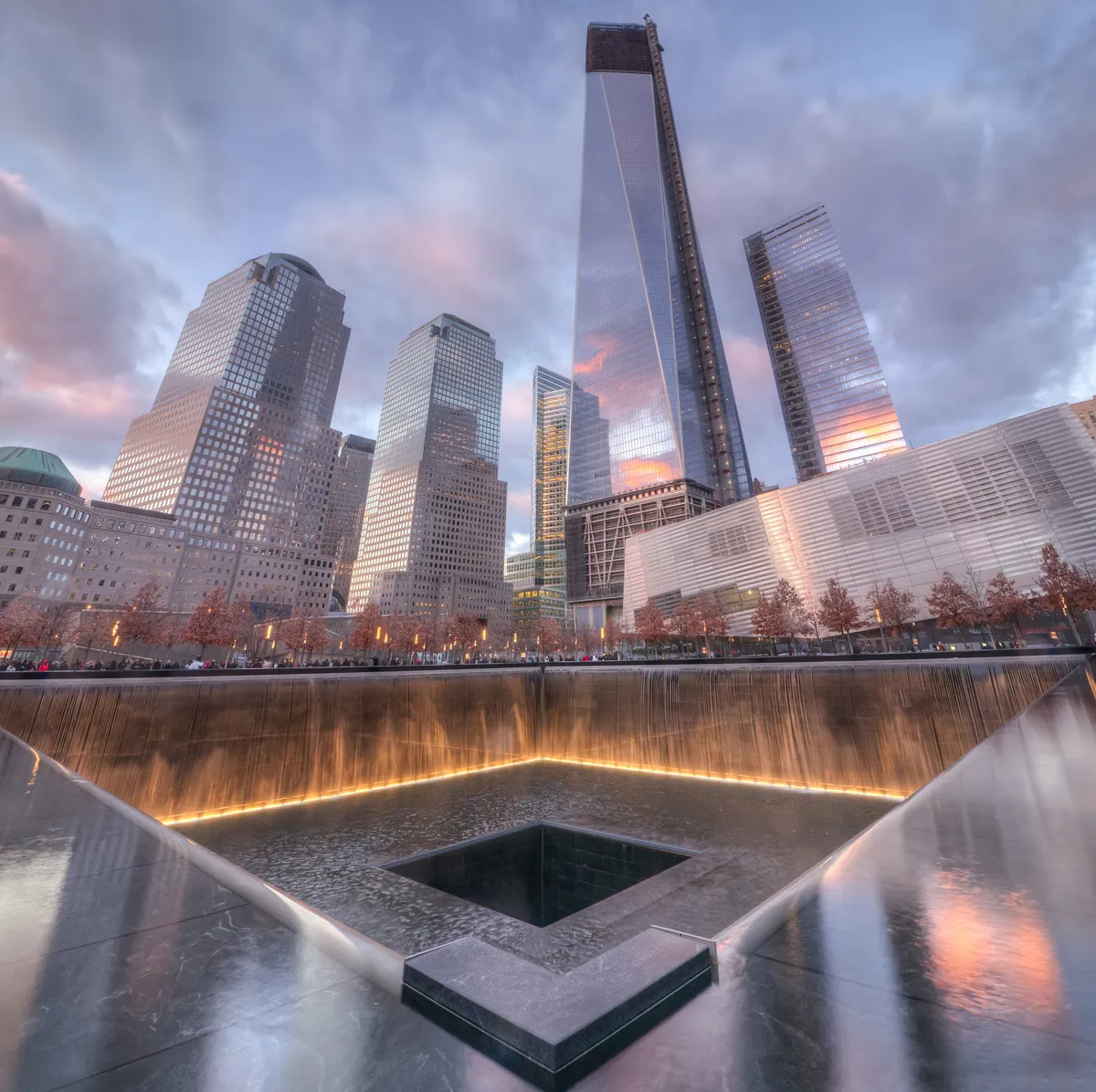
The South Pool. Photo: Dave Z, CC BY 2.0, via Wikimedia Commons (resized). Walk round to Trinity Place, the street behind the church, and follow it north to Cedar Street. Turn left, then right into Greenwich Street; across Liberty Street the memorial plaza is on your left. Its two pools, each nearly an acre, sit in the footprints of the North and South Towers of the World Trade Center. Water falls 30 feet (9 m) into each basin, then another 20 feet into a smaller central void. Bronze parapets carry the names of the 2,983 people killed on 11 September 2001 and in the bombing of the World Trade Center on 26 February 1993. The design, Reflecting Absence by Michael Arad and Peter Walker, was chosen in 2004 from 5,201 entries; the memorial opened on 11 September 2011. Look for the Survivor Tree, a Callery pear found badly damaged at Ground Zero in October 2001, nursed back to health and replanted here in 2010. The memorial is free; the museum below needs a ticket.
More history
The south-west corner, the 9/11 Memorial Glade, opened in 2019 for the rescue workers, survivors and neighbours who fell ill or died from toxins at the site. Its path is flanked by six stone monoliths inlaid with World Trade Center steel.
Sources: 9/11 Memorial & Museum, About the Memorial; 9/11 Memorial & Museum, the Survivor Tree; Wikipedia, National September 11 Memorial & Museum. Visiting: 9/11 Memorial & Museum.
-
St. Paul's Chapel, which survived two disasters
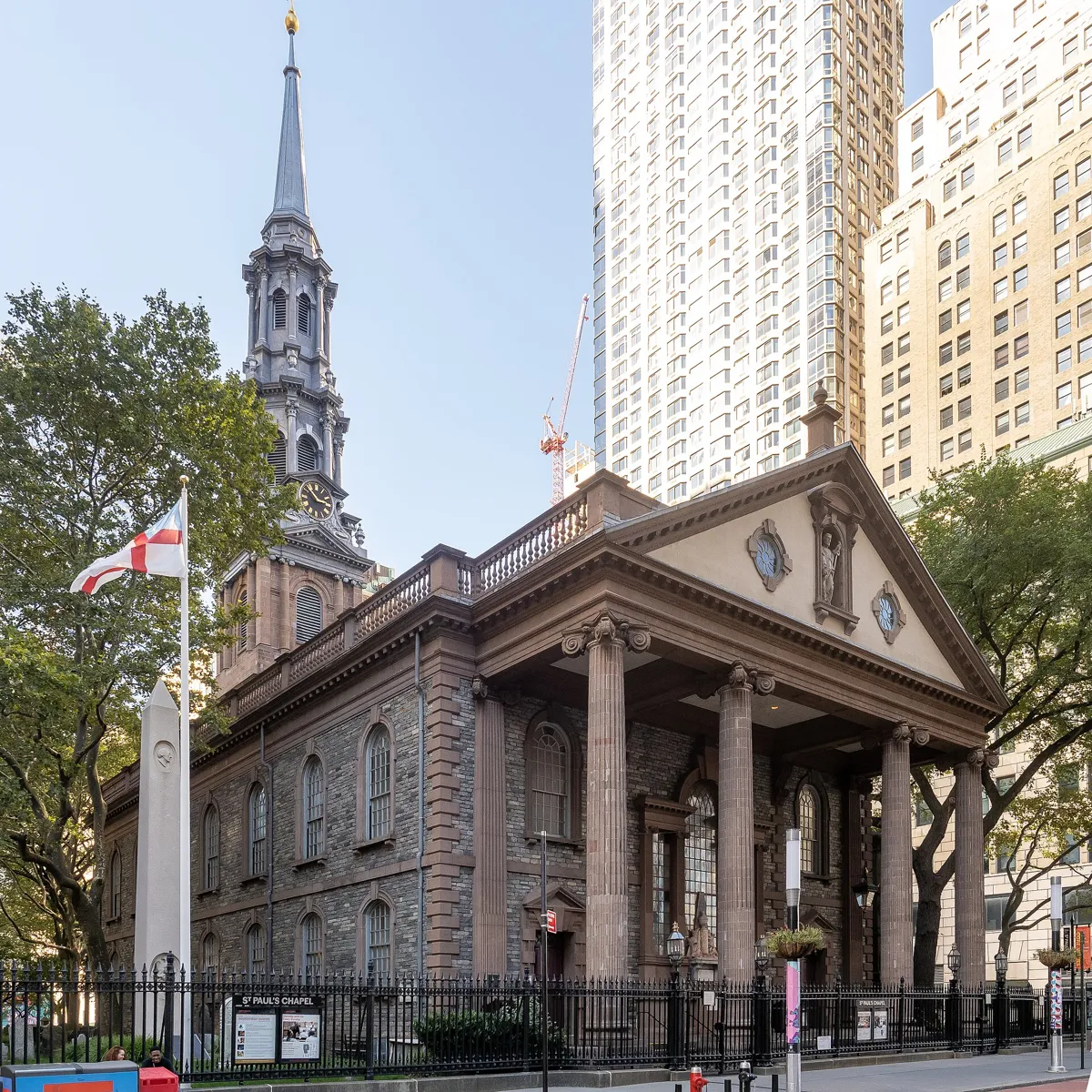
St. Paul's Chapel from Broadway. Photo: Ajay Suresh, CC BY 2.0, via Wikimedia Commons (resized). Leave the plaza at its north-east corner and walk east along Fulton Street, across Church Street, to St. Paul's Chapel, built from 1764 to 1766 as a chapel of Trinity. It is the oldest surviving church building in Manhattan, saved in the fire of 1776 by a bucket chain from the Hudson to its roof. After his inauguration on 30 April 1789, Washington came here from Federal Hall with members of Congress for a service. In 2001 the chapel stood less than 100 yards from the World Trade Center, yet it came through without a broken window; a sycamore in the churchyard took the falling debris. For nine months afterwards it was a refuge for recovery workers. On the Broadway front is the monument to General Richard Montgomery, killed at Quebec in 1775; Trinity describes it as the first monument ever commissioned by the United States Congress. The chapel is closed until 1 November 2026; the churchyard stays open.
More history
The St. Paul in the niche on Broadway is a resin copy; the wooden original, put up in 1790, was moved indoors in 2016. The fallen sycamore's roots became the base of Steve Tobin's bronze Trinity Root.
Sources: Trinity Church, St. Paul's Chapel; Trinity Church, churchyards; Wikipedia, St. Paul's Chapel; Wikipedia, First inauguration of George Washington.
-
City Hall Park and the Brooklyn Bridge
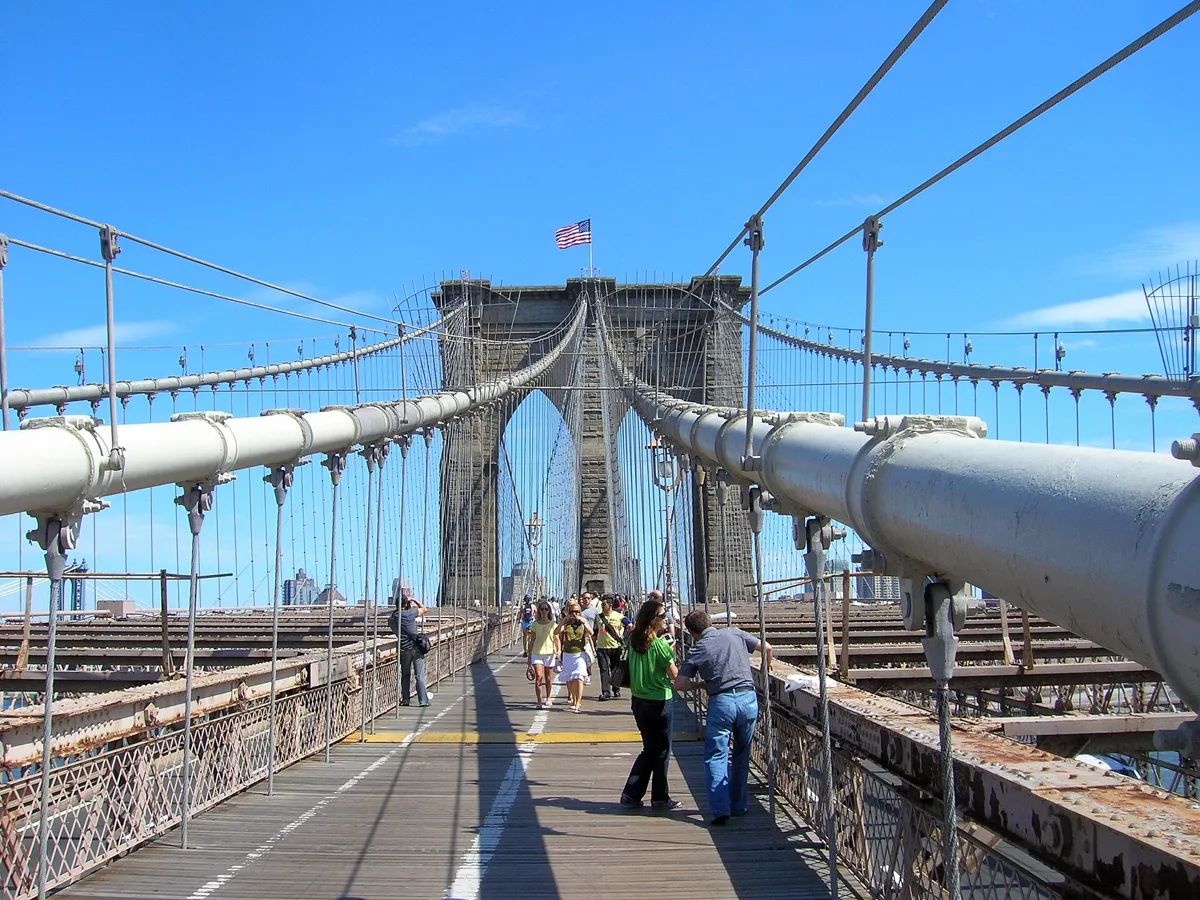
The Brooklyn Bridge promenade in 2009, before bikes moved to the roadway. Photo: Niranjan Arminius, CC BY-SA 4.0, via Wikimedia Commons (resized). Walk up Broadway into City Hall Park, the old town common. On 9 July 1776 the Declaration of Independence was read to Washington's troops here, and the Sons of Liberty led the crowd down Broadway to pull down the king's statue at Bowling Green (stop 2). City Hall, finished in 1812, was designed by John McComb Jr., Castle Clinton's architect, with Joseph-François Mangin. Cross the park to Park Row: the bridge walkway starts at the Centre Street crossing, or up the stairs from Park Row. The Brooklyn Bridge opened on 24 May 1883 as the first fixed crossing of the East River, and its 1,595.5-foot (486 m) main span made it the world's longest suspension bridge. John Augustus Roebling designed it; his son Washington Roebling saw it built, helped by his wife, the engineer Emily Warren Roebling. Since 2021 bikes have used the roadway, so the raised promenade is for people on foot.
More history
When New York abolished slavery on 4 July 1827, the park held a two-day celebration. From the curb at Park Row to Sands Street in Brooklyn, the bridge and its approaches measure 6,016 feet (1,834 m).
Sources: Wikipedia, City Hall Park; Wikipedia, Brooklyn Bridge; Wikipedia, Bowling Green.

.jpg)

.jpg)
.jpg)

.jpg)

Practical details
- Terrain
- Flat: USGS elevation data puts every stop between about 2 and 12 m above sea level. Cobbles around the Charging Bull.
- Step-free
- OpenStreetMap marks South Ferry and Brooklyn Bridge–City Hall stations as wheelchair accessible, but not Whitehall Street. Federal Hall has a ramp at its back entrance, 15 Pine Street, and a lift inside. On Park Row the way up to the bridge walkway is a staircase; the other way on is from the Centre Street crossing.
- Water
- OpenStreetMap lists drinking fountains at the ferry terminal by the start, in the Battery near stop 1, in City Hall Park and near the finish.
- Toilets
- OpenStreetMap lists free toilets in the Staten Island Ferry terminal by the start, and toilets at Castle Clinton. After that, plan on a café or a museum.
- Sit and eat
- Stone Street (between stops 3 and 4) closes to cars in summer and fills with outdoor tables. Otherwise, plan on a café.
- Opening hours
- 9/11 Memorial: free, daily 8:00–20:00; its museum needs a ticket booked ahead and opens Wednesday to Monday and some Tuesdays, 9:00–19:00. Federal Hall: free, Monday to Friday. Castle Clinton: free, daily 7:45–17:00. National Museum of the American Indian: free; see its website for hours. Fraunces Tavern Museum: daily 12:00–17:00. Trinity Church and churchyard: usually daily 8:30–18:00. St. Paul's Chapel: closed until 1 November 2026; its churchyard stays open daily 8:30–18:00.
- Shorter walk
- Finish at stop 6, the 9/11 Memorial: 2.5 km, 33 minutes of walking, about an hour and a quarter with the stops.
- Getting back
- Brooklyn Bridge–City Hall subway station is about 30 m from the finish, and OpenStreetMap marks it wheelchair accessible. Or keep walking: the bridge and its approaches run 1,834 m to Sands Street in Brooklyn.
Walking distances and times from the OSRM foot router on OpenStreetMap data. Elevations from the USGS 3D Elevation Program. Stations, fountains and toilets from OpenStreetMap; opening hours from the National Park Service, the 9/11 Memorial & Museum, Trinity Church, the Smithsonian and Fraunces Tavern Museum. Hours change: check before you go. Checked 4 October 2026.
Questions people ask
How long does a self-guided walking tour of Lower Manhattan take, and is there a map?
About two hours: 3.4 km (2.1 miles), 46 minutes of walking and eight stops, from South Ferry to the Brooklyn Bridge. The map is on this page; you can print it or save it as a PDF.
Is the 9/11 Memorial free?
Yes. The memorial plaza and its two pools are free and open daily, 8:00 to 20:00. The 9/11 Memorial Museum below it is separate and needs a ticket booked ahead.
Where is Alexander Hamilton buried?
In the churchyard of Trinity Church, at Broadway and Wall Street, near the south fence. His monument stands over the vault stone of his wife, Eliza. The churchyard usually opens daily, 8:30 to 18:00.
Where did George Washington take the oath of office?
On the balcony of Federal Hall on Wall Street, on 30 April 1789. That building was pulled down in 1812. Today's Federal Hall, on the same site, was finished in 1842 as the U.S. Custom House; it is free to visit, Monday to Friday.
Can you walk across the Brooklyn Bridge from here?
Yes. The walk ends where the bridge walkway starts, at Centre Street and Park Row. Since 2021 the raised promenade has been for people on foot, with bikes on the roadway. From Park Row to Sands Street in Brooklyn, the bridge and its approaches measure 1,834 m (6,016 feet).
Walk it with Strolio
Open Strolio at South Ferry and ask for two hours through Lower Manhattan. Strolio builds walks in any city with mapped streets, so its route may pick different stops from this page. Stories play as you reach each place, and you can ask about anything else you pass, by voice or with a photo. You can also start from your hotel and choose your own time and interests.
More self-guided walks
- All Strolio walks, with maps and sources.
- Madrid's Barrio de las Letras: about an hour, from Lope de Vega's church to the press that printed Don Quixote.
- Barcelona's Gothic Quarter and El Born: about 90 minutes, from Roman columns to the cathedral and El Call.
Sources
- NYC Landmarks Preservation Commission designation reports: Castle Clinton, Bowling Green Fence, United States Custom House, Fraunces Tavern, Federal Hall National Memorial, Trinity Church and Graveyard. We used their facts and wrote our own text.
- National Park Service: Castle Clinton history, Castle Clinton visitor information, Castle Clinton hours, Federal Hall visitor information, Federal Hall fees
- Venues: Trinity Church, Alexander Hamilton and Trinity Church, Trinity's churchyards, St. Paul's Chapel, 9/11 Memorial & Museum, About the Memorial, the Survivor Tree, National Museum of the American Indian, New York, Fraunces Tavern Museum
- Wikipedia (English): Castle Clinton, Bowling Green, Charging Bull, Alexander Hamilton U.S. Custom House, Fraunces Tavern, Stone Street, Wall Street, Federal Hall, First inauguration of George Washington, New York Stock Exchange Building, Trinity Church, Alexander Hamilton, National September 11 Memorial & Museum, St. Paul's Chapel, City Hall Park, Brooklyn Bridge
- Map data and places: © OpenStreetMap contributors, ODbL; walking route from the OSRM foot router run by FOSSGIS
- Elevations: USGS Elevation Point Query Service (3D Elevation Program)
- Photos: Wikimedia Commons contributors Jim.henderson, Ken Lund, Ajay Suresh, Ferfive, Dave Z and Niranjan Arminius, credited under each photo