
Greenwich self-guided walking tour · 70 minutes · map
Greenwich on foot: the Cutty Sark, the Painted Hall and the hill of the prime meridian
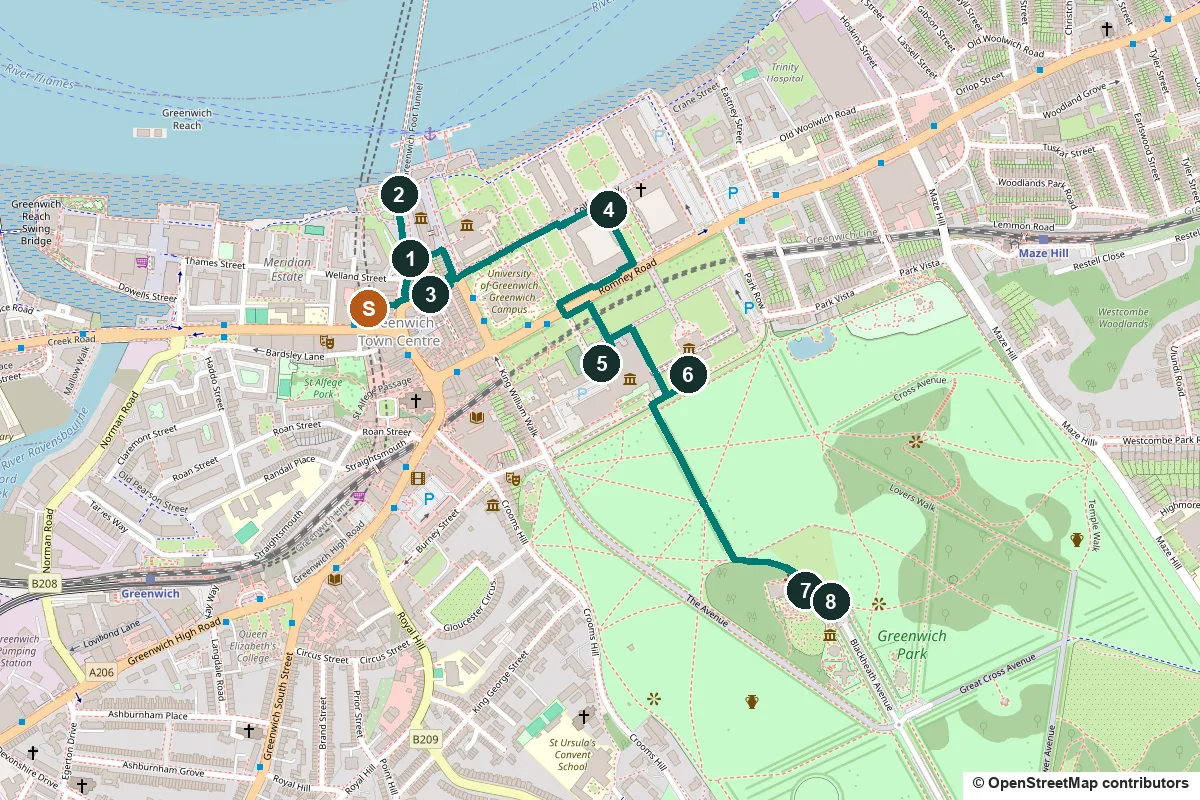
This walk climbs from the river to the hill: the Cutty Sark, the naval college built on a Tudor palace site, two free museums and, at the top, the Royal Observatory, where the world's zero longitude was set, with the view from General Wolfe's statue. It is two kilometres, flat at first and uphill at the end. The Observatory is closed from 2 November 2026, so the walk ends outside it.
Greenwich is a UNESCO World Heritage Site, listed in 1997 as Maritime Greenwich. The site takes in the town centre, Greenwich Park, the Old Royal Naval College and four Royal Museums Greenwich sites: the Cutty Sark, the National Maritime Museum, the Queen's House and the Royal Observatory. This route passes all of them. The museum and the Queen's House are free to enter, the Cutty Sark charges to go aboard, and the Observatory is closed from 2 November 2026.
A note on accuracy and timing: the Cutty Sark is the 1869 ship, but she was badly damaged by fire in 2007 and restored. The Tudor palace is gone, and the Old Royal Naval College replaced it. The whole Royal Observatory is closed from 2 November 2026 for a building project; its Meridian Courtyard is due to reopen in summer 2027. Where something is a rebuild or has been lost, we say so, and every fact links to its source.
- Start
- Cutty Sark for Maritime Greenwich DLR station; Greenwich Pier is beside the ship
- Finish
- The General Wolfe statue by the Royal Observatory, about 960 m from the DLR station and 970 m from Maze Hill station
- Distance
- 2 km, one way
- Time
- About 70 minutes: 26 minutes of walking and 8 stops, plus any visit to the Cutty Sark or the Painted Hall
Terrain, opening days, the Observatory closure and a shorter version ↓
What to see: the stops
-
The Cutty Sark, a tea clipper in dry dock
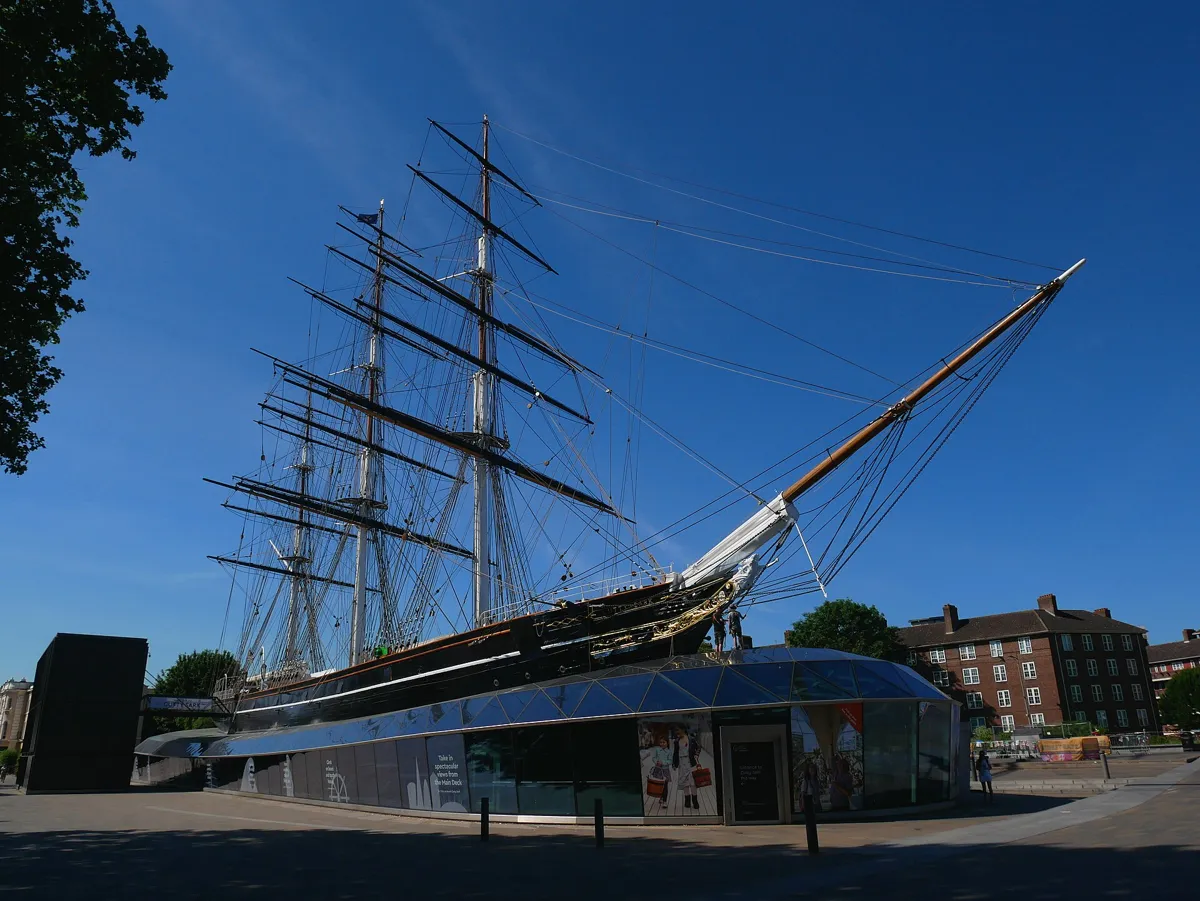
The Cutty Sark from the north-east. Photo: Ethan Doyle White, CC BY-SA 4.0, via Wikimedia Commons (resized). From Cutty Sark DLR station, walk along Crescent Arcade and Greenwich Church Street to the river, 125 m. The ship stands in a dry dock in front of you. She was built at Dumbarton in 1869 for the shipowner John Willis, to be fast. Her name comes from Robert Burns's poem Tam o' Shanter, where a witch wears only a short shift, a "cutty sark" in Scots, and the figurehead shows that witch. The Suez Canal opened in the week she was launched, and steamships soon took over the tea trade, so she moved to Australian wool. In 1886 Captain Richard Woodget brought her from Sydney to London in 73 days. She came to Greenwich in 1954 and opened to the public in 1957. She caught fire on 21 May 2007, while closed for conservation, and reopened in 2012, lifted about three metres above the dock so visitors can walk under her hull, and the figurehead you see is a new carving fitted in June 2021. You can see the ship from the pavement for free. Going aboard costs £22 for an adult and £11 for a child.
More history
In 1872 she raced the tea clipper Thermopylae home from Shanghai. Two weeks in, she led by some 400 nautical miles, then lost her rudder in a gale. The ship's carpenter, Henry Henderson, built a new one from spare timber and iron in six days, and she reached London a week after Thermopylae.
Sources: Royal Museums Greenwich, Cutty Sark history; Royal Museums Greenwich, Cutty Sark; Wikipedia, Cutty Sark.
-
The Greenwich Foot Tunnel entrance
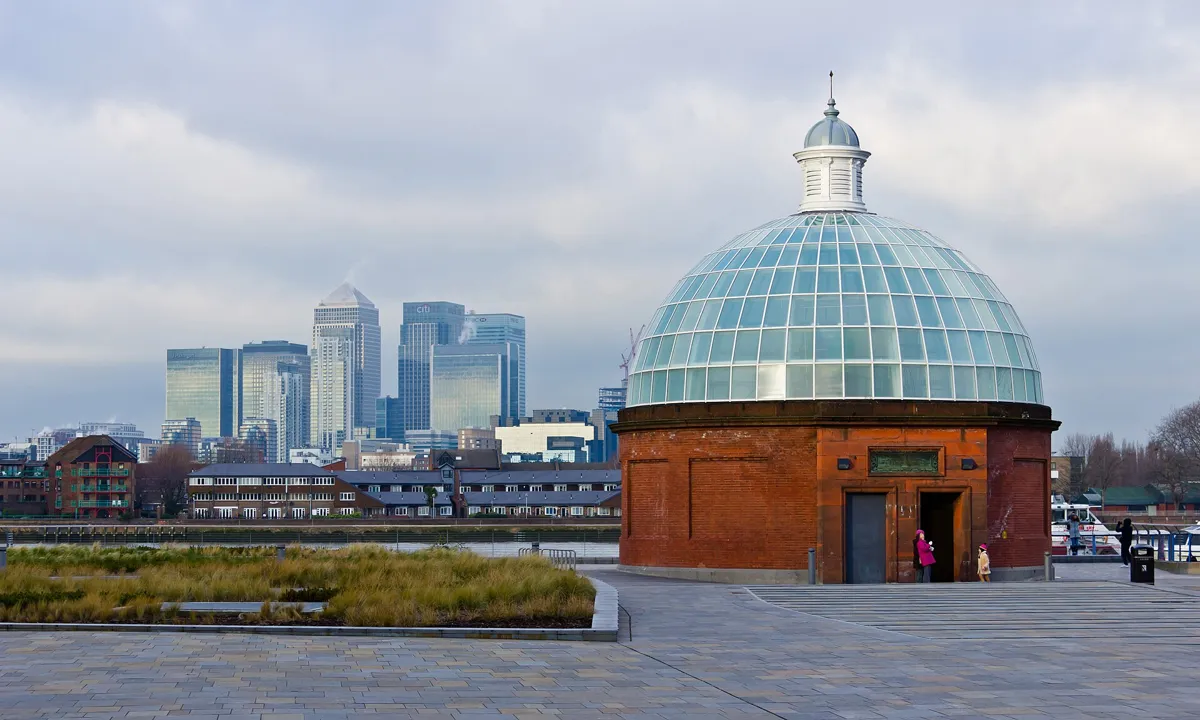
The south entrance, with Canary Wharf behind. Photo: Dmitry Tonkonog, CC BY-SA 3.0, via Wikimedia Commons (resized). Walk 109 m north, along Greenwich Church Street and the footway by the river, to the round brick building with a glass dome, close to the Cutty Sark's bow. This is the south entrance of the Greenwich Foot Tunnel. It opened on 4 August 1902. It replaced a costly ferry for people who lived south of the river and worked in the docks of the Isle of Dogs. The cast-iron tunnel is 370 m long and 15 m deep, and it is normally open day and night. The shaft on this side has 100 steps. There are lifts, but they were out of action for a long period in 2021 and 2022, and on 31 October 2026 the council listed the south lift, on this side, as out of service. Lift work runs until December 2026, and the council says it may close the tunnel at short notice during it, so check its status page before you rely on them. You do not need to go through for this walk.
More history
Building began in June 1899. The far end comes up in Island Gardens, which looks back across the river to the Queen's House and the Old Royal Naval College. The Thames Path uses the tunnel to cross the river, and cyclists have to push their bikes.
Sources: Wikipedia, Greenwich foot tunnel; Royal Borough of Greenwich, foot tunnel status.
-
Greenwich Market
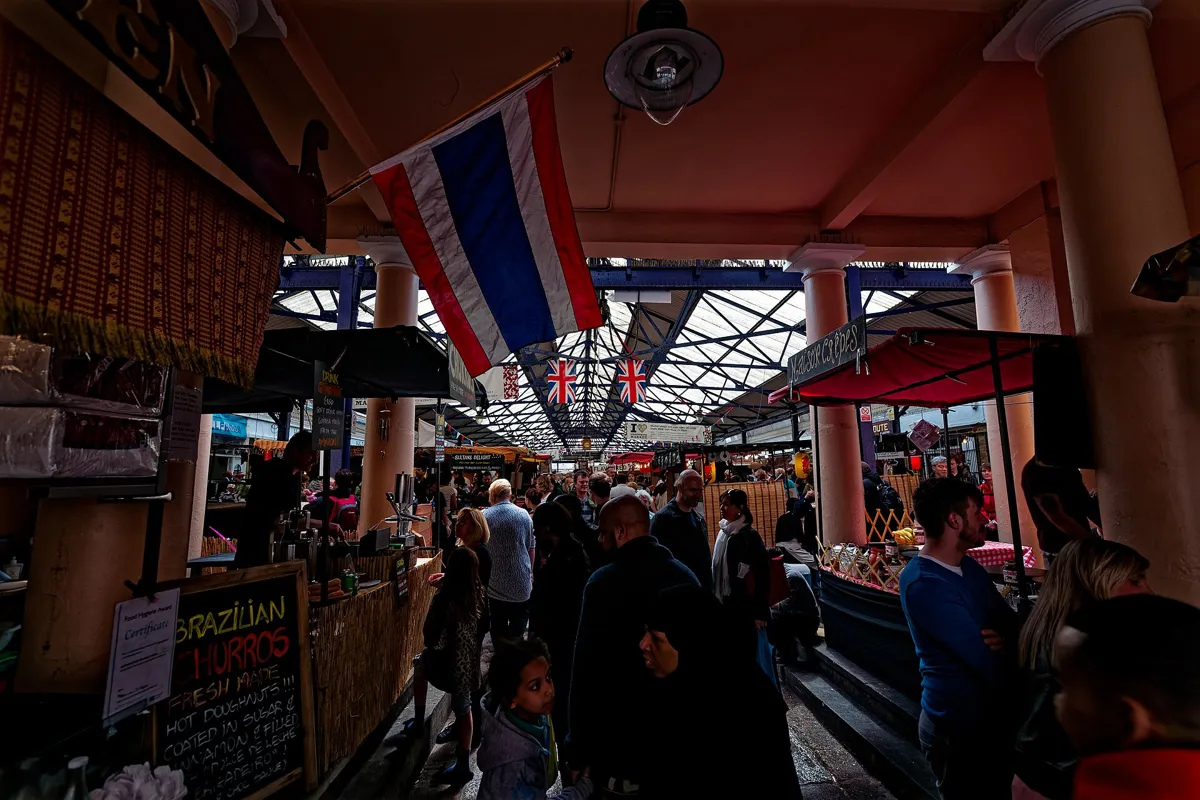
Inside the market. Photo: Txllxt TxllxT, CC BY-SA 4.0, via Wikimedia Commons (resized). Walk back past the ship, then head south-east to the corner of King William Walk and College Approach. Turn right along College Approach for the market, 254 m. It fills an "island site" between College Approach, Greenwich Church Street, King William Walk and Nelson Road. There has been a market in Greenwich since the 14th century, but the present market dates from 1700, when Lord Romney assigned a charter for markets on Wednesdays and Saturdays to the Commissioners of Greenwich Hospital, for 1,000 years. The Grade II listed buildings around it date from 1827 to 1833, and the roof was replaced in 2016. The market says it is open every day from 10:00 to 17:30, except Christmas Day and the first six Mondays of the year. Antiques and collectables stalls trade on Tuesdays, Thursdays and Fridays, arts and crafts on Mondays, Wednesdays, Fridays and weekends. In 2026 a street food market also runs in Cutty Sark Gardens at weekends, until 29 November.
More history
The landowner, Greenwich Hospital, improved the market between 2014 and early 2016. The same name belongs to the Royal Hospital for Seamen, your next stop. The listed buildings were put up under Joseph Kay's direction.
Sources: Wikipedia, Greenwich; Wikipedia, Greenwich Hospital. Opening days and street food: Greenwich Market.
-
The Old Royal Naval College, built where a Tudor palace stood
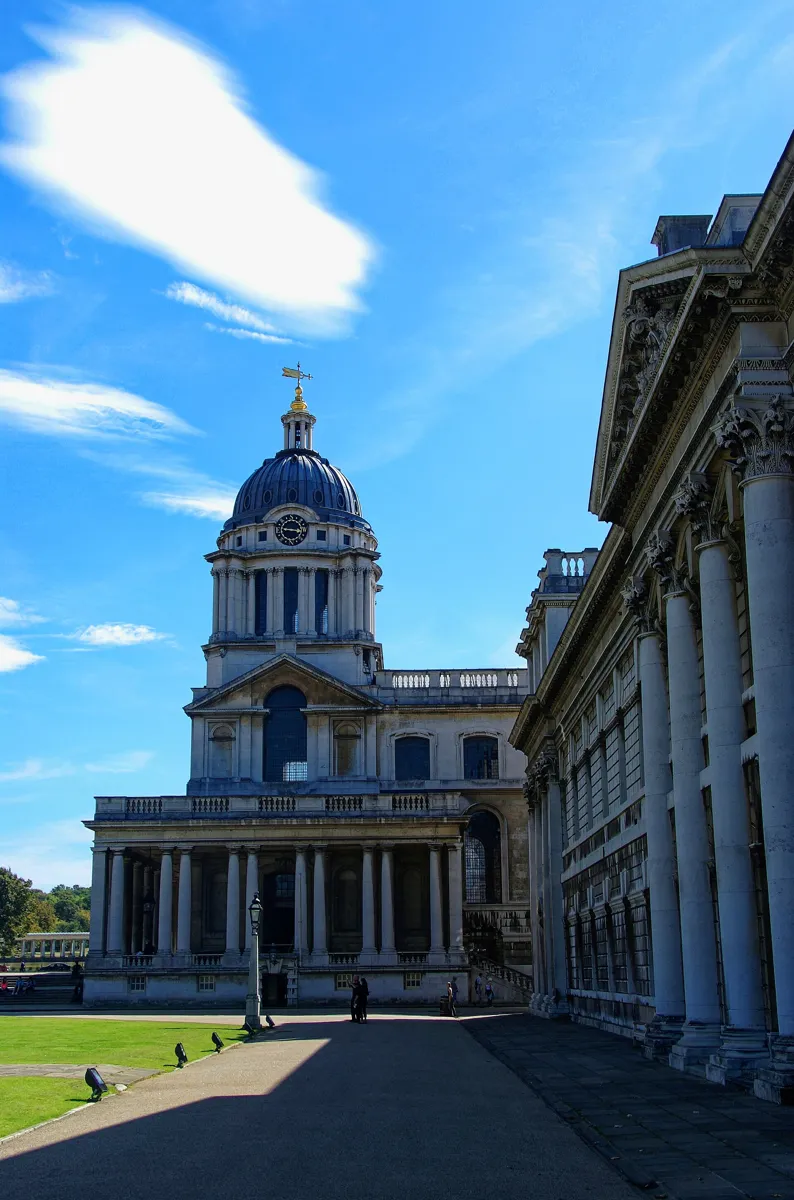
A dome and colonnade at the Old Royal Naval College, seen from the Grand Square. Photo: Txllxt TxllxT, CC BY-SA 4.0, via Wikimedia Commons (resized). From the market, walk along College Approach to King William Walk, then turn onto College Way and into the college grounds, 317 m. Look south along the Grand Square. The college is split in two on purpose. Plans for the hospital would have blocked the river view from the Queen's House, so Queen Mary II ordered the buildings divided to keep it. The buildings were the Royal Hospital for Seamen, a home for retired Royal Navy sailors. Sir Christopher Wren designed it, and the main work ran from 1696 to 1712. This is not the oldest building on the site. A Tudor palace, the Palace of Placentia or Greenwich Palace, stood here, and Henry VIII was born in it in 1491. Only remains of it survive, beneath the Painted Hall. The hospital closed in 1869, and from 1873 until the late 1990s the Royal Navy trained officers here. The grounds are free and open daily from 08:00 to 23:00. The chapel is open to all from 10:00 to 17:00. The Painted Hall, which Sir James Thornhill painted between 1707 and 1726 with about 200 figures, costs £19 for an adult; children aged 16 and under go free. It is open from 10:00 to 17:00, but events close it on some dates, so check the closures list first.
More history
Thornhill was paid £1 a yard for the walls and £3 a yard for the ceiling, £6,685 in all. The hall was meant as a dining room for the pensioners, but it soon drew visitors, and Lord Nelson lay in state there in 1806. Wren and his assistant Nicholas Hawksmoor gave their services free.
Sources: ORNC, Painted Hall; ORNC, our history; ORNC, Greenwich Palace; Wikipedia, Old Royal Naval College; Wikipedia, Greenwich Hospital; Wikipedia, Palace of Placentia; ORNC, explore the site. Hours and prices: ORNC, plan a visit; ORNC, opening times.
-
The National Maritime Museum
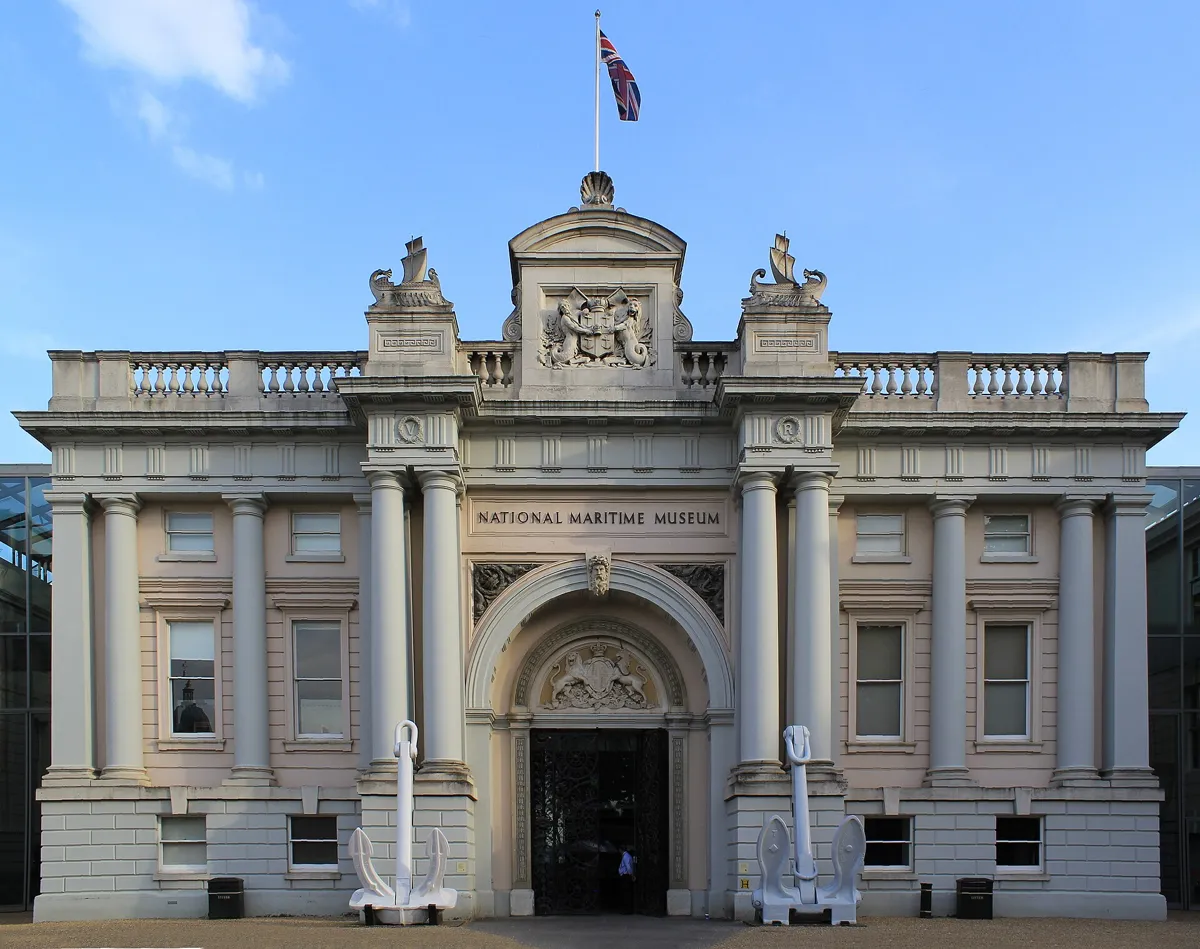
The museum's front on Romney Road. Photo: Katie Chan, CC BY-SA 3.0, via Wikimedia Commons (resized). Walk south down the Grand Square to Romney Road and turn right along it. Cross at the signal crossing, then take the path to the museum's front, 388 m. The National Maritime Museum is free. An Act of 1934 created it, using the gifts of Sir James Caird, and King George VI opened it on 27 April 1937 with his daughter Princess Elizabeth. It holds more than two million items on Britain at sea, from maritime art to ship models, and it occupies the buildings of the old Royal Hospital School, which educated seamen's children here until 1933. You do not need to book, though a free ticket guarantees entry. The Observatory's planetarium is closed, so the museum's new Astronomers Take Over gallery has a paid planetarium experience instead.
More history
A Royal Hospital School opened in Greenwich in 1712 for the orphans of seafarers. The museum's astronomy and timekeeping instruments are kept at the Observatory.
Sources: Wikipedia, National Maritime Museum; Royal Museums Greenwich, Maritime Greenwich guide; Royal Museums Greenwich, Royal Observatory; Royal Museums Greenwich, National Maritime Museum; Royal Museums Greenwich, tickets and prices; Wikipedia, Greenwich Hospital.
-
The Queen's House, England's first classical building
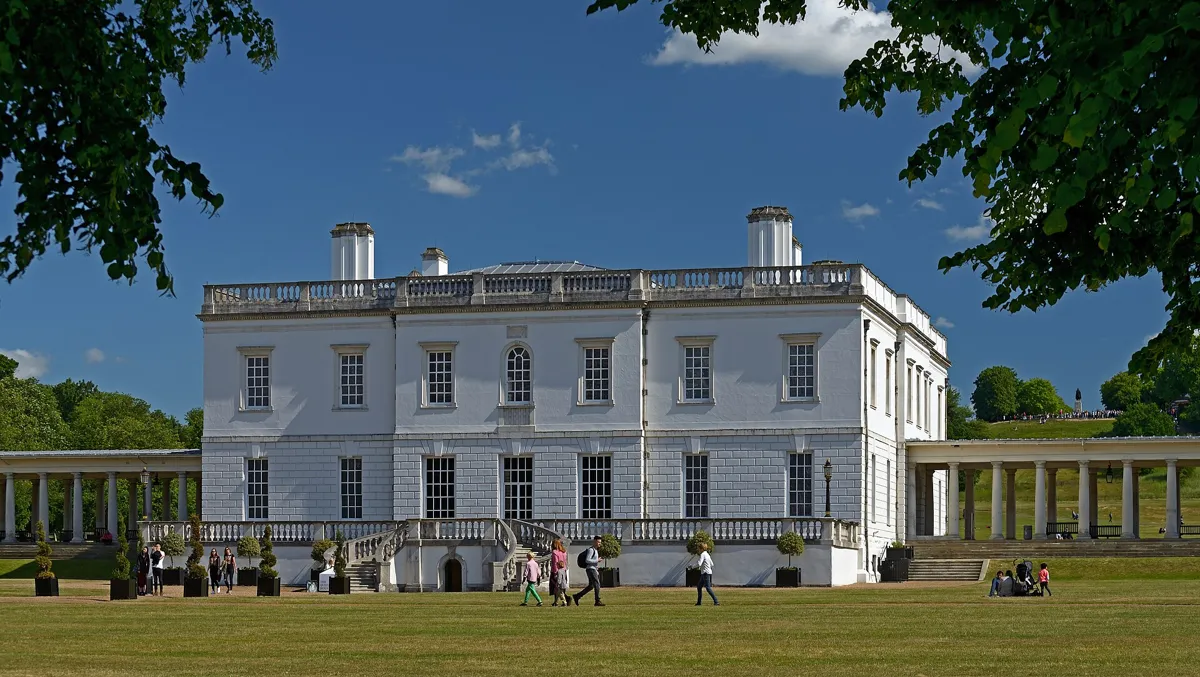
The Queen's House and its colonnades. Photo: Ввласенко, CC BY-SA 3.0, via Wikimedia Commons. From the museum front, follow the paths east, with a short flight of steps on the way, to the Queen's House, 236 m. Work began in 1616 on a villa by Inigo Jones for Anne of Denmark, the wife of James I. Work stopped in 1618 when Anne fell ill, and she died in 1619. The house was finished for Henrietta Maria, Charles I's queen, in 1635. Royal Museums Greenwich calls it the first classical building in England. Inside are the Great Hall, a 40-foot cube, and the Tulip Stairs, England's first spiral staircase with no central support. The house was built to bridge a public road. The road has gone, but the colonnades on each side stand where it ran; they date from the 19th century, not from Jones. Entry is free, with booking recommended, and the Armada Portrait of Elizabeth I hangs here.
More history
Orazio Gentileschi's nine canvases once decorated the Great Hall ceiling. Queen Anne gave them to Sarah Churchill in 1708, and they are now at Marlborough House. In 2016 the artist Richard Wright painted the empty ceiling panels, the first artist to work on that ceiling since 1639.
Sources: Wikipedia, Queen's House; Royal Museums Greenwich, Inspiring architecture at the Queen's House; Royal Museums Greenwich, Armada Portrait.
-
The Royal Observatory gate and the prime meridian
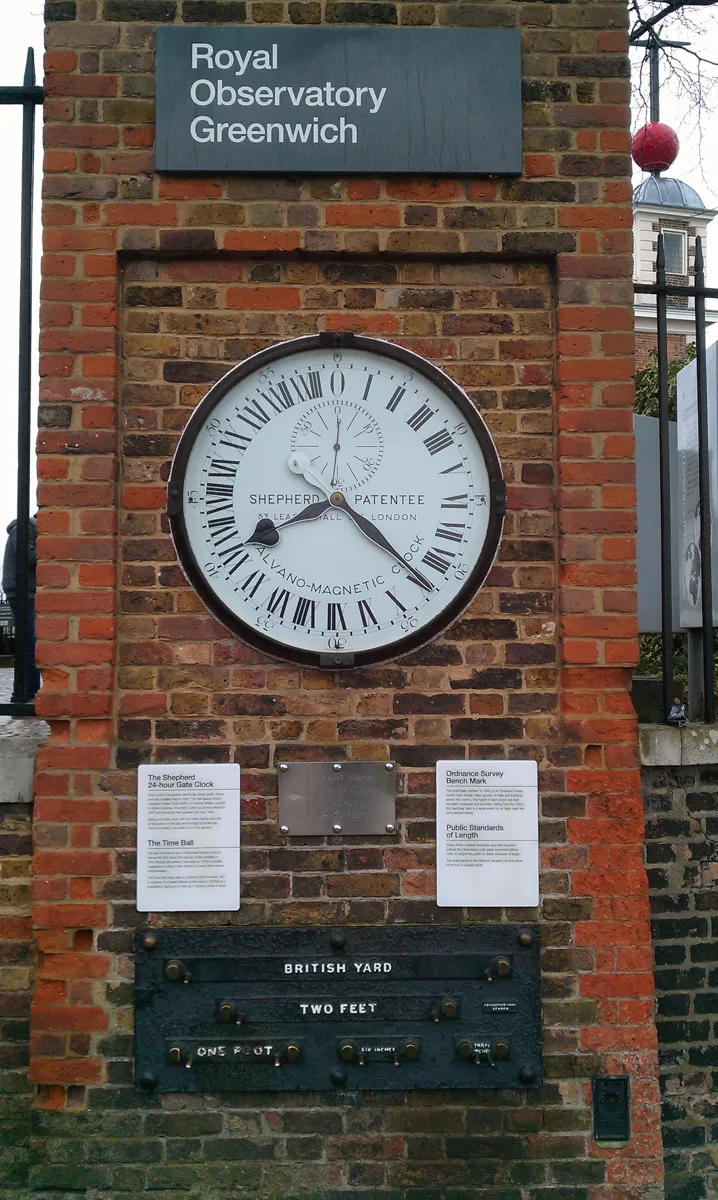
The 24-hour Shepherd Gate Clock outside the Observatory gate. Photo: Andres Rueda, CC BY 2.0, via Wikimedia Commons. From the Queen's House, take the path south up through the park, then follow the path east along the north side of the Observatory to the gate, 490 m. This is the steepest part of the walk. The Royal Observatory was founded by Charles II in 1675, to help sailors fix their position at sea. Wren and Robert Hooke designed it on the ruined foundations of Greenwich Castle, and the first Astronomer Royal, John Flamsteed, moved in on 10 July 1676. In 1884 delegates in Washington voted to make the Greenwich meridian the world's prime meridian. Greenwich won because nearly two-thirds of the world's ships already used charts based on it. The stainless steel strip marking the line is in the courtyard, behind the gate. The whole Observatory is closed from 2 November 2026 for First Light, a building project due to finish by spring 2028, so you cannot go in or stand on the strip. Royal Museums Greenwich says the Meridian Courtyard will reopen in summer 2027, with tickets on sale in January 2027. Before the closure a ticket cost £24 for an adult and £12 for a child. Wikipedia says the line is also marked on a wall of the path just north of the Observatory, the path you have just walked; we have not checked that on the ground. The Shepherd Gate Clock, on the wall outside the gate, went up in 1852 and has a 24-hour dial. It shows Greenwich Mean Time all year, with no change for summer time. Above it, on Flamsteed House, is the red time ball, installed in 1833. Before the closure it rose halfway at 12:55, reached the top at 12:58 and dropped at 13:00 each day. We could not confirm that the ball keeps running during the building work, or that the clock stays in view, so treat them as a bonus.
More history
The Octagon Room, completed in 1676 to Wren's design, is the oldest part of the Observatory. Satellite navigation shows the courtyard strip is not exactly at zero longitude: the modern reference meridian runs about 102 m to the east.
Sources: Royal Museums Greenwich, history of the Royal Observatory; Royal Museums Greenwich, the prime meridian; Royal Museums Greenwich, First Light; Royal Observatory closures; Wikipedia, Shepherd Gate Clock; Wikipedia, Prime meridian (Greenwich); Wikipedia, Greenwich Park.
-
General Wolfe's statue and the view
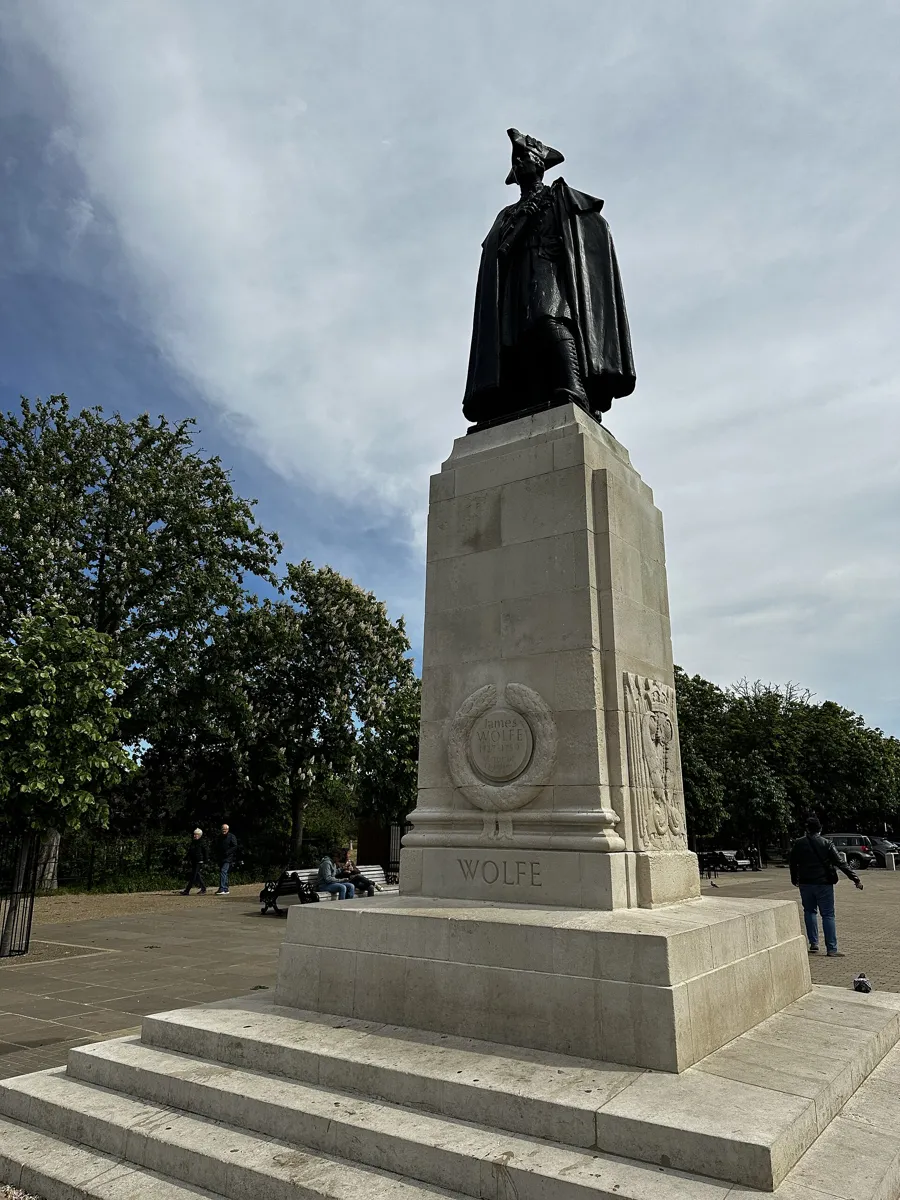
The General Wolfe statue. Photo: Matt Brown, CC BY 4.0, via Wikimedia Commons. Walk 53 m along the path from the Observatory gate to the paved plaza with the statue. James Wolfe (1727 to 1759) won the battle of Quebec for Britain and died in it. His parents lived at Macartney House, on the edge of this park, and he is buried in St Alfege Church in Greenwich. The bronze statue is a gift from the Canadians, designed by Dr Tait Mackenzie and put up in 1930; it is Grade II listed. A descendant of the French commander at Quebec, the Marquis de Montcalm, unveiled it. The plaza is the point of the walk. From here you look down over the Queen's House and the Old Royal Naval College to the Thames, with Canary Wharf beyond, the City of London to the north-west and The O2 to the north. A protected view of St Paul's Cathedral runs from a point just north-east of the statue.
More history
Wolfe's body came back to Britain on HMS Royal William and was laid in the family vault at St Alfege, beside his father. The funeral was on 20 November 1759. The Royal Parks have recently rebuilt this viewing area as a larger, more open plaza.
Sources: The Royal Parks, Greenwich Park monuments; The Royal Parks, Greenwich Park Revealed; Wikipedia, Greenwich Park; Wikipedia, James Wolfe.


Practical details
- Terrain
- Flat, then one climb. The first six stops are on the low ground by the river, and the 490 m from the Queen's House to the Observatory gate is the only real hill. Royal Museums Greenwich calls it steep.
- Step-free
- OpenStreetMap marks Cutty Sark DLR station as wheelchair accessible. On or beside this route it maps 4 steps by the Cutty Sark, a flight of 100 steps down to the foot tunnel, which you do not need, 16 steps on the way into the Grand Square, a short flight between the museum and the Queen's House, 8 steps just before the Observatory gate (wheelchair access "limited") and 3 by the Wolfe statue. At the time of checking, the Painted Hall's lift was out of order, with steps to reach the hall. Greenwich and Maze Hill stations have step-free access by ramp, lift or underpass.
- Water
- OpenStreetMap lists drinking-water points by the Cutty Sark, inside a shop at Greenwich Market, by the Queen's House and by the Wolfe statue.
- Toilets
- OpenStreetMap shows free toilets by the National Maritime Museum and park toilets on Blackheath Avenue, south of the Wolfe statue, both marked wheelchair accessible. The Royal Parks charge 20p, and the ones by the Cutty Sark charge a fee too.
- Sit and eat
- Greenwich Market is the food stop. The Old Royal Naval College has the Undercroft Café and The Old Brewery pub, and the Parkside Café is at the National Maritime Museum. At the top, OpenStreetMap shows the takeaway Wolfe Statue Kiosk, and The Royal Parks name The Pavilion Café as the park's main café.
- When to go
- The Cutty Sark, the museum and the Queen's House open daily from 10:00 to 17:00, with last entry at 16:15. The Royal Observatory is closed from 2 November 2026, and its Meridian Courtyard is due back in summer 2027. The Painted Hall opens daily from 10:00 to 17:00, with last entry at 16:30, but events close it on some dates, so check the closures list. The park's pedestrian gates open at 06:00 and close at dusk, so leave time for the climb on winter afternoons. The college grounds are open from 08:00 to 23:00.
- Shorter walk
- Finish at stop 6, the Queen's House: 1.4 km, about 50 minutes, with no hill.
- Getting back
- Cutty Sark DLR station is about 960 m from the Wolfe statue, 13 minutes on foot down Nevada Street. Maze Hill station is about 970 m, and Greenwich station about 1.3 km.
Walking distances and times from the OSRM foot router on OpenStreetMap data. Stations, fountains, toilets and steps from OpenStreetMap; opening times and prices from Royal Museums Greenwich, the Old Royal Naval College, Greenwich Market and the Royal Parks. Checked 31 October 2026.
Questions people ask
How long does a self-guided walking tour of Greenwich take, and is there a map?
About 70 minutes: 2 km, 26 minutes of walking and eight stops, from Cutty Sark DLR station to the General Wolfe statue beside the Royal Observatory. The map is on this page, and you can print it or save it as a PDF. Add time if you go inside the Cutty Sark or the Painted Hall.
How do you get to Greenwich from central London?
Take the DLR to Cutty Sark for Maritime Greenwich, a two-minute walk from the ship, or a train from London Bridge or Cannon Street to Greenwich station. Uber Boat by Thames Clippers sails to Greenwich Pier, next to the Cutty Sark: 20 minutes from Tower Pier, 25 from London Bridge Pier and 45 from London Eye Pier. The Jubilee line stops at North Greenwich, and a bus from there takes about 25 minutes.
Can you stand on the prime meridian in Greenwich for free?
Not on the famous line. The stainless steel strip is in the Royal Observatory's courtyard, and the whole Observatory is closed from 2 November 2026. Royal Museums Greenwich says the Meridian Courtyard will reopen in summer 2027, with tickets on sale in January 2027. Before the closure a ticket cost £24 for an adult and £12 for a child. Wikipedia says the meridian is also marked on a wall of a path just north of the Observatory, where this walk goes, and by plaques in Chesterfield Walk and Park Vista, outside the park. We have not checked those on the ground. The Royal Parks also say a sundial by the boating lake marks the line.
How long does it take to walk up to the Royal Observatory?
From the Queen's House it is 490 m, about six or seven minutes at the pace of this walk, and it is uphill. Royal Museums Greenwich calls the hill to the Observatory steep. From Cutty Sark DLR station to the Observatory gate the whole route is about 1.9 km. The Observatory is closed from 2 November 2026, so you will see it only from the outside.
What is Maritime Greenwich?
It is the UNESCO World Heritage Site that UNESCO made of Greenwich in 1997. It takes in the historic town centre, Greenwich Park, the Old Royal Naval College and the four Royal Museums Greenwich sites: the National Maritime Museum, the Royal Observatory, the Cutty Sark and the Queen's House. This walk passes all of them.
Walk it with Strolio
Open Strolio at the Cutty Sark and ask for an hour or so through Greenwich. Strolio builds walks in any city with mapped streets, so its route may pick different stops from this page. Stories play as you reach each place, and you can ask about anything else you pass, by voice or with a photo. You can also start from your hotel and choose your own time and interests.