
Ancient Rome self-guided walking tour · about 90 minutes · map
Ancient Rome on foot: the Colosseum, the Imperial Fora and the Capitoline from the outside and above
This walk sees ancient Rome from its public streets: round the Colosseum, along the road above the Imperial Fora, up Michelangelo's square on the Capitoline Hill and out to a free terrace over the Roman Forum. It ends at a theatre older than the Colosseum, with a palace built on top.
Everything on the route can be seen for free. Going inside the Colosseum, the Roman Forum and the Palatine needs a ticket from the Parco archeologico del Colosseo, the state body that runs them; the Capitoline Museums and Trajan's Markets sell their own. If you want to go in, book your Colosseum slot first and fit the walk around it.
A note on accuracy: much of what you see was rebuilt, propped up or copied later. The brick ends of the Colosseum are 19th-century repairs, the bronze emperors on Via dei Fori Imperiali are 1930s copies, and the Marcus Aurelius on the Capitoline is a copy of the original indoors. Where that happens, we say so, and every fact links to its source.
- Start
- Colosseo metro (lines B and C), beside the Colosseum
- Finish
- The Theatre of Marcellus, beside Via del Teatro di Marcello; the Piazza Venezia bus station is about 380 m away
- Distance
- 3.0 km, one way
- Time
- About 90 minutes: 40 min walking and 8 stops, all seen from outside; much longer if you go into any of the sites
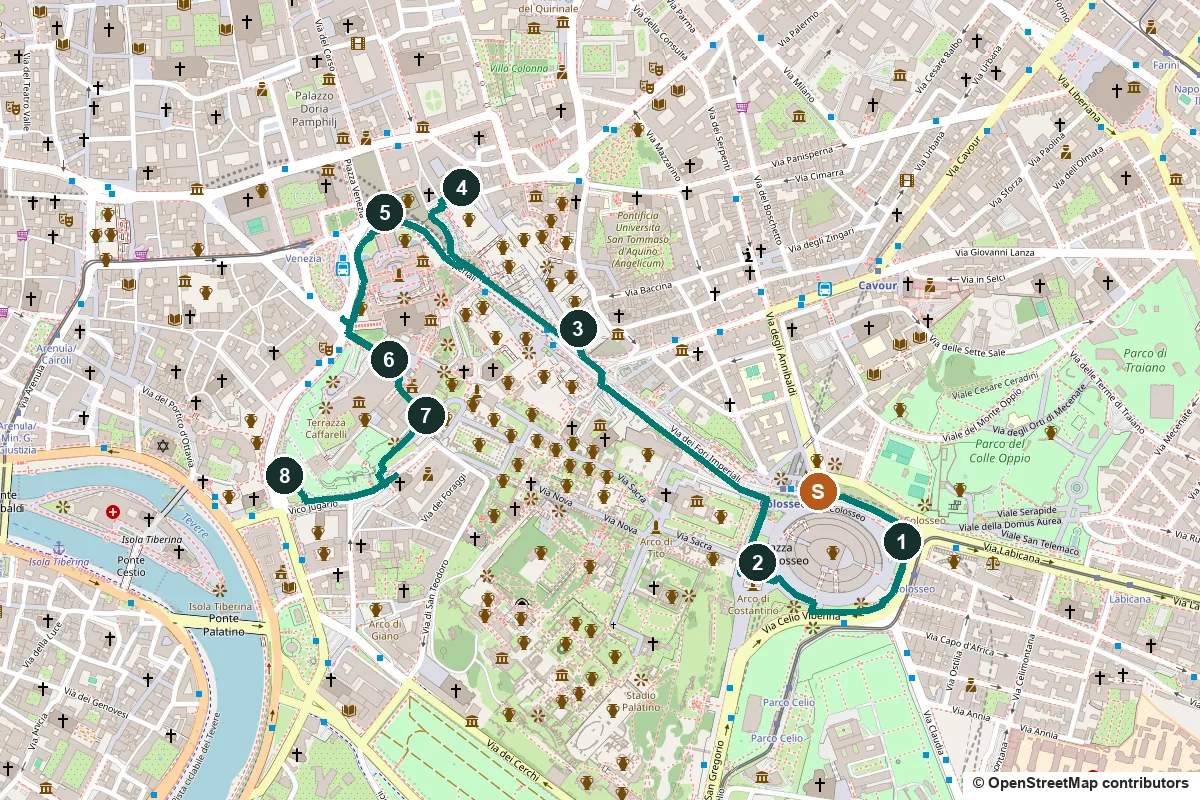
Terrain, water, tickets, opening times and a shorter version ↓
What to see: the stops
-
The Colosseum, from the outside
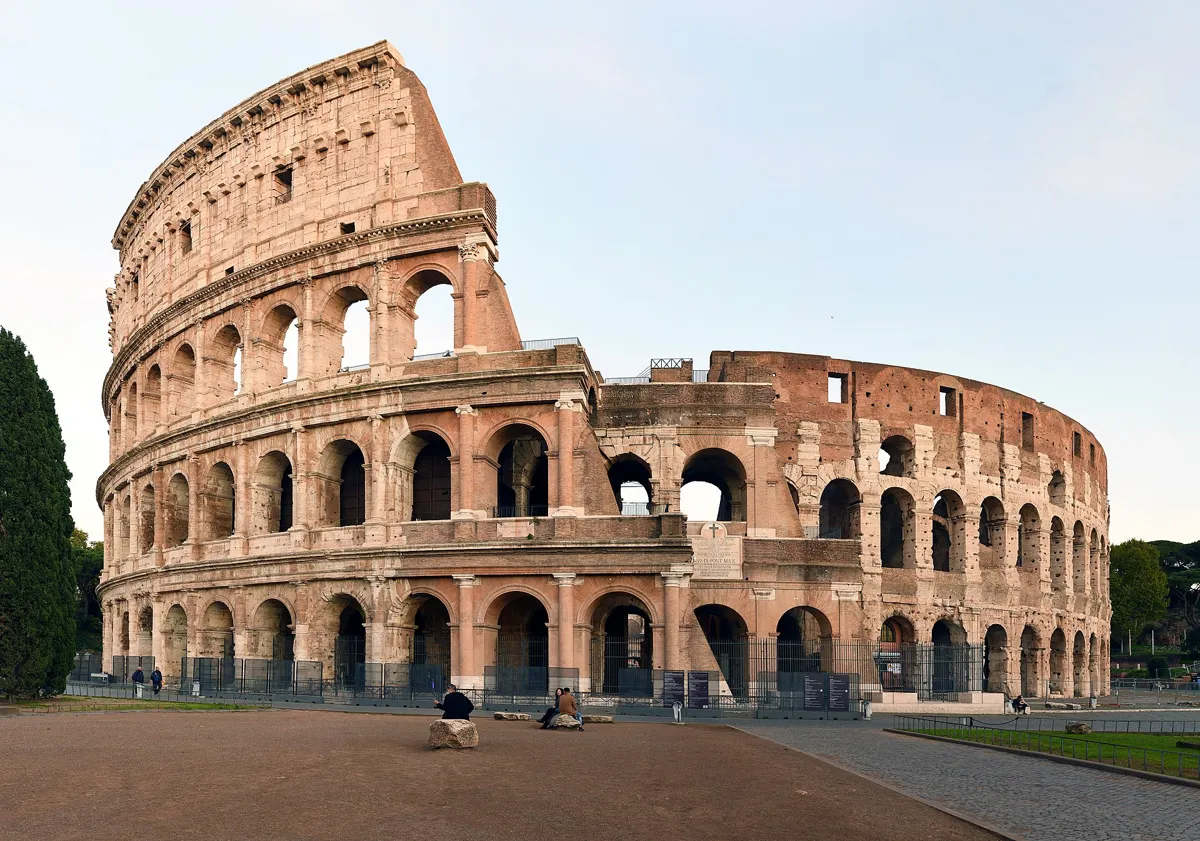
The full-height outer wall on the left; on the right, the inner ring left standing where the outer one fell. Photo: FeaturedPics, CC BY-SA 4.0, via Wikimedia Commons (resized). From Colosseo metro, cross to the amphitheatre and walk round its north side to the east end. Work began under the emperor Vespasian in the early 70s AD, on ground where Nero had dug an artificial lake for his palace, and his son Titus finished it in 80. It held an estimated 50,000 or more spectators for gladiator fights, animal hunts and executions. Its name probably comes from a giant bronze statue of Nero that stood nearby. The side you have just walked along is the only stretch of the outer wall still standing, about 48 m high, its 80 ground-floor arches once numbered entrances. The great earthquake of 1349 brought down the outer south side, which stood on unstable river soil. Look at the two ends of the tall wall: the brick wedges are 19th-century props, one built in a hurry by Raffaele Stern after an earthquake in 1806, the other, facing the Forum, by Giuseppe Valadier from 1823, with brick arches copying the stone ones. The many holes in the stone are where later Romans hacked out the iron clamps.
More history
For centuries the building was a quarry: in one year Pope Nicholas V took 2,500 cartloads of travertine and tufa from it. In 1749 Pope Benedict XIV banned the quarrying and dedicated the arena to the Passion of Christ.
Sources: Wikipedia (it), Colosseo; Wikipedia, Colosseum. Going in: a ticket from the Parco archeologico del Colosseo, with a timed Colosseum slot.
-
The Arch of Constantine, built from older monuments
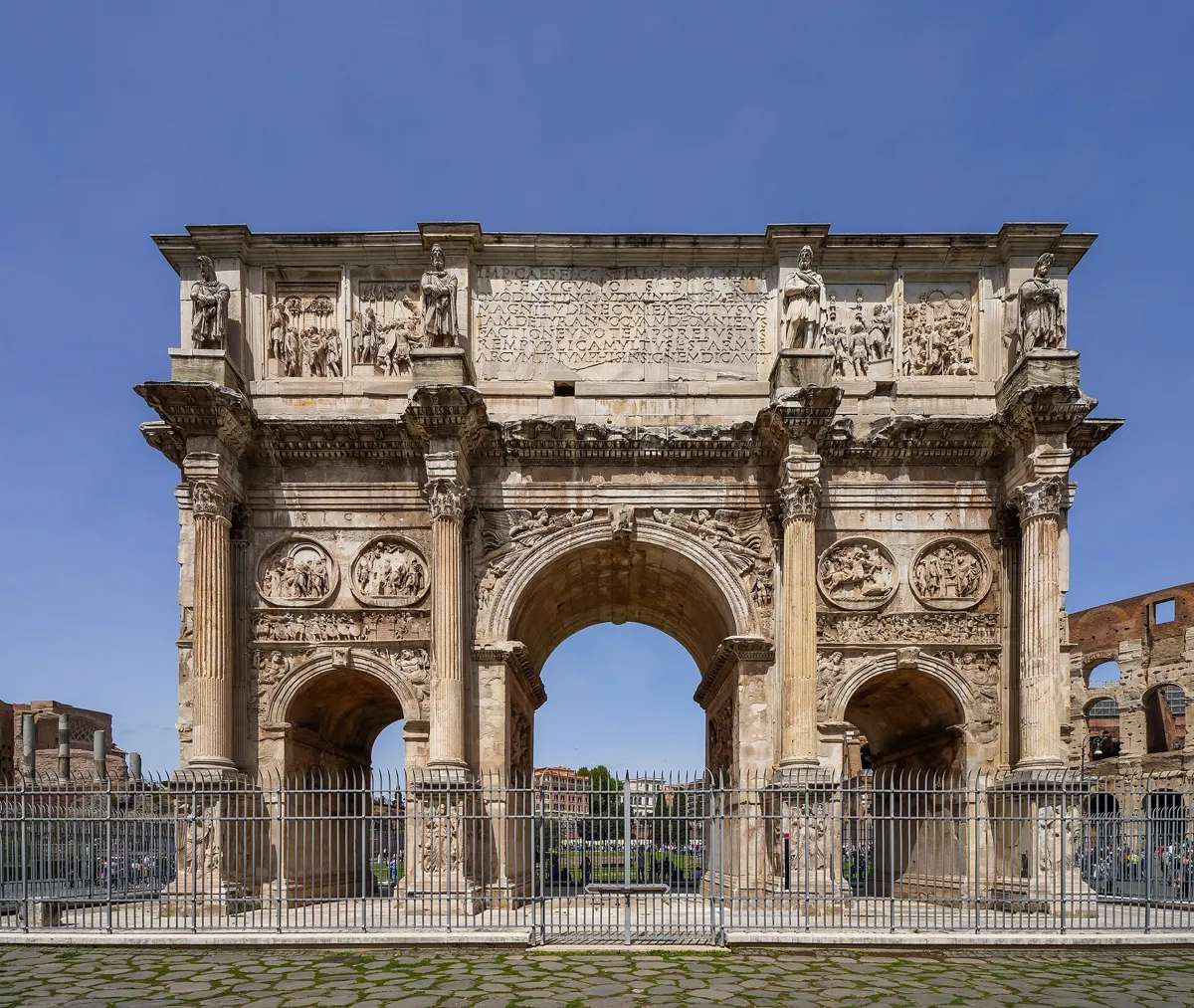
The south side of the arch. Photo: NikonZ7II (Paris Orlando), CC BY-SA 4.0, via Wikimedia Commons (resized). Walk on round the south side of the Colosseum, past Via Celio Vibenna, where the outer ring is missing and you see the inner wall, back into Piazza del Colosseo. The arch stands behind a railing at the west end of the square. The Senate put it up for Constantine's victory over his rival Maxentius at the Milvian Bridge on 28 October 312, and it opened on 25 July 315. At 21 m high and nearly 26 m wide it is the largest Roman triumphal arch. Much of its sculpture is second-hand. The round hunting and sacrifice scenes date from Hadrian's reign, the eight panels on the attic from one of Marcus Aurelius, and the captive Dacians on top of the columns from Trajan's time; some emperors' heads were recut as Constantine. The thin frieze above the side arches was carved new and tells the story of his campaign. The inscription says he won "by divine inspiration", a phrase vague enough to please both Christians and pagans.
More history
In the Middle Ages the arch was built into a noble family's stronghold. In 1534 Lorenzino de' Medici cut the heads off some of its statues. It was the finish line of the marathon at the 1960 Rome Olympics.
Sources: Wikipedia, Arch of Constantine; Wikipedia (it), Arco di Costantino.
-
Via dei Fori Imperiali and the Forum of Augustus
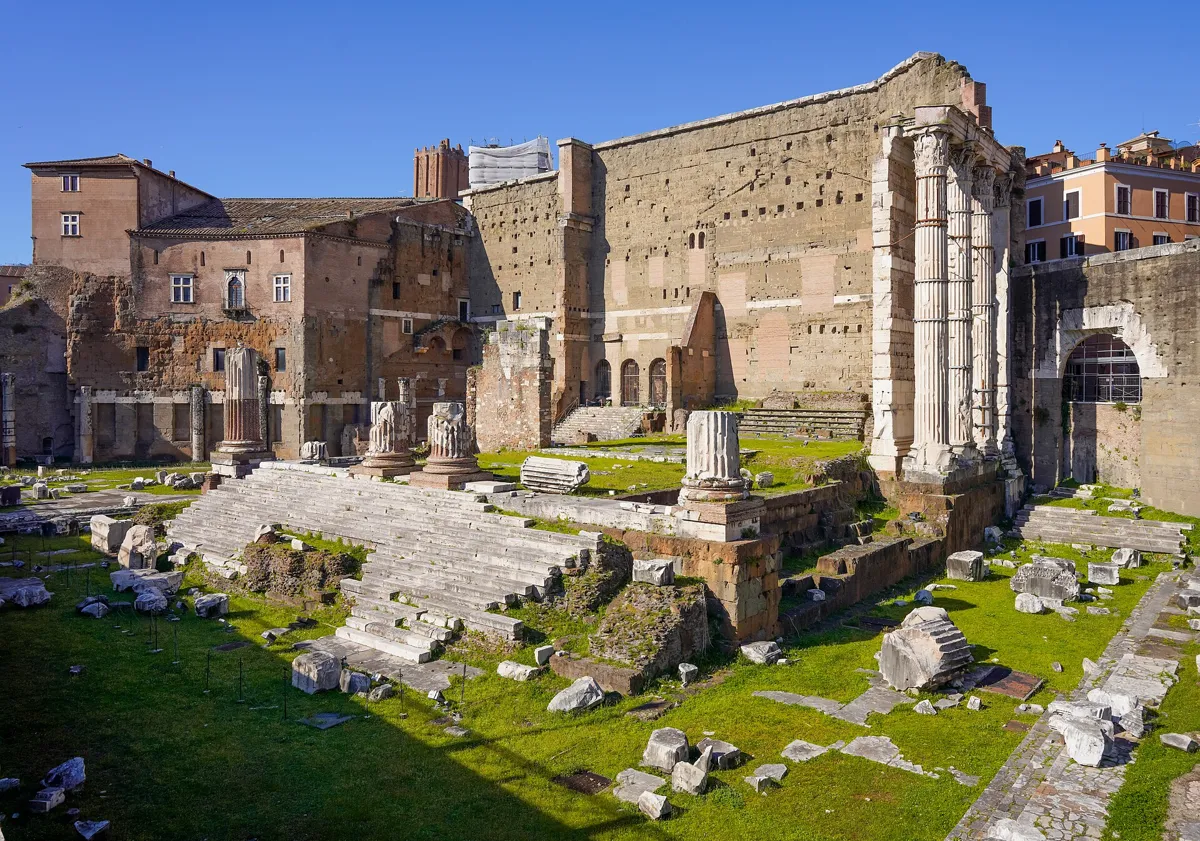
The Temple of Mars Ultor and the high wall of the Forum of Augustus. Photo: NikonZ7II, CC BY-SA 4.0, via Wikimedia Commons (resized). Cross Piazza del Colosseo and walk up the left-hand side of Via dei Fori Imperiali. On the brick wall to your left are four marble maps of Rome's growth up to the reign of Trajan, put up in 1934. At Largo della Salara Vecchia, cross to Via Alessandrina and stop above the ruins. The road was built between 1924 and 1932 and opened as Via dell'Impero. To clear its line, a crowded old quarter was knocked down and much of a low hill, the Velia, dug away, so that the Colosseum closes the view from Piazza Venezia. Below you lie the Imperial Fora, five monumental squares built between 46 BC and 113 AD by Julius Caesar, Augustus, Vespasian, Nerva and Trajan. On your right as you look towards Trajan's Column is the Forum of Augustus. He vowed its temple to Mars the Avenger in 42 BC, at the battle of Philippi against Caesar's killers, and opened it in 2 BC. The high wall behind it shut out the crowded Suburra district and kept fires away. The bronze emperors along the road date from 1933, copies of ancient marble statues: the Augustus copies the one from Prima Porta in the Vatican Museums.
More history
A fifth marble map, of Mussolini's empire with its colonies, was added in 1936 and taken down in November 1945.
Sources: Wikipedia (it), Via dei Fori Imperiali; Wikipedia, Via dei Fori Imperiali; Wikipedia (it), Fori Imperiali; Wikipedia, Imperial fora; Sovrintendenza Capitolina, Fori Imperiali.
-
Trajan's Column and Trajan's Markets
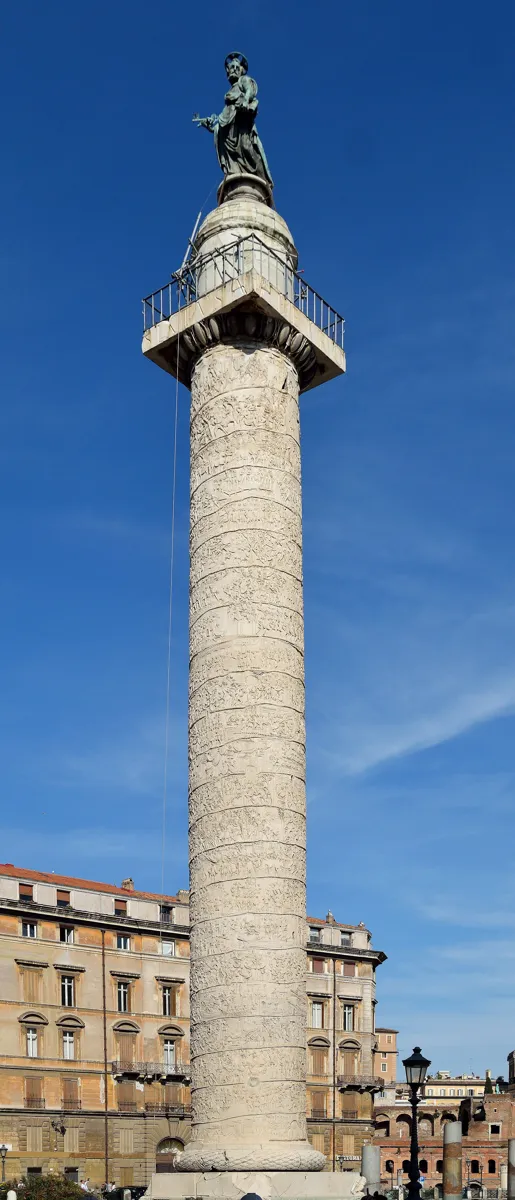
The column, with Saint Peter on top since 1587. Photo: Livioandronico2013, CC BY-SA 4.0, via Wikimedia Commons (resized). Carry on along Via Alessandrina to its end at the column. Trajan's Column was dedicated on 12 May 113. Its shaft is almost exactly 100 Roman feet tall, and a carved band winds around it with the story of Trajan's two wars against the Dacians, in 101–102 and 105–106. Inside, a spiral stair of 185 steps climbs to the top. The inscription on the base says the column shows how high the ground between the Capitoline and Quirinal hills once stood before it was cut away to make room for the forum. After Trajan died in 117, his ashes were placed in the base. His statue on top was lost in the Middle Ages, and in 1587 Pope Sixtus V put up the bronze Saint Peter. The great curved brick building cut into the hillside beside the forum is Trajan's Markets, built in the same years. It is named for its rows of shop-like rooms, but scholars now think it was mostly offices for running the fora.
More history
In the Middle Ages the markets got extra floors and the Torre delle Milizie, the tall brick tower above them. Since 2007 they have housed the Museum of the Imperial Fora.
Sources: Wikipedia, Trajan's Column; Wikipedia (it), Colonna Traiana; Wikipedia (it), Mercati di Traiano; Wikipedia, Trajan's Market. Going in: Mercati di Traiano, entrance at Via Quattro Novembre 94; a separate ticketed path through the fora starts at the column (Sovrintendenza Capitolina).
-
The Vittoriano, the Altar of the Fatherland
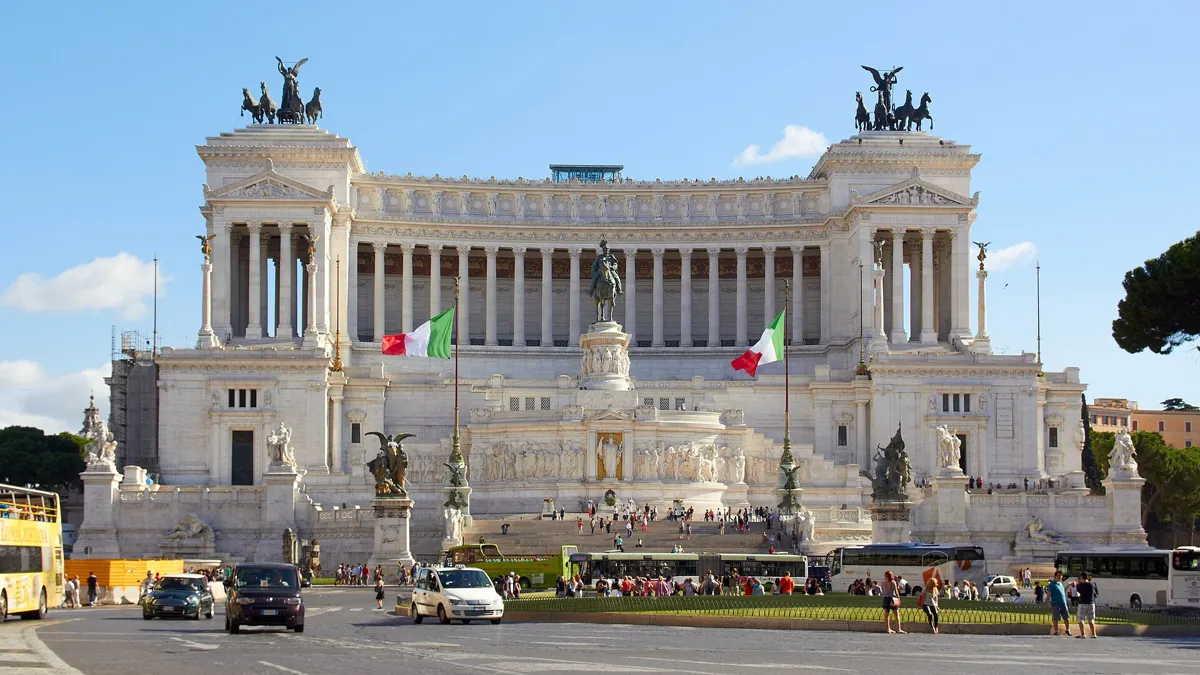
The Vittoriano from Piazza Venezia. Photo: Max_Ryazanov, CC BY-SA 3.0, via Wikimedia Commons (resized). Walk back to Via dei Fori Imperiali and follow it into Piazza Venezia, in front of the white monument. This is not ancient: it honours Victor Emmanuel II, the first king of united Italy, and was planned in 1878, the year he died. Giuseppe Sacconi designed it, and it was built from 1885 to 1935, though opened in 1911. To make room, a medieval quarter on the slope of the Capitoline was pulled down, including the friars' convent of the Aracoeli. It is 135 m wide and 70 m high, 81 m to the top of the two bronze chariots, and faced in white Botticino marble from near Brescia. Romans nicknamed it "the wedding cake" and "the typewriter". On the first terrace, under the statue of the goddess Roma, lies Italy's Unknown Soldier of the First World War, buried here in 1921; the guard changes every hour. Entry to the monument is free. Panoramic lifts also climb to a terrace at the top, 70 m up.
More history
Two bombs went off here on 12 December 1969. No one was killed, but the monument then stayed closed to the public for thirty years.
Sources: VIVE, Vittoriano; VIVE, info e orari; VIVE, Terrazza panoramica; Wikipedia (it), Vittoriano; Wikipedia, Victor Emmanuel II Monument.
-
Piazza del Campidoglio and the horse of Marcus Aurelius
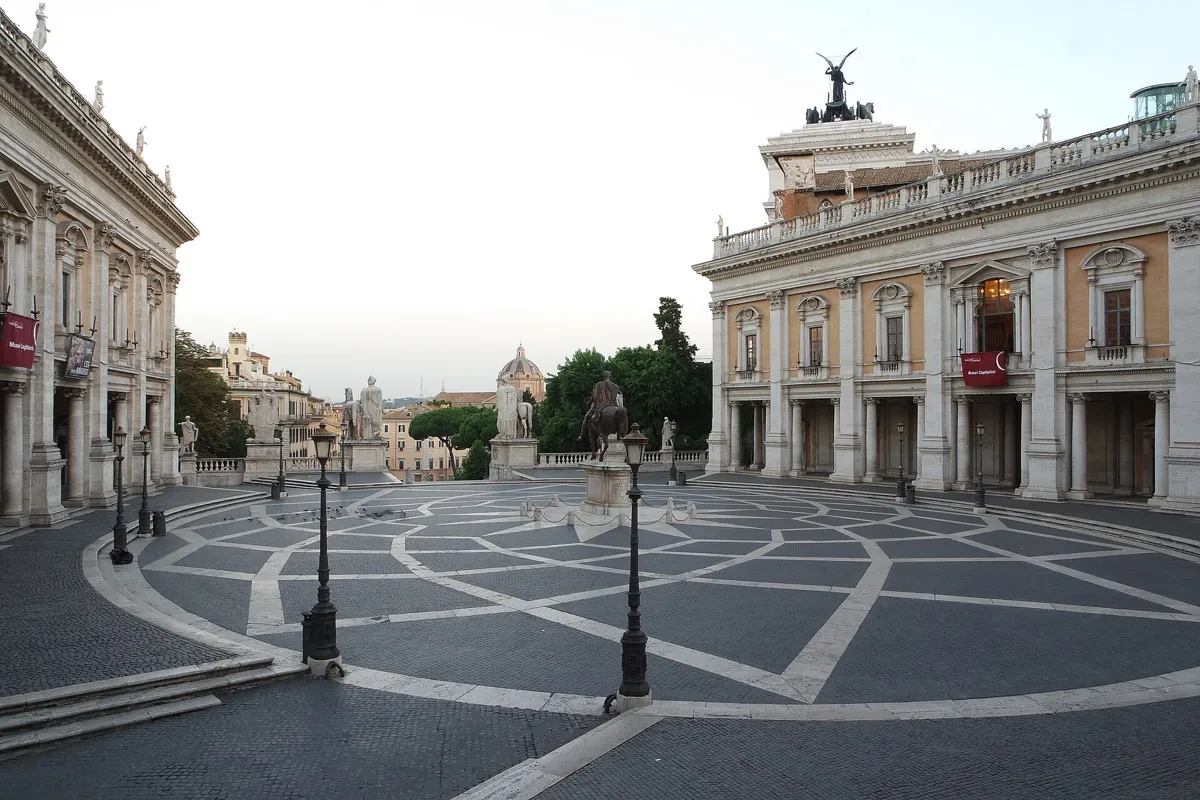
The square seen from Palazzo Senatorio, with the copy of Marcus Aurelius. Photo: Kameister, CC BY-SA 4.0, via Wikimedia Commons (resized). Walk along the left side of the Vittoriano. In the corner between it and the steep steps of Santa Maria in Aracoeli, look down on the brick remains of a 2nd-century Roman apartment block, the Insula dell'Ara Coeli, found when a church built on top of it was taken down in the 20th century. Then climb the Cordonata, the broad ramp of shallow steps between two black Egyptian lions, with Roman statues of Castor and Pollux at the top. Pope Paul III asked Michelangelo to remake this hilltop after Emperor Charles V's triumphal visit in 1536, when it was so neglected that people called it goat hill. Michelangelo turned the square away from the Forum to face the modern city. Palazzo Senatorio, ahead, has been Rome's city hall since the 12th century and stands on an ancient records office. Work went slowly: the palace on your left was finished only in 1674, and the star in the paving was laid in 1940, from a print of his design. The bronze emperor on horseback is a copy put here in 1997. The original, from the late 2nd century AD, survived because people thought it showed Constantine; it is now inside the Capitoline Museums.
More history
The statue stood by the Lateran Palace until 1538. On 1 August 1347 Cola di Rienzo threw a feast where wine and water ran from the horse's nostrils. A bomb in 1979 damaged its base; restoration began in 1981, and since 1990 the original has stayed indoors.
Sources: Musei Capitolini, Piazza del Campidoglio (PDF); Wikipedia (it), Piazza del Campidoglio; Wikipedia, Piazza del Campidoglio; Wikipedia (it), Cordonata; Wikipedia (it), Statua equestre di Marco Aurelio; Wikipedia, Equestrian statue of Marcus Aurelius; Wikipedia (it), Insula dell'Ara Coeli. Going in: Musei Capitolini.
-
The free view over the Roman Forum
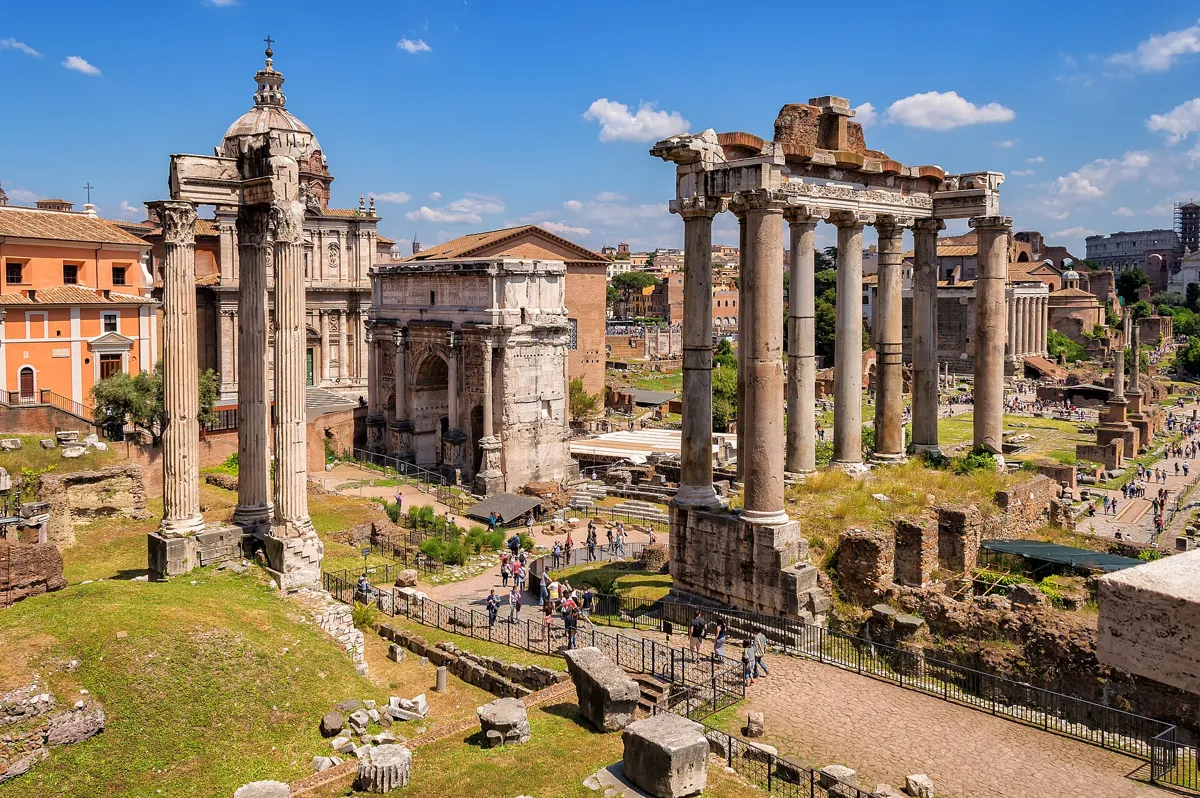
The Forum from the Capitoline: the Temple of Vespasian's three columns, the Arch of Septimius Severus and the Temple of Saturn. Photo: Stefano Lovato from Bologna, Italia, CC BY 2.0, via Wikimedia Commons (resized). Take Via del Campidoglio down the right-hand side of Palazzo Senatorio to the terrace on the corner of Via di Monte Tarpeo. Below you, the massive stone wall under the palace is the Tabularium, built around 78 BC after a fire in 83 BC; it is usually called Rome's state records office, though that is debated. The three tall columns in front belong to the temple Titus began in 79 for his deified father, Vespasian; his brother Domitian finished it. To their right, the eight columns of the Temple of Saturn belong to the third building on a site traditionally dated to 497 BC; it held the Republic's treasury. The white marble arch is the Arch of Septimius Severus, dedicated in 203 for his wars against the Parthians; after his son Caracalla had his brother Geta killed, Geta's name was removed from it. OpenStreetMap marks a second viewpoint on the other side of the palace.
More history
The Tabularium's gallery, 67 m long, can only be reached from inside the Capitoline Museums, where it gives a similar view of the Forum.
Sources: OpenStreetMap, Forum Romanum view; Wikipedia, Tabularium; Wikipedia (it), Tabularium; Wikipedia, Temple of Vespasian and Titus; Wikipedia, Temple of Saturn; Wikipedia, Arch of Septimius Severus. Going in: the Forum needs a Parco archeologico del Colosseo ticket.
-
The Theatre of Marcellus, with a palace on top
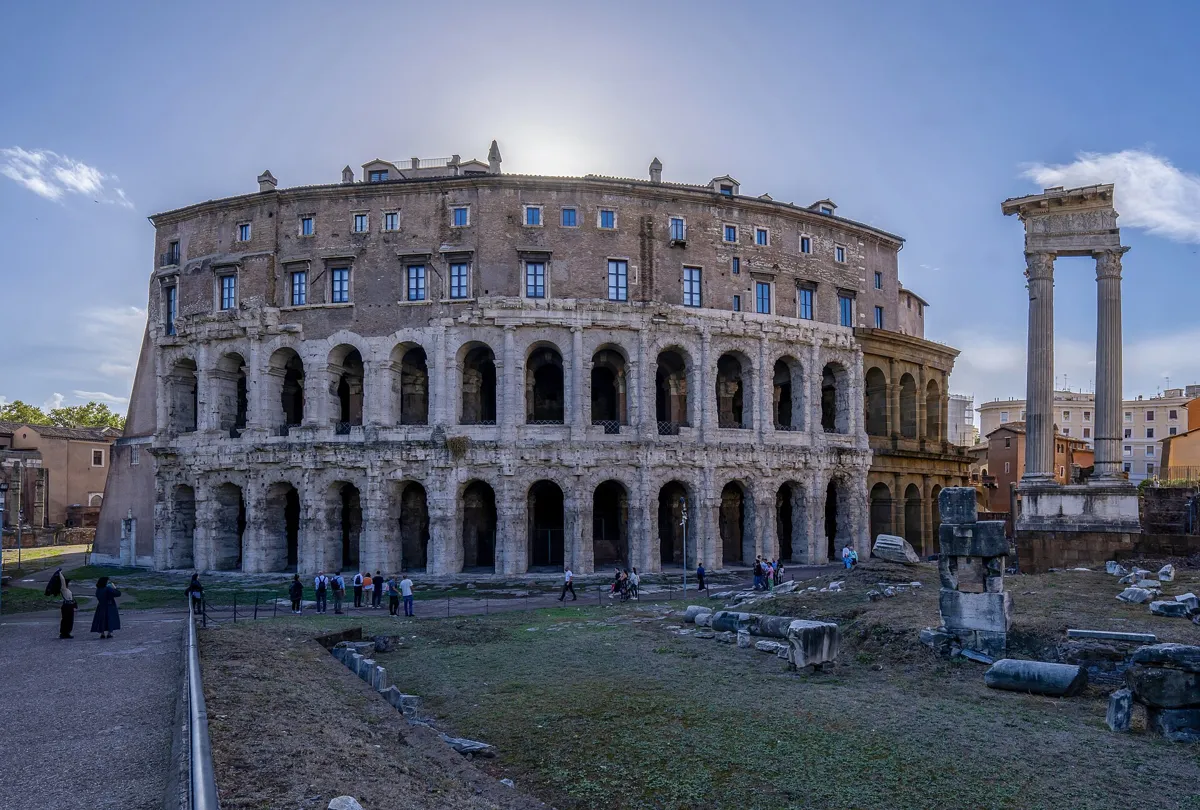
The two surviving tiers of arches, with the 16th-century palace above. Photo: Fiat 500e, CC BY-SA 4.0, via Wikimedia Commons (resized). Walk down Via di Monte Tarpeo, turn right into Via della Consolazione, and follow the paths along the foot of the hill, ending on Via di Monte Caprino, to the open ground beside the theatre. Julius Caesar cleared this site for a theatre to rival Pompey's, but died with only the foundations laid. Augustus bought more land, built it bigger and named it after his nephew and chosen heir, Marcellus, who had died young. It was already in use for the Secular Games of 17 BC. It held perhaps 15,000 to 20,000 people, and it is one of the oldest Roman theatres to survive. The lower arches carry Doric half-columns and the upper ones Ionic; the third tier is gone. In the Middle Ages powerful families turned it into a fortress, and in the 16th century Baldassarre Peruzzi built the palace you see on top for the Savelli, later sold to the Orsini. From 1926 to 1932 the city cleared out the shops that filled the arches and dug them out, since about 4 m of their height had been buried; the brick props date from that work.
More history
According to Suetonius, Augustus's chair gave way at the opening ceremony and he fell on his back.
Sources: Sovrintendenza Capitolina, Teatro di Marcello; Wikipedia (it), Teatro di Marcello; Wikipedia, Theatre of Marcellus.


Practical details
- Terrain
- One real climb, up the Capitoline Hill: Open-Meteo puts Piazza del Campidoglio at about 43 m above sea level, against about 20 m on Via dei Fori Imperiali and at the Theatre of Marcellus.
- Step-free
- Not quite. OpenStreetMap maps the Cordonata up to the Capitoline as 22 broad steps, and short flights on the paths down to the Theatre of Marcellus. It marks Colosseo metro and the Forum viewpoint at stop 7 as wheelchair accessible, but not the Piazza Venezia bus station.
- Water
- OpenStreetMap lists drinking fountains at the Forum viewpoint (stop 7), about 40 m from the Arch of Constantine and several more around the Colosseum.
- Toilets
- OpenStreetMap shows free women's toilets about 70 m from Colosseo metro and paid ones by Trajan's Column. At the Vittoriano, the toilets cost €1, or are free with a café receipt or a VIVE ticket.
- Tickets
- Everything on the route is free from outside. The Colosseum, Forum and Palatine share tickets from the Parco archeologico del Colosseo: named, with a timed Colosseum slot, and free on the first Sunday of the month (no booking; collect at the Arch of Titus ticket office). The Vittoriano is free. Check colosseo.it before you go.
- When to go
- The Vittoriano opens every day, 9:30 to 19:30 (last entry 18:45). The Capitoline Museums and Trajan's Markets open every day, 9:30 to 19:30, last entry an hour before, and close on 1 May and 25 December.
- Shorter walk
- Stop at Trajan's Column (stop 4): 1.7 km, about 45 minutes.
- Getting back
- The Piazza Venezia bus station is about 380 m from the finish. Colosseo metro is 1.4 km away, about 19 minutes on foot.
Walking distances and times from the OSRM foot router on OpenStreetMap data. Elevations from Open-Meteo. Stations, fountains, toilets and steps from OpenStreetMap; hours and prices from VIVE, the Musei Capitolini, the Mercati di Traiano, the Sovrintendenza Capitolina and Turismo Roma. Checked 4 October 2026.
Questions people ask
How long does a self-guided walking tour of ancient Rome take, and is there a map?
This route is 3.0 km with about 40 minutes of walking and eight stops, so allow about 90 minutes from the outside. Going in takes much longer: the Sovrintendenza Capitolina allows about two hours for the Forum, the Imperial Fora and the Palatine alone. The map is on this page, and you can print it or save it as a PDF.
Can you see the Colosseum without a ticket?
Yes. You can walk all the way round the outside for free, as this walk does. Going in needs a ticket from the Parco archeologico del Colosseo, with a timed slot for the Colosseum. On the first Sunday of each month entry is free, but you cannot book ahead: tickets are handed out at the ticket office by the Arch of Titus.
Is the Roman Forum free?
Not inside. The Forum and the Palatine are part of the Parco archeologico del Colosseo, and need a ticket; book on colosseo.it. Entry is free on the first Sunday of the month. Looking down on it is free: from the terraces beside Palazzo Senatorio on the Capitoline Hill.
Where is the best free view of the Roman Forum?
For a free view, go to the terrace where Via del Campidoglio meets Via di Monte Tarpeo, to the right of Palazzo Senatorio on the Capitoline Hill (stop 7 on this walk). It looks straight down the Forum past the Temple of Saturn and the Arch of Septimius Severus. A second terrace sits on the other side of the palace. The view from the Tabularium inside the Capitoline Museums needs a museum ticket.
How far is the Colosseum from the Pantheon?
About 1.9 km on foot from Colosseo metro to the Pantheon, around 26 minutes' walk. Our historic centre walk starts nearby at Campo de' Fiori and passes the Pantheon and the Trevi Fountain.
Walk it with Strolio
Open Strolio at the Colosseum and ask for an hour and a half of ancient Rome. Strolio builds walks in any city with mapped streets, so its route may pick different stops from this page. Stories play as you reach each place, and you can ask about anything else you pass, by voice or with a photo. You can also start from your hotel and choose your own time and interests.
More walks in Rome
- The historic centre: ~70 min, 7 stops. From the square where Giordano Bruno was burned, past the Pantheon and Bernini's elephant, to the Trevi Fountain and the Spanish Steps.
- The Jewish Ghetto and Trastevere: ~80 min, 8 stops. The Jewish Ghetto, over a Roman bridge of 62 BC to Trastevere and Raphael's Galatea.
- Castel Sant'Angelo to St Peter's: ~75 min, 8 stops. Bernini's angels, an avenue begun under Mussolini, the Passetto, the Swiss Guard and the Vatican walls.
- All Rome walks, with maps side by side.
- Walks in other cities.
Sources
- Official sites: Parco archeologico del Colosseo; VIVE – Vittoriano e Palazzo Venezia; Musei Capitolini and its guide to Piazza del Campidoglio; Mercati di Traiano; Roma Capitale's Sovrintendenza Capitolina pages for the Imperial Fora and the Theatre of Marcellus; Turismo Roma on free first Sundays. We used their facts and wrote our own text.
- Wikipedia (Italian): Colosseo, Arco di Costantino, Via dei Fori Imperiali, Fori Imperiali, Colonna Traiana, Mercati di Traiano, Vittoriano, Insula dell'Ara Coeli, Piazza del Campidoglio, Cordonata, Statua equestre di Marco Aurelio, Tabularium, Teatro di Marcello, Colosseo (metropolitana di Roma)
- Wikipedia (English): Colosseum, Arch of Constantine, Via dei Fori Imperiali, Imperial fora, Trajan's Column, Trajan's Market, Victor Emmanuel II Monument, Piazza del Campidoglio, Equestrian statue of Marcus Aurelius, Tabularium, Temple of Vespasian and Titus, Temple of Saturn, Arch of Septimius Severus, Theatre of Marcellus
- Map data and places: © OpenStreetMap contributors, ODbL; walking route from the OSRM foot router at routing.openstreetmap.de
- Elevations: Open-Meteo
- Photos: Wikimedia Commons contributors FeaturedPics, NikonZ7II, Livioandronico2013, Max_Ryazanov, Kameister, Stefano Lovato and Fiat 500e, credited under each photo