
Île de la Cité to the Louvre self-guided walking tour · 80 minutes · map
From Notre-Dame to the Louvre: the Île de la Cité on foot
The Île de la Cité is the island in the Seine where Paris began, and the Louvre is the palace its kings moved to. This 80-minute walk goes from Notre-Dame past the Conciergerie and the Sainte-Chapelle, across the Pont Neuf and through the Louvre courtyards to the Palais-Royal.
The island was the heart of medieval Paris, and the Capetian kings lived at its western end in the Palais de la Cité until Charles V, who reigned from 1364, moved his residence to the Louvre. The old palace then became the law courts and a prison, and the Louvre grew from a fortress into the palace you see now. The walk follows that move, from the cathedral through the old palace and over the river.
A note on accuracy: several things here are not original. Notre-Dame's roof frame and spire were rebuilt after the 2019 fire, the Point zéro disc is new, most of Place Dauphine has been rebuilt, the statue of Henry IV dates from 1818 and the Pont Neuf's carved masks are copies. Notre-Dame is free; the Sainte-Chapelle, the Conciergerie and the Louvre charge for entry. Every fact links to its source.
- Start
- Cité metro (line 4), on the island
- Finish
- The Colonnes de Buren in the Palais-Royal courtyard, about 170 m from Palais Royal – Musée du Louvre metro (lines 1, 7)
- Distance
- 2.8 km, one way, almost flat
- Time
- About 80 minutes: 38 min walking and 8 stops, plus any visit inside Notre-Dame, the Sainte-Chapelle, the Conciergerie or the Louvre
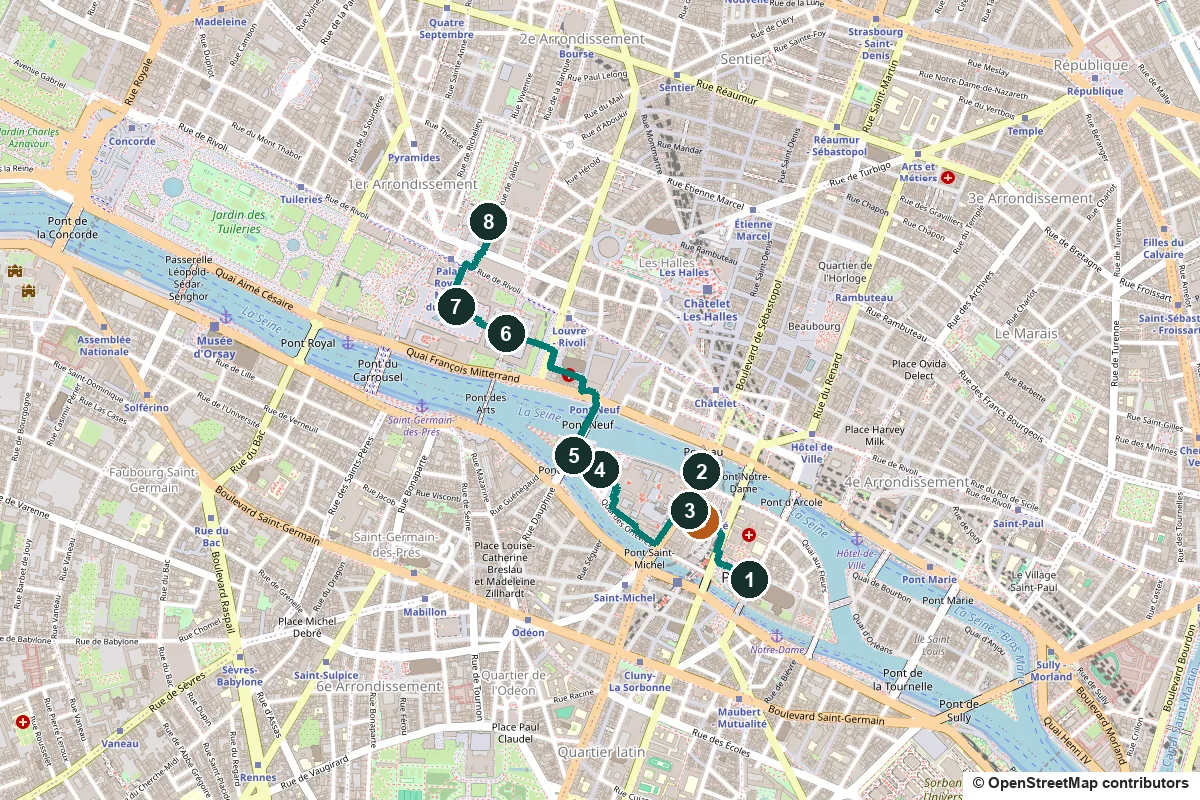
Terrain, steps, water, opening hours and a shorter version ↓
What to see: the stops
-
Notre-Dame and the Point zéro, back after the fire
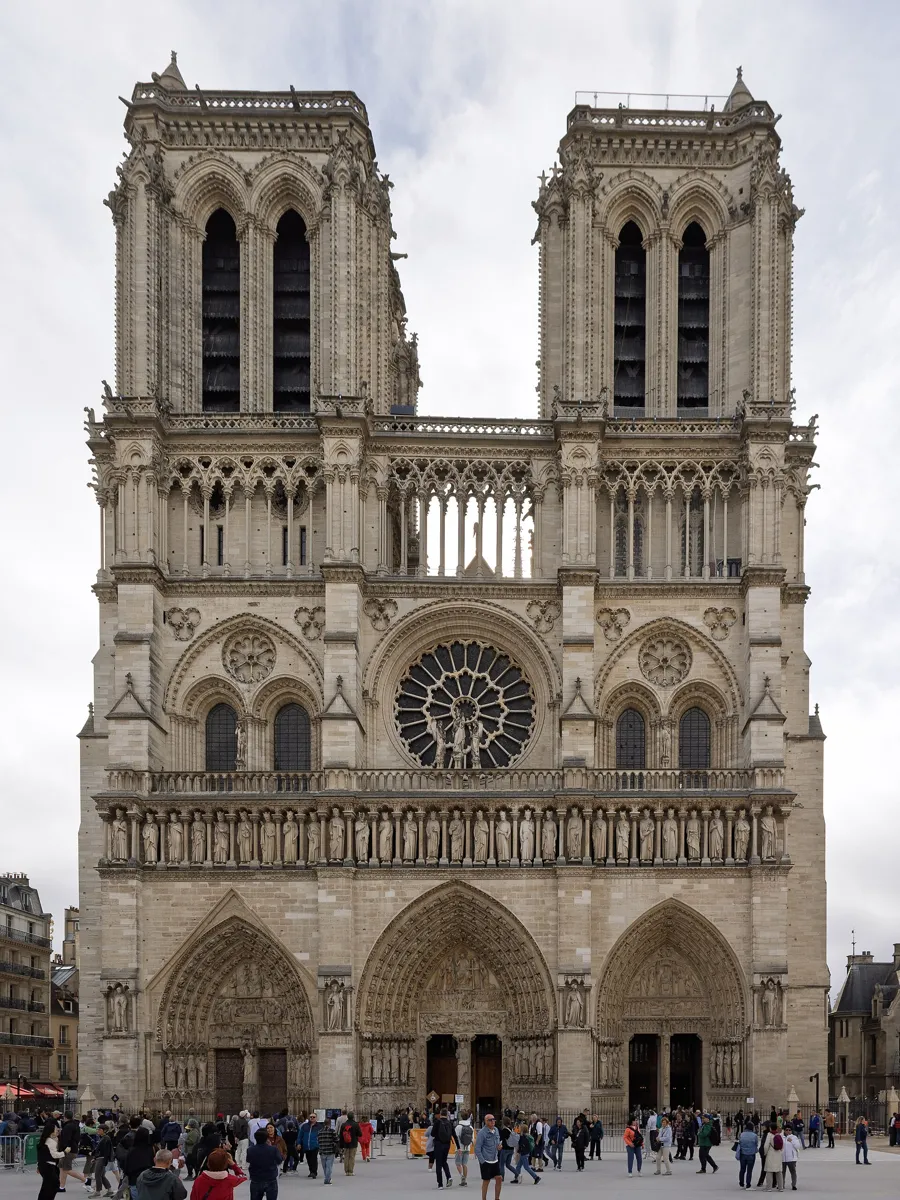
The west front from the parvis. Photo: The wub, CC BY-SA 4.0, via Wikimedia Commons (resized). 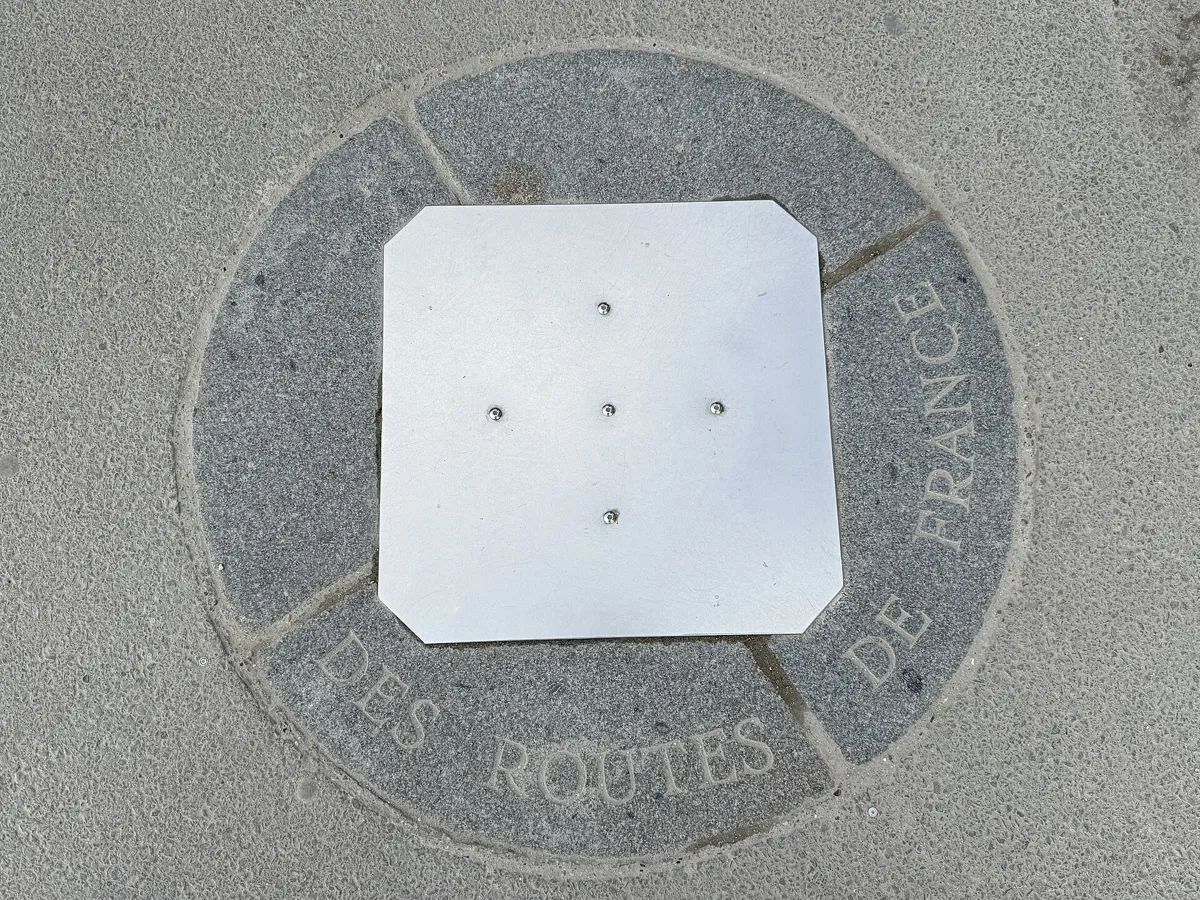
The Point zéro spot in March 2025, before the new brass medallion was set back on 1 July 2025. Photo: Chabe01, CC BY-SA 4.0, via Wikimedia Commons (resized). From the Cité metro exit, take Rue de Lutèce, cross Place Louis-Lépine and walk down Rue de la Cité to the parvis, the square in front of the cathedral. Notre-Dame was begun in 1163 under Bishop Maurice de Sully and largely finished by 1260. On 15 April 2019 a fire destroyed the spire and the whole roof frame over the nave, choir and transept. The cathedral reopened with a ceremony on 7 December 2024 and to the public the next day, and the roof frame and spire have been rebuilt in the same materials as before, oak and lead. Entry is free through the central Portal of the Last Judgment; booking a free slot online only shortens the wait. Now look down. The brass disc called the Point zéro marks the spot from which road distances between Paris and other French towns are measured. A medieval gallows stood here. The disc you see is new: the 1924 plate was taken out after the fire, judged too damaged, remade and put back on 1 July 2025. Tradition says anyone who steps on it will return to Paris. The city says works around the cathedral will mostly finish in 2028, so expect fencing.
More history
Victor Hugo published his novel Notre-Dame de Paris in 1831, when the cathedral was so run down that city officials considered demolishing it. A restoration led by Viollet-le-Duc followed from 1844 to 1864. The Crown of Thorns, kept at Notre-Dame, came back to the cathedral on 13 December 2024; it is shown every Friday from 15:00 to 18:30.
Sources: Notre-Dame, opening hours; access; FAQ; Ville de Paris, Point zéro; Ville de Paris, the surroundings; Wikipedia, Notre-Dame de Paris; Wikipedia (fr), Notre-Dame de Paris; Wikipedia (fr), Point zéro.
-
The Conciergerie and the clock tower, palace turned prison
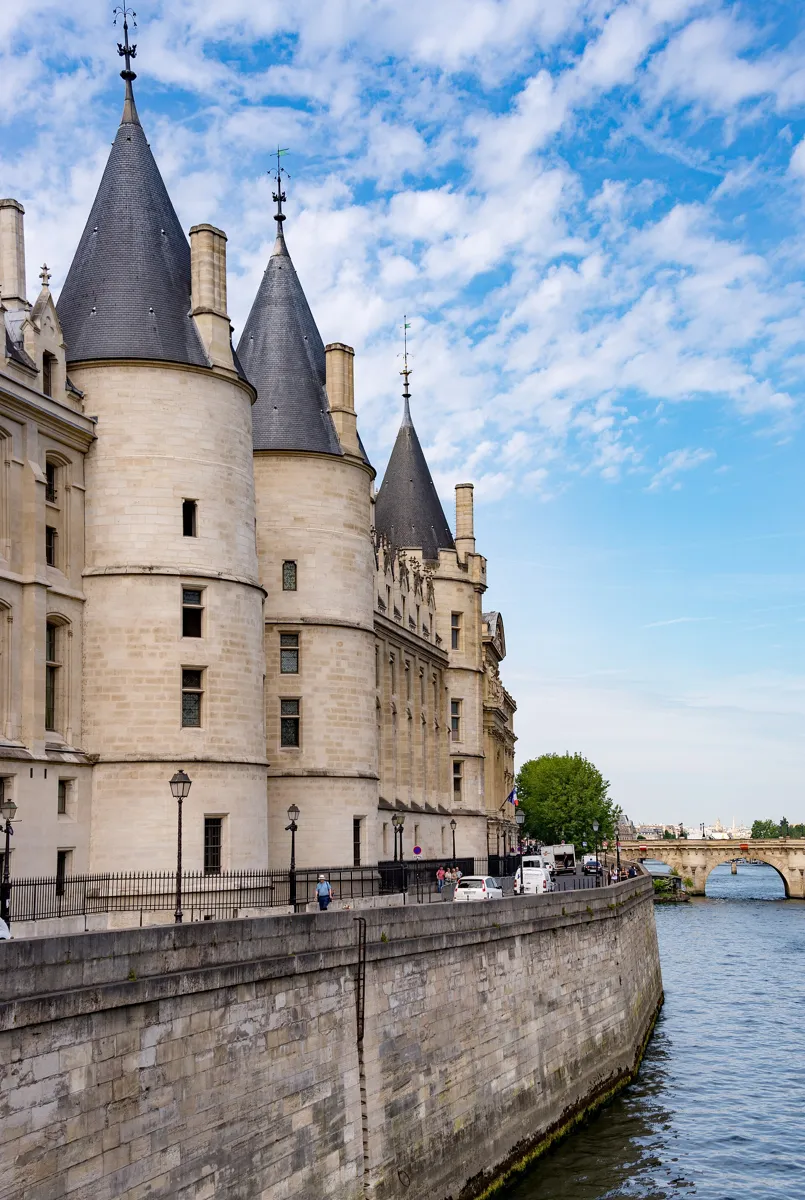
The Conciergerie's river front from the quay. Photo: xiquinhosilva from Cacau, CC BY 2.0, via Wikimedia Commons (resized). Walk back up Rue de la Cité and Rue de Lutèce to Place Louis-Lépine, then follow Boulevard du Palais north to the Quai de la Corse, by the Pont au Change. This is what is left of the Palais de la Cité, where French kings lived until Charles V, who reigned from 1364, moved his residence to the Louvre. The keeper of the old palace, the concierge, gave the building its name, and it became a courthouse and prison. The Tour de l'Horloge stands at the corner of the boulevard and the Quai de l'Horloge. Its clock of 1370 was the first public clock in Paris, and the dial you see was framed in 1585 for Henry III by the sculptor Germain Pilon. In the Revolution, 2,781 prisoners were held, tried and sentenced here, Marie Antoinette among them. She was tried on 14 to 16 October 1793 and guillotined on 16 October. Her cell is gone; a memorial chapel built in 1815 stands on its site. The prison closed in 1934; parts have been open to visitors since 1914. Parts of the towers were rebuilt and raised in the 19th century. A ticket costs 13 euros, and the building has no access for people with reduced mobility.
More history
The Salle des Gens d'Armes, the hall of the king's men-at-arms, was built in the early 14th century. It is 61 m long and described as the largest non-religious Gothic hall in Europe.
Sources: Centre des monuments nationaux, Conciergerie; Wikipedia, Conciergerie; Wikipedia (fr), Conciergerie; Wikipedia (fr), Tour de l'Horloge.
-
The Sainte-Chapelle, a royal jewel box of glass
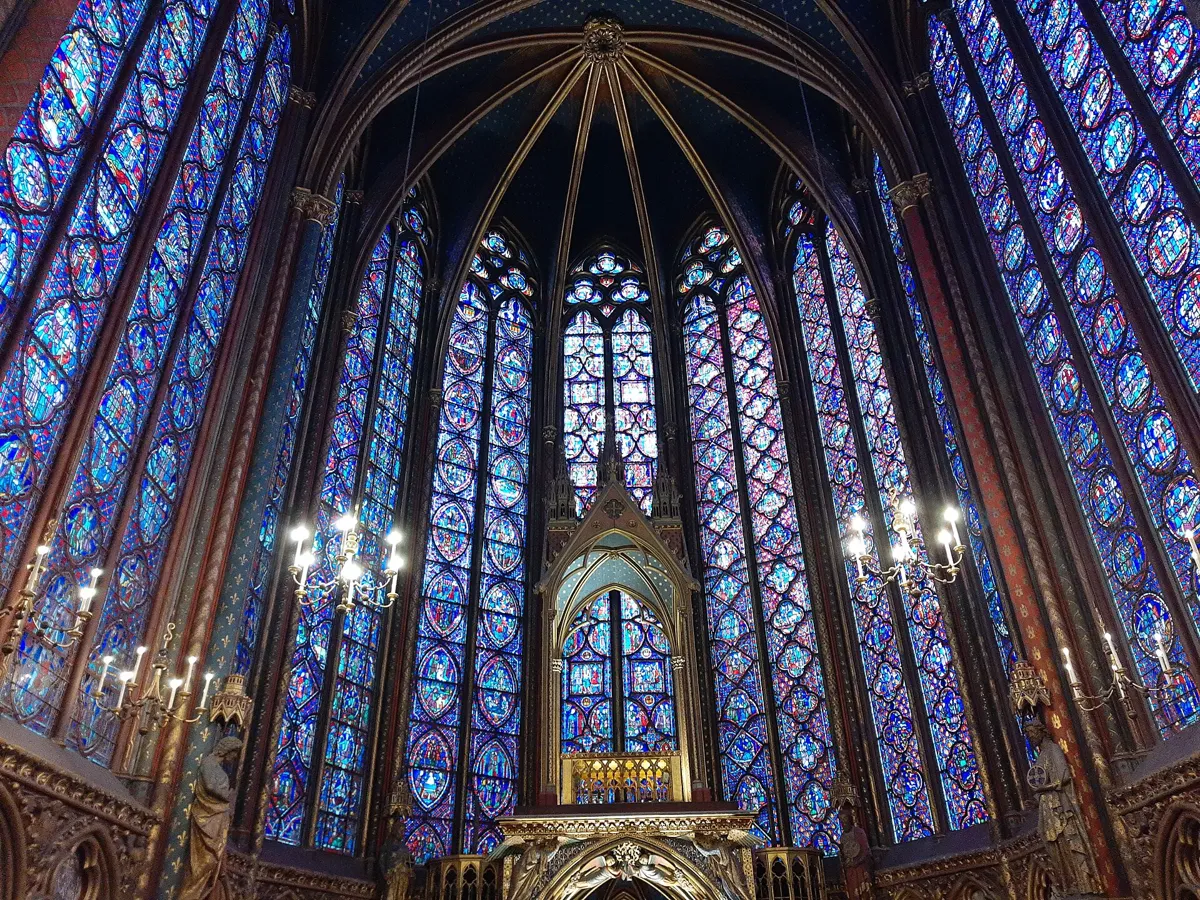
Inside the upper chapel. Photo: Gerda Arendt, CC0, via Wikimedia Commons (resized). Walk back south down Boulevard du Palais for 140 m to number 10. The chapel stands inside the Palais de Justice, so you queue for a security check, and the monument advises booking a time slot online. Louis IX had it built to house relics of Christ's Passion, among them the relic claimed to be the Crown of Thorns, which he bought from the emperor Baldwin II for 135,000 livres. The chapel itself cost 40,000. It was consecrated on 26 April 1248. The lower chapel served the palace staff and soldiers; the upper one, up a narrow stair, was for the royal family and their guests. The upper walls are almost all glass, about 670 square metres across fifteen great windows. Nearly two-thirds of the glass is original; the rest comes from a long 19th-century restoration, and the slim 33 m spire dates from the 1850s. The Revolution scattered the relics; the Crown of Thorns is now at Notre-Dame.
More history
After the Revolution the upper chapel was used from 1803 to 1837 to store the Palais de Justice's archives, and the lowest two metres of glass were removed to give light for the clerks. A flood in the winter of 1689 to 1690 had already damaged the lower chapel's painted walls.
Sources: Centre des monuments nationaux, Sainte-Chapelle; its FAQ; Wikipedia, Sainte-Chapelle; Wikipedia (fr), Sainte-Chapelle.
-
Place Dauphine, a royal square that lost its fourth side
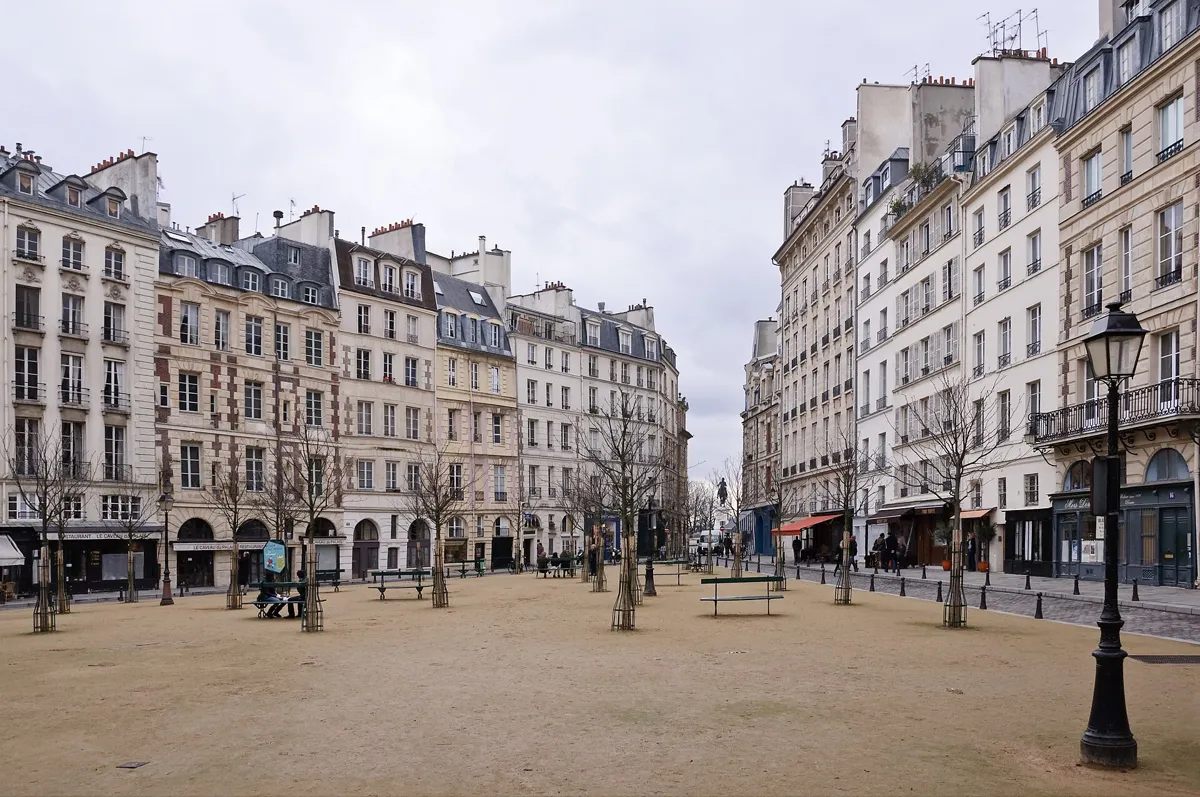
Place Dauphine, looking towards the Pont Neuf. Photo: Myrabella, CC BY-SA 3.0, via Wikimedia Commons (resized). Go south on Boulevard du Palais to the river, follow Quai des Orfèvres west to Rue de Harlay, and turn up it into the square. Henry IV had the Place Dauphine laid out in 1607, the second of his Paris squares after today's Place des Vosges. He gave the land to Achille de Harlay on condition that he built houses to one plan, in brick and stone, and he named the square after his son, the Dauphin, the future Louis XIII. It is a triangle, 102 m long and 67 m wide. Of the 32 identical houses, only the two corner pavilions facing the Pont Neuf survive intact. In 1874, at Viollet-le-Duc's suggestion, the row of houses along the east side, on Rue de Harlay, was pulled down to show the back of the Palais de Justice; the trees you see stand along that line. Calculations published by the national mapping agency IGN in 2016 put the geographic centre of Paris on this square.
More history
Before the Revolution, painters refused by the Academy showed their work here on the feast of Corpus Christi, in an open-air show called the Salon de la jeunesse. The Revolution renamed the square Place de Thionville, a name it kept from 1792 to 1814.
Sources: Wikipedia (fr), Place Dauphine; Wikipedia, Place Dauphine.
-
The Pont Neuf and the statue of Henry IV
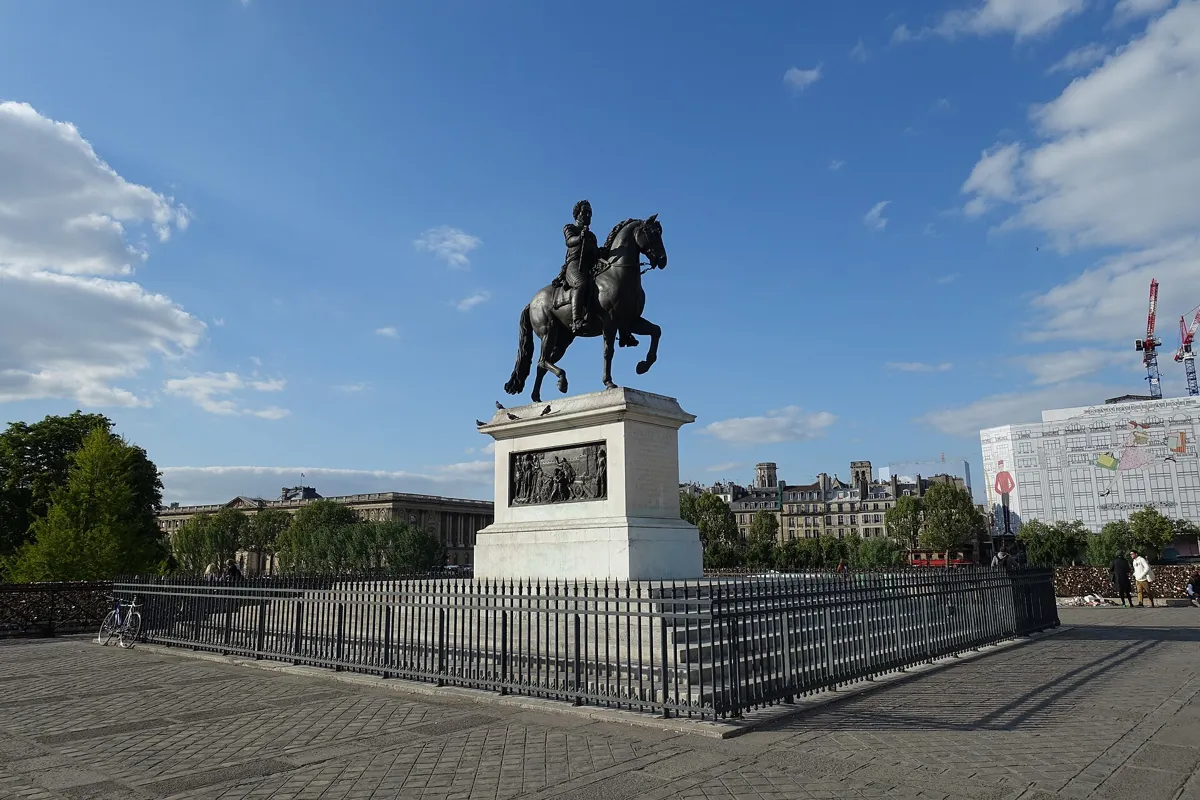
The statue on the Pont Neuf. Photo: Guilhem Vellut, CC BY 2.0, via Wikimedia Commons (resized). Leave Place Dauphine by its narrow west end and follow the 40 m Rue Henri-Robert to Place du Pont-Neuf, the paved platform in the middle of the bridge. Despite its name, the Pont Neuf, or New Bridge, is the oldest standing bridge across the Seine in Paris. Henry III laid its first stone in 1578, and Henry IV inaugurated it in 1607. It was the first stone bridge in Paris with no houses along it. Henry IV decided against houses so that nothing would block the view of the Louvre. It is really two bridges, one of five arches to the Left Bank and one of seven to the Right Bank. The 381 stone masks along the sides are copies of the Renaissance originals. The bronze king on horseback is not the first. Marie de' Medici's statue of 1614 was pulled down on 12 August 1792, in the Revolution. The present one, by François-Frédéric Lemot, was unveiled on 25 August 1818. At the island's tip below, the Square du Vert-Galant is named after Henry IV's nickname, the Green Gallant.
More history
The horse for the 1614 statue was a gift from Cosimo II of Florence. The ship carrying it sank off Savona and the bronze lay on the seabed for a month before it was raised. Five pieces of the toppled statue were found in the Seine and are now in the Musée Carnavalet.
Sources: Wikipedia, Pont Neuf; Wikipedia (fr), Pont Neuf; Wikipedia (fr), statue of Henri IV.
-
The Colonnade and the Cour Carrée, where the Louvre grew
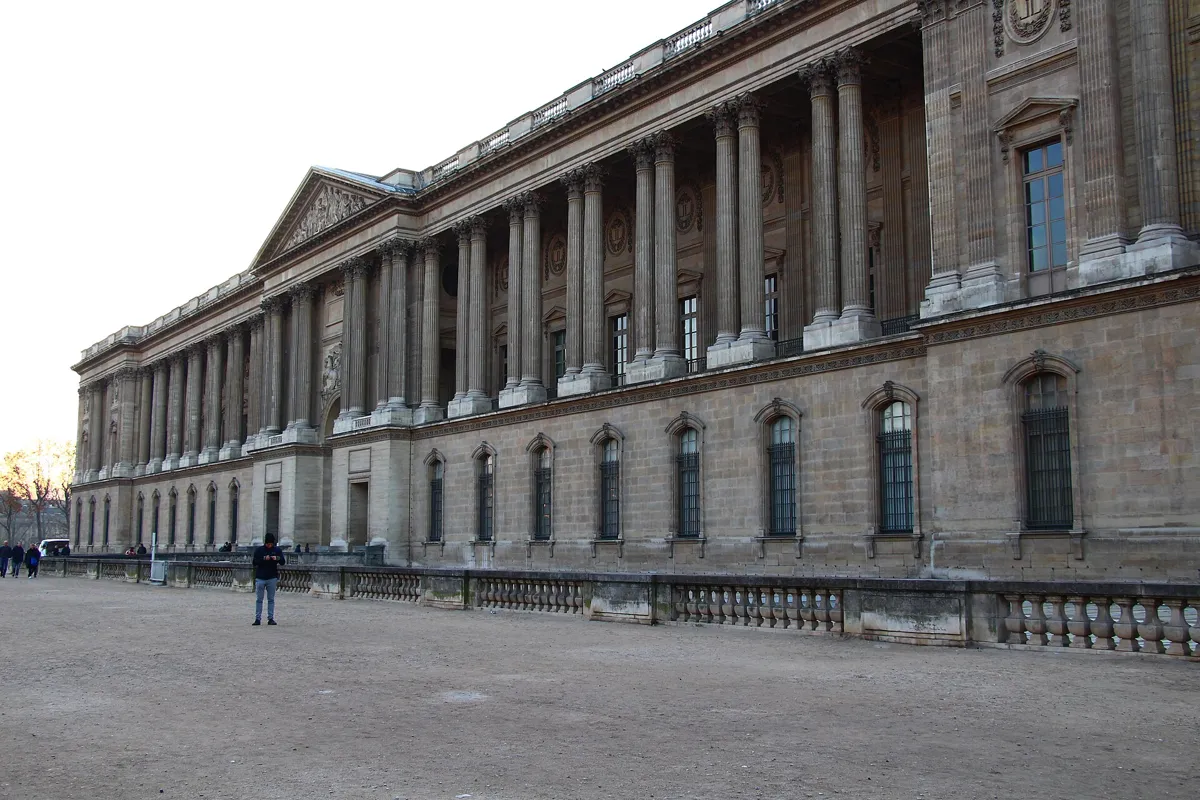
The Colonnade, the Louvre's east front. Photo: Fred Romero, CC BY 2.0, via Wikimedia Commons (resized). Cross the bridge's longer arm to the Right Bank, cross the Quai du Louvre and go west across Place de l'École. Take Rue des Prêtres Saint-Germain-l'Auxerrois to Place du Louvre, and follow Rue de l'Amiral de Coligny to the Colonnade. This 183 m front was built between 1667 and 1670 and was meant to be the palace's main entrance. Louis XIV moved the court to Versailles before it was finished as planned. Go through the passage in its middle pavilion to the Cour Carrée, the square courtyard. It grew in stages on the site of the fortress Philip Augustus built between 1190 and 1215: Francis I pulled down the great keep in 1528, and from 1546 Pierre Lescot and Jean Goujon built the Renaissance wing on the west side. Lemercier mirrored it on the north side in the 1630s, and Louis XIV doubled the south wing. The courtyard is open from 7:30 to 19:45. Several kings left their monogram on the parts they built.
More history
The Colonnade's pediment is made of just two stones, each 17.5 m long. In the guard room of the Lescot wing, Molière played before Louis XIV for the first time, on 16 October 1658.
Sources: Wikipedia (fr), Colonnade du Louvre; Wikipedia (fr), Cour Carrée; Louvre, hours and admission.
-
The Louvre Pyramid, the glass entrance that caused a scandal
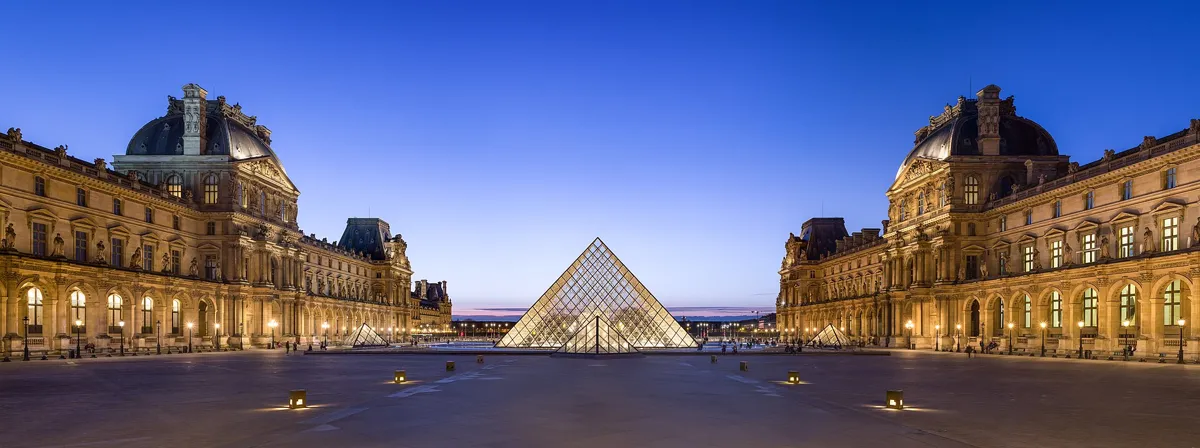
The Pyramid in the Cour Napoléon at dusk. Photo: Benh LIEU SONG, CC BY-SA 4.0, via Wikimedia Commons (resized). Cross the Cour Carrée to its west side and go out into the larger Cour Napoléon, 200 m. The Pyramid is the main entrance to the museum. It belongs to the Grand Louvre project that President Mitterrand announced in 1981; I. M. Pei was chosen as architect in 1983. It is 21.6 m high, with a 34 m square base, and the Louvre confirms 673 panes: 603 rhombi and 70 triangles. The rumour of 666 panes is false. It was completed in 1989. When the design went public in January 1984, a French newspaper headline read, in translation, “The new Louvre is already a scandal”, and the dispute lasted until 1986. You need no ticket to stand beside it, because the courtyard opens at 7:30 and closes at 21:00. The museum itself is closed on Tuesdays and open late on Wednesdays and Fridays. Tickets cost 22 euros for European Economic Area residents and 32 euros for others; booking a time slot is recommended.
More history
A pyramid in this courtyard had been proposed before: a pamphlet of 1809 suggested one as a national monument to Napoleon. Pei's design was meant for a museum with 4.5 million visitors a year, but attendance had doubled by 2014, and the lobby underneath was redesigned.
Sources: Wikipedia, Louvre Pyramid; Wikipedia (fr), Pyramide du Louvre; Louvre, hours and admission; Louvre, entrances.
-
Buren's columns in the Palais-Royal courtyard
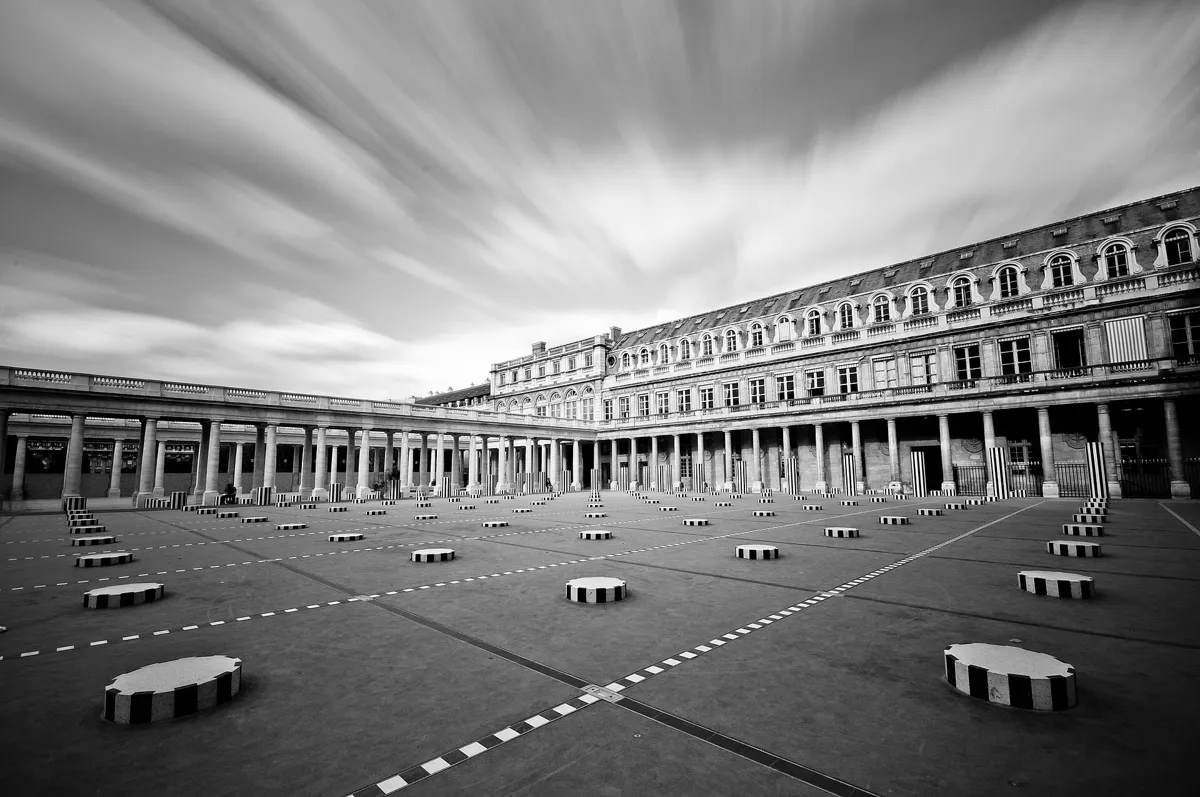
The Colonnes de Buren in the Palais-Royal courtyard. Photo: ros k @ getfunky_paris, CC BY 2.0, via Wikimedia Commons (resized). Leave the Cour Napoléon through the Passage Richelieu to Rue de Rivoli, cross to Place du Palais-Royal, cross Rue Saint-Honoré and follow Rue de Valois north. The Passage de la Cour des Fontaines takes you into the courtyard, 375 m from the Pyramid. Cardinal Richelieu had the Palais-Royal built from 1633 to 1639, but later owners altered it so much that almost nothing of the original design remains. It now houses the Ministry of Culture, the Conseil d'État and the Constitutional Council. The courtyard once served as a car park. In 1985 and 1986 the artist Daniel Buren filled it with Les Deux Plateaux, 260 truncated columns of striped marble in a grid, in three heights from 8.7 to 62 cm, with stripes 8.7 cm wide. Some stand below ground level, in pools of water. Culture minister Jack Lang commissioned it, and it caused a row over cost and its place in a historic site.
More history
When Louis XIV died in 1715, Philippe II of Orléans ruled France as Regent from the Palais-Royal while the young Louis XV lived at the Tuileries. The Orléans collection of some 500 paintings hung here for public viewing until it was sold abroad in 1791.
Sources: Wikipedia (fr), Les Deux Plateaux; Wikipedia, Les Deux Plateaux; Wikipedia, Palais-Royal; Wikipedia (fr), Palais-Royal.


Practical details
- Terrain
- Almost flat. Open-Meteo puts the stops between about 26 m, by the river, and 51 m at the Louvre Pyramid, so there are no real climbs; treat the figures as rough in a dense city centre.
- Step-free
- Not fully. OpenStreetMap maps 16 steps at Place Dauphine and 7 steps down between the Cour Carrée and the Cour Napoléon, and marks neither Cité nor Palais Royal station as wheelchair accessible. The Conciergerie says it has no access for reduced mobility. The Sainte-Chapelle says its visit is accessible to people with reduced mobility, by lift to the upper chapel on request, and the Louvre Pyramid has a lift for disabled visitors.
- Water
- OpenStreetMap lists drinking fountains by the Conciergerie, at the Pont Neuf and near the Colonnes de Buren.
- Toilets
- OpenStreetMap shows a free public toilet, open around the clock, about 50 m from the Notre-Dame parvis, and another free one by the Pont Neuf.
- Sit and eat
- Place Dauphine (stop 4) has small restaurants and cafés, and the Square du Vert-Galant at the island's western tip is a quiet park. The Palais-Royal garden, a public park, is just behind the finish.
- When to go
- Notre-Dame is open daily: 7:50 to 19:00 on weekdays (22:00 on Thursdays), 8:15 to 19:30 at weekends. The Sainte-Chapelle is open 9:00 to 17:00 from 1 October to 31 March and 9:00 to 19:00 from 1 April to 30 September, last entry 30 minutes before closing; it is closed on 1 January, 1 May and 25 December. The Conciergerie is open daily 9:30 to 18:00, last entry 17:30, closed on 1 May and 25 December. The Louvre is closed on Tuesdays and on 1 January, 1 May and 25 December.
- Shorter walk
- Finish at the Pont Neuf, stop 5: 1.6 km, about 22 minutes of walking and 50 minutes with stops. Pont Neuf metro station (line 7) is on the Right Bank, by the bridge.
- Getting back
- Palais Royal – Musée du Louvre metro (lines 1, 7) is about 170 m from the finish. The Carrousel du Louvre metro entrance, marked wheelchair accessible, is about 250 m away.
Walking distances and times from the OSRM foot router on OpenStreetMap data. Elevations from Open-Meteo. Steps, fountains, toilets and stations from OpenStreetMap; opening hours and prices from the official sites of Notre-Dame, the Centre des monuments nationaux and the Louvre. Checked 5 October 2026: check before you go.
Questions people ask
How long does it take to walk from Notre-Dame to the Louvre, and is there a map?
Along this route, Notre-Dame to the Louvre Pyramid is about 2.2 km, roughly 30 minutes of walking at the router's pace. This whole walk goes on to the Palais-Royal: 2.8 km, 38 minutes of walking and eight stops, about 80 minutes in all. Allow more if you go inside Sainte-Chapelle, the Conciergerie or the Louvre. The map is on this page, and you can print it or save it as a PDF.
Is Notre-Dame open, and is it free?
Yes. The cathedral reopened in December 2024 after the 2019 fire, and entry is free. It is open every day: 7:50 to 19:00 on weekdays (to 22:00 on Thursdays) and 8:15 to 19:30 at weekends, with last entry 30 minutes before closing. You can turn up without booking, or reserve a free time slot on the cathedral's official site to cut the wait. The towers and the Treasury are separate and the Treasury charges.
Do you need tickets for the Sainte-Chapelle?
Yes, it charges for entry, and the monument strongly advises booking a time slot online, because security checks at the Palais de Justice are slow and queues can be long. Since 12 January 2026 a ticket costs 16 euros for residents of the European Economic Area and 22 euros for other visitors. A twin ticket with the Conciergerie costs 23 or 30 euros. From 1 October to 31 March it is open 9:00 to 17:00.
Can you see the Louvre Pyramid without a ticket?
Yes. The Pyramid stands in the Cour Napoléon, which the Louvre lists as open from 7:30 to 21:00, and you only need a ticket to go inside the museum. The museum is closed on Tuesdays and open until 21:00 on Wednesdays and Fridays. A ticket costs 22 euros for residents of the European Economic Area and 32 euros for other visitors.
What is the Point zéro in Paris?
It is the brass medallion set in the paving in front of Notre-Dame, from which road distances between Paris and other French towns are measured. The one you see is new: the 1924 original was removed after the 2019 fire, found too damaged, remade and put back on 1 July 2025.
Walk it with Strolio
Open Strolio at Notre-Dame and ask for 80 minutes on the Île de la Cité and towards the Louvre. Strolio builds walks in any city with mapped streets, so its route may pick different stops from this page. Stories play as you reach each place, and you can ask about anything else you pass, by voice or with a photo. You can also start from your hotel and choose your own time and interests.
More walks in Paris
- Le Marais: ~80 min, 8 stops. From the medieval city wall and the Place des Vosges to the Jewish quarter on rue des Rosiers.
- Montmartre: ~75 min, 8 stops. From the Moulin Rouge up past Picasso's studio, the last windmills and the vineyard to Sacré-Cœur.
- The Latin Quarter: ~80 min, 8 stops. Roman baths, the Sorbonne and the Panthéon, from Place Saint-Michel to the Luxembourg Garden.
- All Paris walks, with maps side by side.
- Walks in other cities.
Sources
- Notre-Dame de Paris, official site: opening hours, access and FAQ
- Ville de Paris: the Point zéro and the cathedral's surroundings
- Centre des monuments nationaux: Sainte-Chapelle, practical information and FAQ; Conciergerie, practical information
- Musée du Louvre: hours and admission and map and entrances
- Wikipedia (English): Notre-Dame de Paris, Conciergerie, Sainte-Chapelle, Place Dauphine, Pont Neuf, Louvre Pyramid, Palais-Royal, Les Deux Plateaux
- Wikipedia (French): Notre-Dame de Paris, Point zéro, Conciergerie, Tour de l'Horloge, Sainte-Chapelle, Place Dauphine, Pont Neuf, statue of Henri IV, Colonnade du Louvre, Cour Carrée, Pyramide du Louvre, Colonnes de Buren, Palais-Royal
- Map data and places: © OpenStreetMap contributors, ODbL; walking route from the OSRM foot router run by FOSSGIS
- Elevations: Open-Meteo
- Photos: Wikimedia Commons contributors The wub, Chabe01, xiquinhosilva from Cacau, Gerda Arendt, Myrabella, Guilhem Vellut, Fred Romero, Benh LIEU SONG and ros k @ getfunky_paris, credited under each photo