
Museum Island self-guided walking tour · 75 minutes · map
Unter den Linden and Museum Island on foot: Prussian Berlin from the Gendarmenmarkt to the Nikolaiviertel
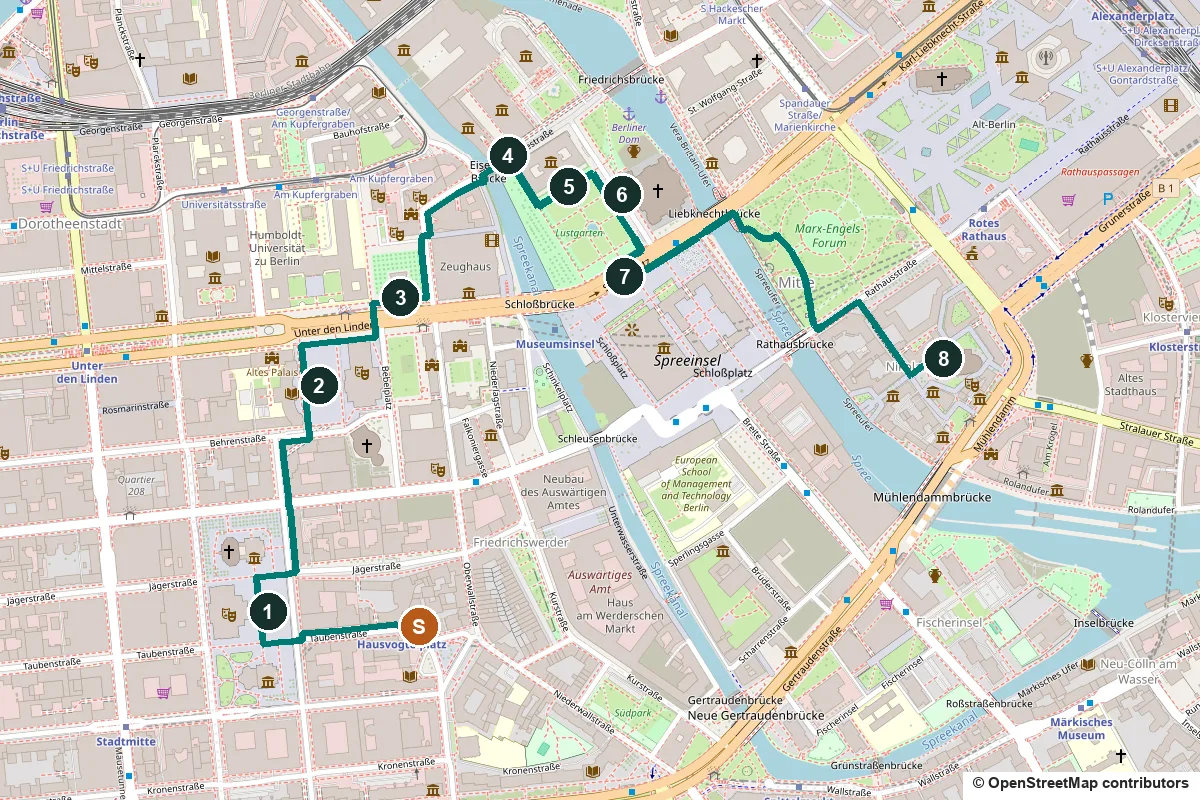
This 75-minute walk crosses the showpiece of Prussian Berlin: the squares, churches, museums and palace front its kings built. It runs from the Gendarmenmarkt past the site of the 1933 book burning to Museum Island, the cathedral, the rebuilt palace and the medieval core of the city.
Museum Island holds five museums built between 1830 and 1930, listed together by UNESCO in 1999. Almost everything on this route was burned out or wrecked in the Second World War and rebuilt by East Germany or after 1990. Unter den Linden runs west from here to the Brandenburg Gate, which our Berlin Wall walk covers. The Pergamonmuseum is closed until June 2027; we say what you can see instead.
A note on accuracy: several stops are reconstructions or copies of what stood there. Where a building is not the original, we say so, and every fact links to its source.
- Start
- Hausvogteiplatz U-Bahn station (U2), 300 m east of the Gendarmenmarkt
- Finish
- The Nikolaikirche, about 220 m from Rotes Rathaus U-Bahn station (U5)
- Distance
- 2.4 km, one way
- Time
- About 75 minutes: 32 min walking and 8 stops, plus any museum or the cathedral
Terrain, water, opening hours and a shorter version ↓
What to see: the stops
-
The Gendarmenmarkt, two churches and a theatre
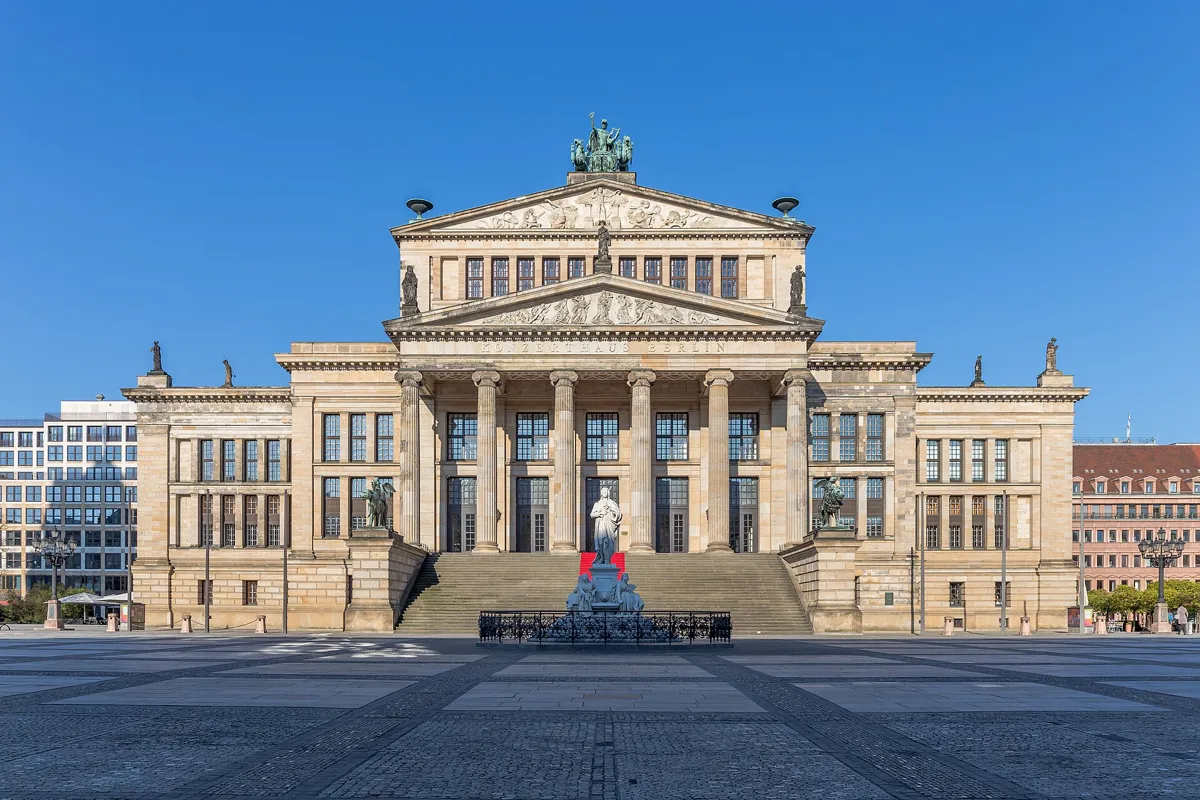
Schinkel's theatre, now the Konzerthaus, with the Schiller monument. Photo: Ansgar Koreng, CC BY 3.0 DE, via Wikimedia Commons (resized). From Hausvogteiplatz station, walk west along Taubenstraße into the square and stand in front of the theatre steps. The square was laid out from 1688 as the market of the new Friedrichstadt, where many Huguenot refugees from France settled. King Frederick I gave the French Church the north side, begun in 1701, and the German Church the south. In 1780–85 Frederick the Great added the two matching domed towers by Carl von Gontard, built for show with no real link to the churches behind them. Between them, Karl Friedrich Schinkel finished his theatre, now the Konzerthaus, in 1821. All three buildings burned out in the Second World War and were rebuilt from 1976 to 1993.
More history
The name comes from the Gens d'armes, a cavalry regiment whose stables stood here. On 2 October 1990, the eve of reunification, East Germany held its last state ceremony here, with Beethoven's Ninth Symphony conducted by Kurt Masur.
Sources: Landesdenkmalamt Berlin, Gendarmenmarkt; Landesdenkmalamt Berlin, Französischer Dom; Wikipedia (de), Gendarmenmarkt; Wikipedia, Gendarmenmarkt.
-
Bebelplatz and the empty library, where books burned in 1933
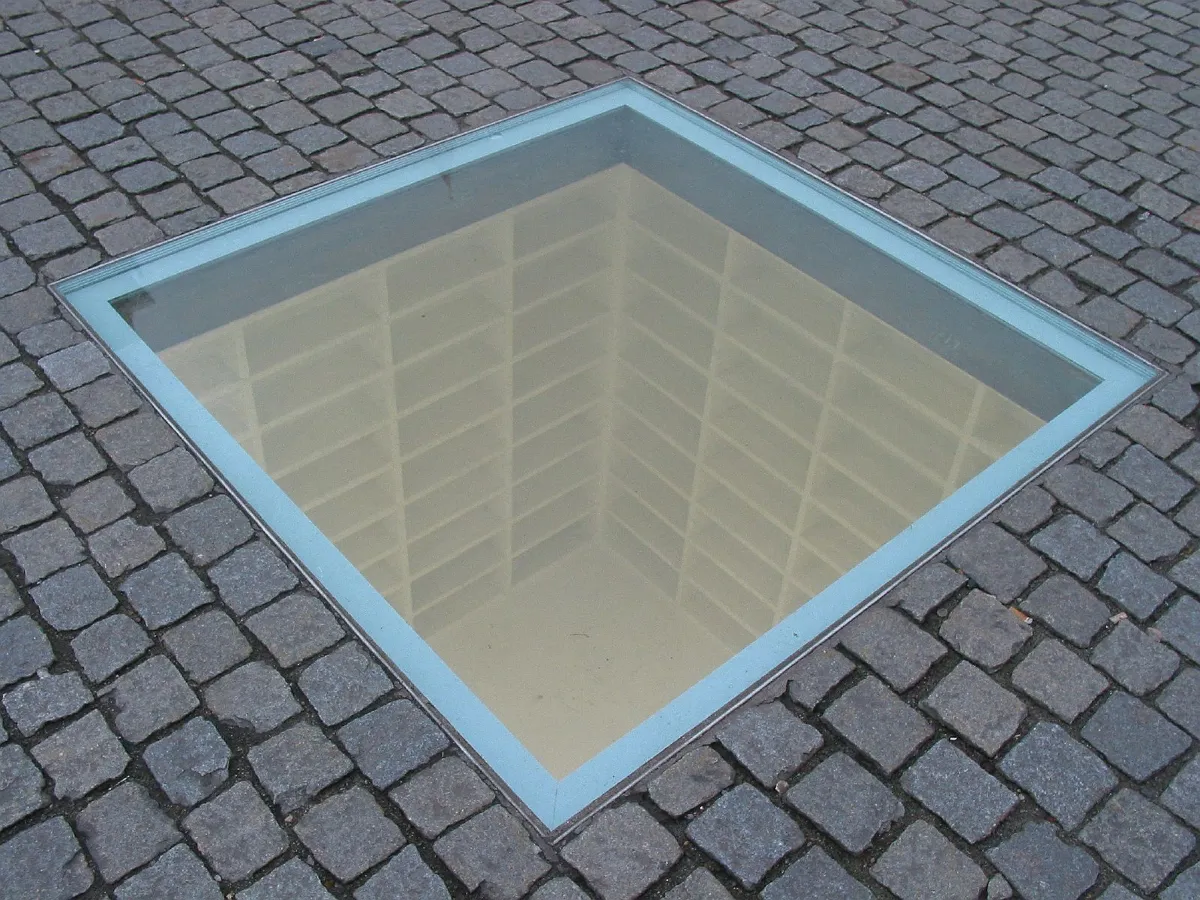
Micha Ullman's memorial, seen through the glass in the paving. Photo: Charlotte Nordahl, CC BY-SA 2.0, via Wikimedia Commons (resized). Walk north towards the French Church, turn right just before it to the corner of Jägerstraße, and turn left up Markgrafenstraße, past the church. At Behrenstraße, turn right for a few steps, then cross into Bebelplatz and walk to the glass panel in the paving. Georg Wenzeslaus von Knobelsdorff laid out the square from 1740 for Frederick the Great. Around it stand the State Opera of 1741–43 and St Hedwig's Cathedral, the first Catholic church built in Prussia after the Reformation. Across Unter den Linden, Prince Henry's palace is now Humboldt University's main building. On the evening of 10 May 1933, Nazi students, with SA and SS units, burned about 20,000 books here, and Joseph Goebbels gave a speech at the fire. Among them were works by Heinrich Heine, Karl Marx, Sigmund Freud, Kurt Tucholsky and Erich Kästner, who stood in the crowd and watched. Look down through the glass: Micha Ullman's memorial, unveiled on 20 March 1995, is a sealed white room with empty shelves for about 20,000 books. Bronze plates nearby quote Heine's play Almansor of 1821: "That was only a prelude; where they burn books, they will in the end burn people too."
More history
It was raining hard that night, and the fire brigade helped light the pyre with petrol. Since 1947 the square has carried the name of August Bebel, a founder of the Social Democratic Party.
Sources: bpb, Denkmal Bücherverbrennung; Wikipedia (de), Denkmal zur Erinnerung an die Bücherverbrennung; Wikipedia (de), Bücherverbrennung 1933; Wikipedia (de), Bebelplatz; Wikipedia, Bebelplatz; Wikipedia (de), Staatsoper.
-
The Neue Wache, Schinkel's guardhouse turned national memorial
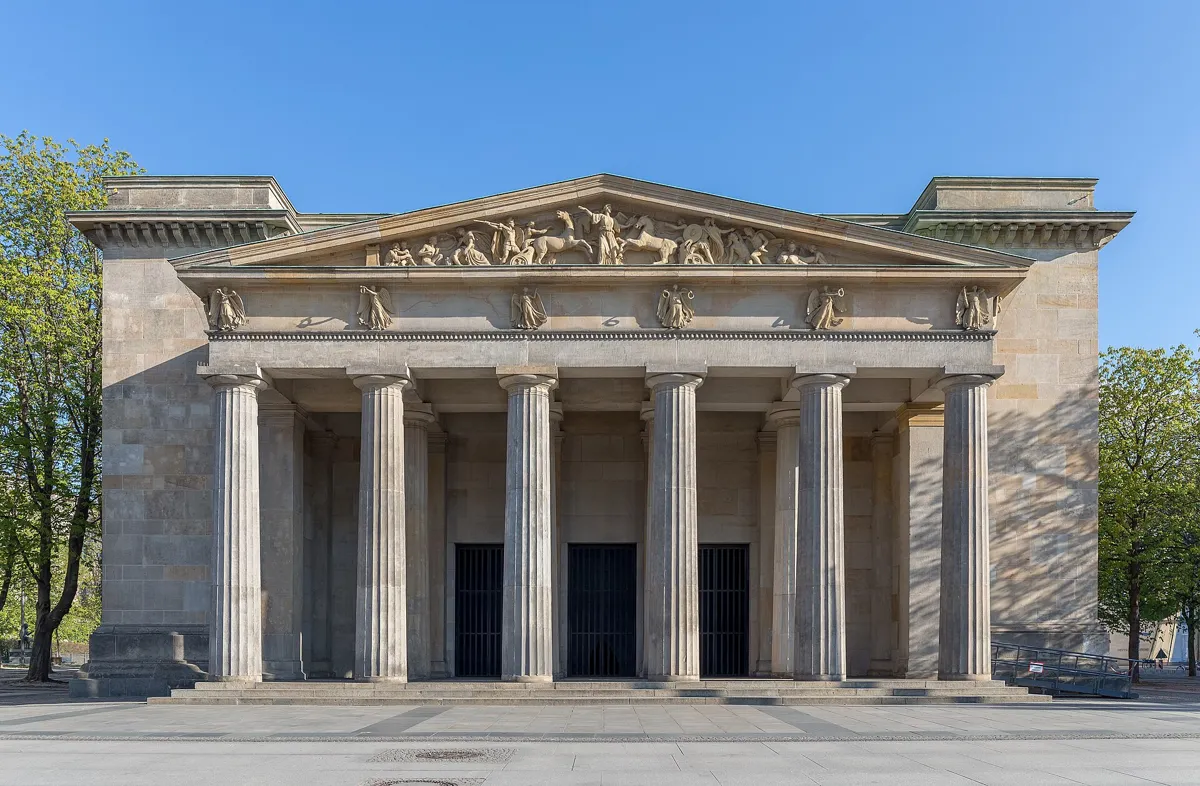
The Neue Wache from Unter den Linden. Photo: Ansgar Koreng, CC BY 3.0 DE, via Wikimedia Commons (resized). Walk north to Unter den Linden, turn right past the State Opera and cross the boulevard at the lights to the small temple-fronted building. Schinkel built it in 1816–18 for King Frederick William III as a guardhouse for the palace across the road; it was his first major building in Berlin. He based the plan on a Roman fort, with four solid corner towers behind a Doric portico. In 1931 Heinrich Tessenow turned it into a memorial to the dead of the First World War, with a round opening in the roof. East Germany rebuilt it after war damage and reopened it in 1960 as a memorial to the victims of fascism and militarism. An unknown soldier and an unknown concentration-camp prisoner are buried inside. Since 1993 it has been Germany's central memorial to the victims of war and tyranny. Under the open roof sits an enlarged copy of Käthe Kollwitz's sculpture of a mother holding her dead son, left open to rain and snow. Entry is free, daily from 10:00 to 18:00.
More history
Kollwitz's son Peter was killed in the First World War. Chancellor Helmut Kohl chose the sculpture himself, and the choice was fiercely argued over: the Academy of Arts wanted Tessenow's bare room restored instead.
Sources: Landesdenkmalamt Berlin, Neue Wache; berlin.de; bpb, Neue Wache; Wikipedia (de), Neue Wache; Wikipedia, Neue Wache. Visiting: Deutsches Historisches Museum, visitor code.
-
Museum Island: the James-Simon-Galerie and the Neues Museum
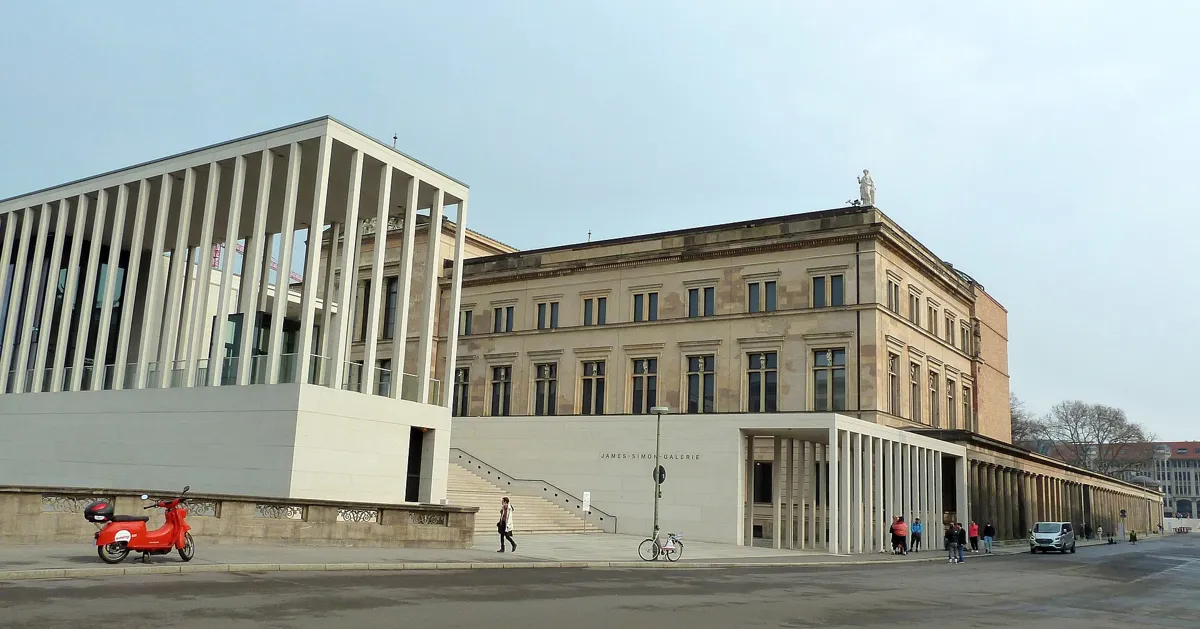
The James-Simon-Galerie (left) and the Neues Museum. Photo: Derbrauni, CC BY-SA 4.0, via Wikimedia Commons (resized). Walk round the right side of the Neue Wache, north through the chestnut grove beside the Zeughaus and along the Mollergasse path to the Kupfergraben canal. Cross the Eiserne Brücke onto Bodestraße. In 1841 King Frederick William IV declared the north of this island a place for art and science. In front of you, the white colonnade of the James-Simon-Galerie is the island's visitor centre, designed by David Chipperfield and opened on 12 July 2019. It is named after James Simon (1851–1932), a great patron of Berlin's museums. Beside it is the Neues Museum, begun in 1841 to plans by Friedrich August Stüler. Its staircase burned out in 1943, bombs destroyed the north-west wing in 1945, and the ruin decayed for decades. Chipperfield rebuilt it from 1999 to 2009: he repaired what survived and added new parts in the old shapes, without hiding the joins. It reopened on 16 October 2009 and holds the Egyptian collection, with the bust of Nefertiti. The Pergamonmuseum behind is shut until 4 June 2027.
More history
The Neues Museum's soft ground needed 2,344 wooden piles, driven in with the first steam engine used on a Berlin building site. While the Pergamonmuseum is closed, Pergamonmuseum. Das Panorama, at Am Kupfergraben 2, shows major pieces from Pergamon and a 360-degree panorama of the ancient city.
Sources: Staatliche Museen zu Berlin, Pergamonmuseum; Neues Museum; Wikipedia (de), James-Simon-Galerie; Wikipedia (de), Neues Museum; Wikipedia, Neues Museum; Wikipedia, Museum Island.
-
The Lustgarten and Schinkel's Altes Museum
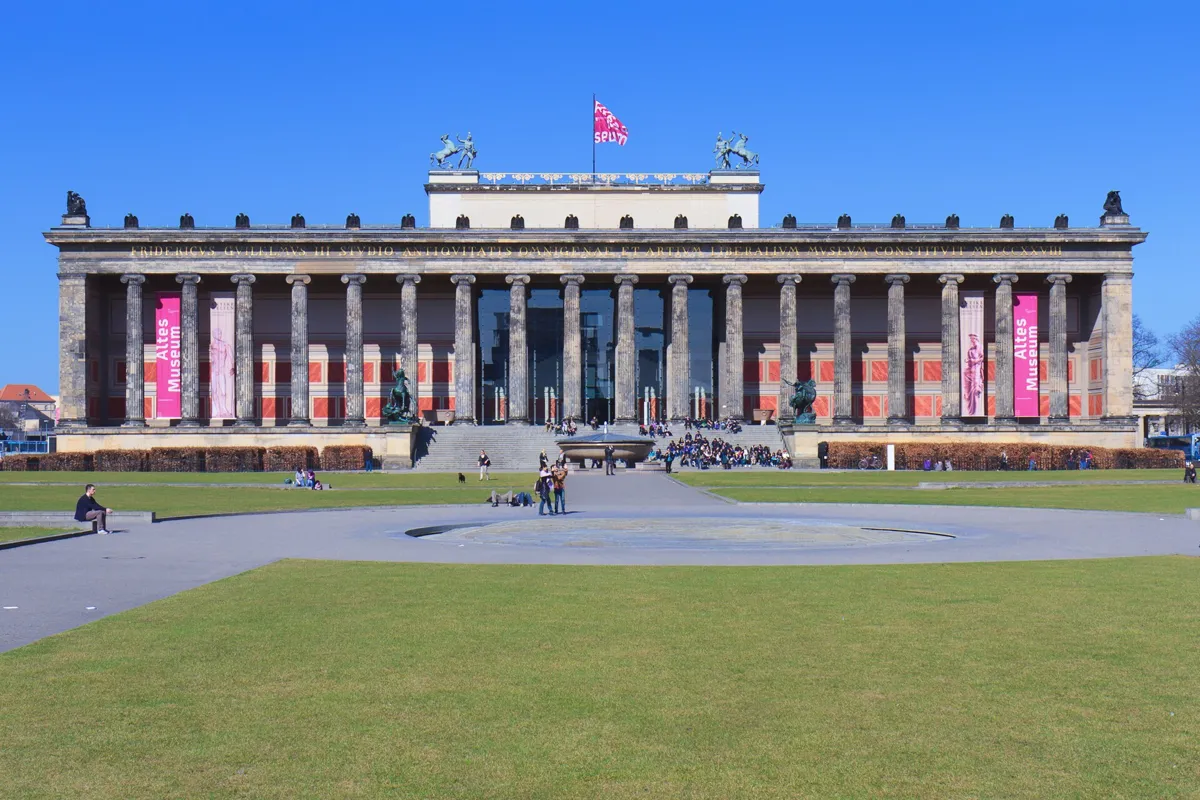
The Altes Museum from the Lustgarten. Photo: Avda, CC BY-SA 3.0, via Wikimedia Commons (resized). Walk down the side of the Altes Museum, beside the canal, into the Lustgarten, and stop at the huge granite bowl below the museum steps. The Lustgarten began in 1573 as the palace kitchen garden and has carried its name, "pleasure garden", since 1646. Schinkel built the Altes Museum in 1825–30 for Frederick William III; it was the first building in Berlin put up as a museum. Eighteen Ionic columns face the garden, and inside, a domed rotunda copies the Pantheon in Rome. Schinkel saw the square as a set: the palace for worldly power, the Zeughaus for the army, the cathedral for God, and the museum for learning. Christian Gottlieb Cantian cut the bowl, nearly 7 m across, from a glacial boulder and polished it with a steam engine; it was handed over in 1834. It was meant for the rotunda but came out too big.
More history
The first potatoes grown in Prussia were planted here in 1649. In the 1930s the Nazis paved the garden as a parade ground and moved the bowl beside the cathedral; it was back in its place by the early 1980s.
Sources: Landesdenkmalamt Berlin, Altes Museum; Granitschale; Lustgarten; Wikipedia (de), Altes Museum; Wikipedia, Altes Museum; Wikipedia (de), Lustgarten. Visiting: Altes Museum.
-
Berlin Cathedral, the Hohenzollern church
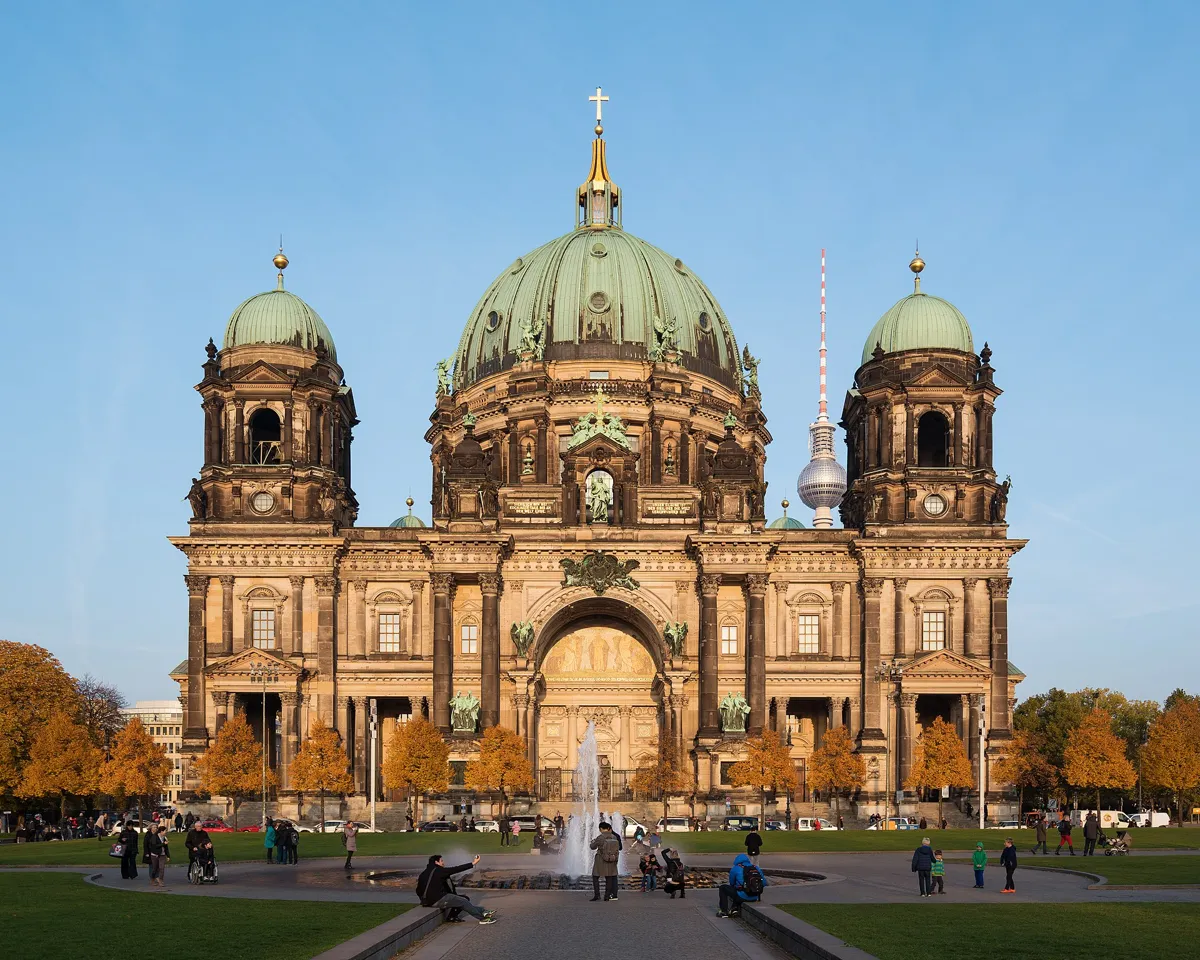
The cathedral from the Lustgarten. Photo: Thomas Wolf, www.foto-tw.de, CC BY-SA 3.0 DE, via Wikimedia Commons (resized). Cross the garden to the cathedral steps. Emperor Wilhelm II had it built from 1894 to 1905 to designs by Julius Raschdorff, in place of an older cathedral that Schinkel had remodelled. It is the largest Protestant church in Germany, though never a cathedral in the strict sense: no bishop has had his seat here. The crypt below holds about ninety coffins and tombs of the Hohenzollern family, from the 16th to the 20th century. On 24 May 1944 an air raid set the dome on fire, and its lantern crashed down into the church. East Germany rebuilt the outside in simplified form: the dome and towers lost their tops and 16 m of height, and in 1975–76 the Memorial Church on the north side was pulled down. The church once stood 114 m tall; today it is 98 m. The interior was restored by 1993. A gallery 50 m up circles the dome.
More history
The restored Hohenzollern crypt reopened on 1 March 2026.
Sources: Landesdenkmalamt Berlin, Dom; Wikipedia (de), Berliner Dom; Wikipedia, Berlin Cathedral. Visiting: Berliner Dom, visitor service.
-
The Humboldt Forum, the rebuilt Berlin Palace
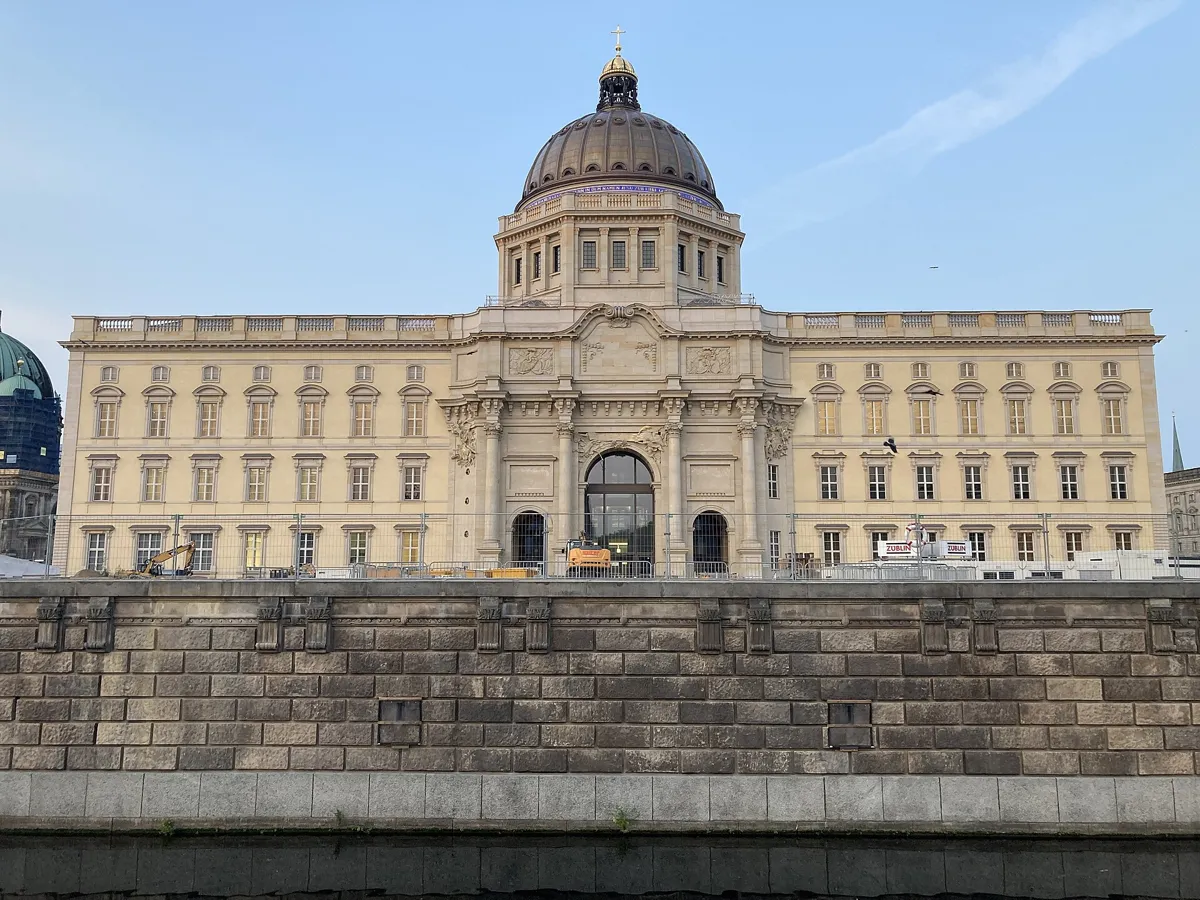
The rebuilt west front and dome, seen across the Spree canal in 2020. Photo: Ernstol, CC BY-SA 4.0, via Wikimedia Commons (resized). Walk south along Am Lustgarten and cross the main road at the lights to the palace front. The Hohenzollerns began their palace here in 1443, and Andreas Schlüter rebuilt it as a baroque royal residence from 1698 to 1713. Frederick the Great was born in it in 1712. Burned out in 1945, it was blown up on East German orders in 1950 to clear space for mass rallies; the later Palace of the Republic was itself demolished in 2006–08. What you see is a new building from 2013–2020, designed by Franco Stella. Three of the four baroque fronts, the dome and three sides of the Schlüter courtyard are copies of the old palace. The east front on the Spree, which you pass next, and all the interiors are modern. Inside, the Humboldt Forum shows the Ethnological Museum and the Museum of Asian Art. It opened to visitors in 2021, amid criticism over objects taken in colonial times, such as the Benin Bronzes.
More history
The rebuilt palace cost 677 million euros. Exhibition tickets cost 9 euros, but the Palace Cellar and the Sculpture Hall are free.
Sources: Wikipedia (de), Berliner Schloss; Wikipedia (de), Humboldt Forum; Wikipedia, Humboldt Forum. Visiting: Humboldt Forum, visit and prices.
-
The Nikolaikirche and the Nikolaiviertel, old Berlin rebuilt in the 1980s
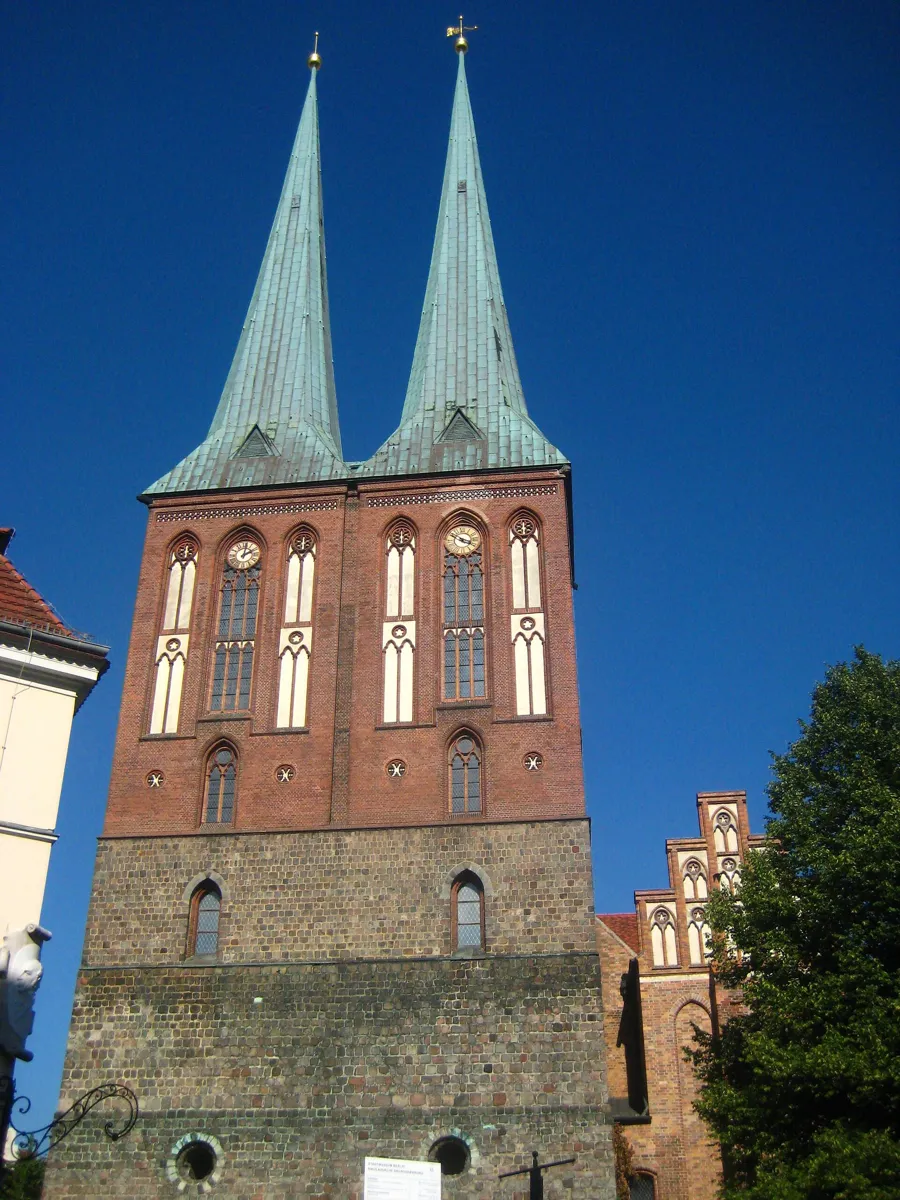
The Nikolaikirche's west front, with its stone base from about 1230. Photo: Jörg Zägel, CC BY-SA 3.0, via Wikimedia Commons (resized). Walk east along the palace's north side and cross the Spree on the Liebknechtbrücke. At the far end, take the steps down on the right to the riverside path and follow it south: across the water is the palace's plain modern east front. Turn left along Rathausstraße, right down Poststraße and left on Propststraße to the twin-spired church. This is the oldest part of Berlin. The Nikolaikirche was begun around 1230 as a fieldstone church; the grey granite base of its tower is the oldest standing masonry in the city. Hermann Blankenstein added the two spires in 1876–78. By 1945 only the outer walls and the tower base were left. East Berlin rebuilt the church, with simplified spires, and the whole quarter between 1980 and 1987, for the city's 750th anniversary. Most of the "old" houses around you are prefabricated concrete buildings on a roughly medieval street plan. Only the Knoblauchhaus and a few houses in Poststraße survived the war. The church has been a museum since 1987: open daily, 7 euros, free for under-18s.
More history
The hymn writer Paul Gerhardt was a pastor here from 1657 to 1667, working with the church's cantor, Johann Crüger. The Zum Nußbaum inn and the Gerichtslaube were rebuilt from real models, but not on their original sites.
Sources: Landesdenkmalamt Berlin, Nikolaikirche; Nikolaiviertel; Wikipedia (de), Nikolaikirche; Wikipedia (de), Nikolaiviertel. Visiting: Stadtmuseum Berlin, Nikolaikirche.


Practical details
- Terrain
- Flat. Open-Meteo gives 33 to 50 m above sea level along the way; in a dense city centre those figures can include buildings, and on foot there are no real slopes. Wide pavements, with busy crossings on Unter den Linden and by the palace.
- Step-free
- OpenStreetMap maps steps in two places on the route: a short flight of seven on the path from Bodestraße down beside the Altes Museum (between stops 4 and 5), and flights of 13 and 2 steps from the east end of the Liebknechtbrücke down to the riverside path (between stops 7 and 8), with a ramp strip for prams and bikes. It does not mark Hausvogteiplatz station as wheelchair accessible, but it does mark Rotes Rathaus and Klosterstraße near the finish. The Neue Wache has step-free access, and the cathedral says it is fully accessible since March 2026.
- Water
- OpenStreetMap lists drinking fountains by the Gendarmenmarkt (stop 1) and about 60 m from the Nikolaikirche (stop 8, May to October).
- Toilets
- OpenStreetMap shows free toilets near the Gendarmenmarkt and near Bebelplatz, and a paid 24-hour toilet about 50 m from the cathedral.
- Sit and eat
- The Gendarmenmarkt has restaurants around it, the James-Simon-Galerie and the cathedral have cafés, and the Nikolaiviertel at the finish has 22 restaurants. The Lustgarten lawns are the place to sit.
- Opening hours
- Neue Wache: daily 10:00–18:00, free. Altes Museum: Tuesday to Friday 10:00–17:00, weekends 10:00–18:00. Neues Museum: Tuesday to Sunday 10:00–18:00. Both close on Mondays. Cathedral: Monday to Saturday 9:00–18:00, Sunday 12:00–18:00, last entry an hour before; 15 euros, with audio guide, and no bags bigger than A3. Humboldt Forum: 10:30–18:30, closed Tuesdays. Nikolaikirche: daily 10:00–18:00 (Thursdays 12:00–20:00 until 18 April 2027). Hours change on holidays and for services, so check before you go.
- Shorter walk
- Finish at stop 6, the cathedral: 1.5 km, about 50 minutes. The Staatliche Museen give Museumsinsel U-Bahn (U5) as the nearest station.
- Getting back
- Rotes Rathaus U-Bahn station (U5) is about 220 m from the Nikolaikirche, and Klosterstraße (U2) about 350 m.
Walking distances and times from the OSRM foot router on OpenStreetMap data. Elevations from Open-Meteo. Stations, fountains, toilets and steps from OpenStreetMap; opening hours and prices from the Staatliche Museen zu Berlin, the Berliner Dom, the Humboldt Forum, the Stadtmuseum Berlin and the Deutsches Historisches Museum. Checked 4 October 2026.
Questions people ask
How long does a Museum Island walking tour take, and is there a map?
About 75 minutes: 2.4 km, 32 minutes of walking and eight stops, from Hausvogteiplatz U-Bahn station to the Nikolaikirche, about 220 m from Rotes Rathaus station. The map is on this page, and you can print it or save it as a PDF. Add time for any museum or the cathedral.
What is on Museum Island, and is it a UNESCO World Heritage Site?
Five museums built between 1830 and 1930: the Altes Museum, the Neues Museum, the Alte Nationalgalerie, the Bode-Museum and the Pergamonmuseum. UNESCO listed them together as a World Heritage Site in 1999. The island also holds the Berlin Cathedral, the Lustgarten and, since 2019, the James-Simon-Galerie visitor centre.
Can you visit Museum Island for free?
Walking around the island and the Lustgarten costs nothing, but the museums charge for entry. Children and teens under 18 get in free. On this walk, the Neue Wache and the book-burning memorial on Bebelplatz are free, and so are the Palace Cellar and Sculpture Hall in the Humboldt Forum. The cathedral costs 15 euros.
Is the Pergamon Museum open?
Not yet. It has been fully closed since 2023 for renovation. The North Wing and central building, with the Pergamon Altar, are due to reopen on 4 June 2027; the South Wing is expected to stay shut until 2037. Until then, Pergamonmuseum. Das Panorama at Am Kupfergraben 2 shows major pieces from Pergamon and a 360-degree panorama of the ancient city.
What happened at Bebelplatz?
On 10 May 1933 Nazi students, with SA and SS units, burned about 20,000 books here, among them works by Heinrich Heine, Karl Marx, Sigmund Freud and Erich Kästner, and Joseph Goebbels gave a speech at the fire. Since 1995 Micha Ullman's memorial, an underground room of empty shelves seen through a glass panel in the paving, has marked the spot. It is open at all times.
Walk it with Strolio
Open Strolio at the Gendarmenmarkt and ask for an hour and a quarter along Unter den Linden and across Museum Island. Strolio builds walks in any city with mapped streets, so its route may pick different stops from this page. Stories play as you reach each place, and you can ask about anything else you pass, by voice or with a photo. You can also start from your hotel and choose your own time and interests.
More walks in Berlin
- Along the Wall: ~1½ h, 8 stops. Follow the Berlin Wall's line from the Reichstag and Brandenburg Gate to Checkpoint Charlie, past the last pieces still standing.
- Kreuzberg: ~90 min, 7 stops. Squats, Kotti and street art, from a canal market to the East Side Gallery.
- All Berlin walks, with maps side by side.
- Walks in other cities.
Sources
- Landesdenkmalamt Berlin, Denkmaldatenbank: Gendarmenmarkt, Französischer Dom, Neue Wache, Altes Museum, Granitschale im Lustgarten, Lustgarten, Dom, Nikolaikirche, Nikolaiviertel. We used their facts and wrote our own text.
- Bundeszentrale für politische Bildung: Denkmal Bücherverbrennung, Neue Wache; and berlin.de, Neue Wache
- Wikipedia (German): Gendarmenmarkt, Bebelplatz, Denkmal zur Erinnerung an die Bücherverbrennung, Bücherverbrennung 1933 in Deutschland, Staatsoper Unter den Linden, Neue Wache, Museumsinsel, James-Simon-Galerie, Neues Museum, Altes Museum, Lustgarten, Berliner Dom, Berliner Schloss, Humboldt Forum, Nikolaikirche, Nikolaiviertel
- Wikipedia (English): Gendarmenmarkt, Bebelplatz, Neue Wache, Museum Island, Neues Museum, Altes Museum, Berlin Cathedral, Humboldt Forum
- Opening times, prices and visits: Staatliche Museen zu Berlin (Pergamonmuseum, Pergamonmuseum refurbishment, Neues Museum, Altes Museum, Museumsinsel FAQ), Berliner Dom, Humboldt Forum (visit, prices), Stadtmuseum Berlin, Nikolaikirche, Deutsches Historisches Museum, Neue Wache visitor code
- Map data and places: © OpenStreetMap contributors, ODbL; walking route from the OSRM foot router run by FOSSGIS
- Elevations: Open-Meteo
- Photos: Wikimedia Commons contributors Ansgar Koreng, Charlotte Nordahl, Derbrauni, Avda, Thomas Wolf, Ernstol and Jörg Zägel, credited under each photo